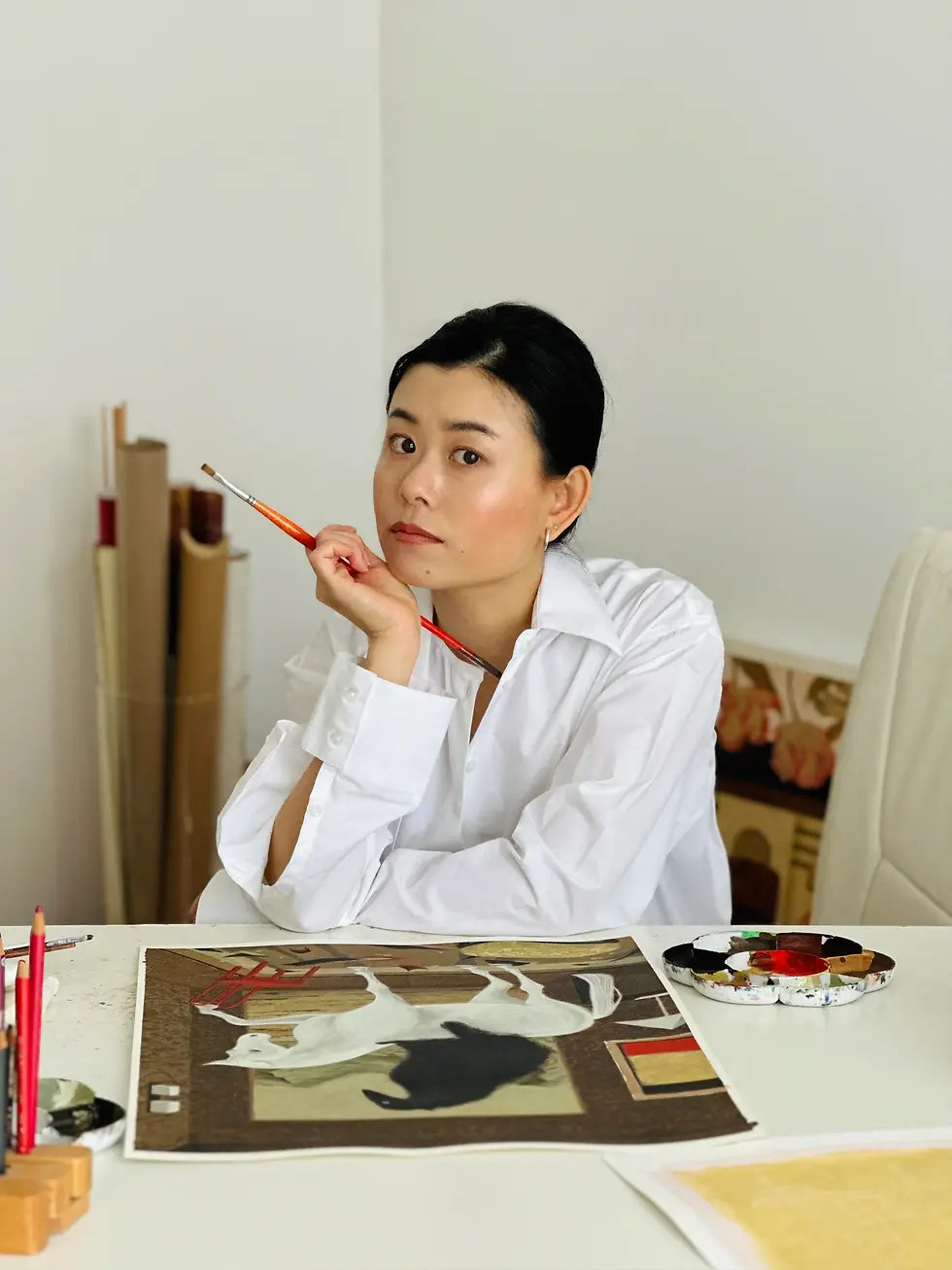
Stefan Macheiner
Stefan Macheiner is an Austrian artist based in Linz who works with graphics, printing, and mixed media. He has a background in multimedia art and taught himself programming at a young age, and he still uses algorithms as part of how he thinks through an image. His process often starts on the computer, where he sets up simple rules and structures, and then continues by translating them into physical form with techniques like printing, embossing, or working on glass and stone. Reduction is key in his art, stripping the image back to its core elements.

Q: What first brought scientific and technological systems into your work?
A: I have always been fascinated by nature and by the ways in which humans attempt to understand it through science and technology. The natural sciences in particular are often perceived as dry, difficult to access, or abstract. For me, however, they primarily represent order, structure, and predictability. Through my artistic work with these structures, I realized early on that they help me to organize my own thoughts and inner processes. When I translate scientific themes into reduced, abstract visual worlds, my aim is less to provide an intellectual explanation of scientific concepts than to approach nature through sensory experience. The working process itself becomes a form of orientation and personal structure, helping me to better understand not only the world, but also myself.

Q: When did programming start to function as a material for you, not just a tool?
A: I have been fascinated from an early age by how I can interact with computers and the results that emerge from this interaction. At the age of eleven, I received my first Commodore C64 and began teaching myself programming step by step. Admittedly, I was never particularly good at it and am not a trained programmer even today, but this form of communication with a machine has always fascinated me. For me, the computer is no longer just a tool, but often an equal partner in the creative process.
Where it appears to generate suggestions independently, produce errors, or develop structures based on chance, it becomes a co-creator. For this reason, I design the algorithms through which I communicate with it in a way that allows unpredictable, non-intentional results to emerge. At this point, programming itself becomes a kind of material for me.

Q: How do you decide when a digital structure is ready to take physical form?
A: I generally work in a highly process-oriented way. At the start, I focus on conceptual thinking and research: I read and write a lot while exploring which techniques and materials might be relevant and how they could shape the outcome. In this early phase, I also roughly outline the potential development process and determine at which points a translation from digital to analog will occur. At the same time, the process is never meant to be linear. I deliberately leave room for chance, mistakes, and unexpected developments. Especially while experimenting with materials, results often emerge that are not suitable for the current project but have interesting potential. I archive such outcomes to revisit them later in different contexts or works. Even during the execution phase, the process remains open and flexible. I continuously question decisions and adjust the workflow when new conceptual or formal possibilities arise. For me, the creative process is therefore not a matter of simply following a predefined plan, but a dynamic interplay of concept, material, chance, and reflection.
Q: What is usually the final decision you make before a work is finished?
A: In my work, I have a permanent focus on reduction, both conceptually and formally. I do not understand reduction as merely removing elements, but as a gradual, layered process of uncovering ideas and forms. Step by step, I eliminate everything that is not essential until the core of a form or thought becomes visible.
The goal is to create clarity and reveal something that may appear simple at first glance, yet carries a deep inner complexity. This approach requires constant consideration: how much can be removed without losing something essential? The question of the right balance is present at every stage of the work.
Revealing the core of an idea or visual structure is often the most challenging, but also the most engaging part of my artistic process. Accordingly, the moment when a piece is considered finished is very delicate. Deciding when a work is “complete” cannot follow fixed rules. Each decision is unique, depending on the concept, the material, and the formal context.

Q: You work with glass, stone, and digital processes. What usually sets the material choice?
A: Materials have not only technical properties defined by their nature, but also carry conceptual or symbolic associations. Transparent glass, for instance, can evoke lightness, fragility, and openness, while also acting as an invisible barrier. Stone, on the other hand, initially appears solid and static, yet, due to its long formation process, can also be read as a material manifestation of condensed time. When developing my work, I aim to consider these different levels of meaning and select materials that correspond to the conceptual aspects of the theme. Alongside these conceptual considerations, practical and technical aspects also play a role: how can a material be worked with, what possibilities and limitations does it bring along, and how does the resulting aesthetic outcome relate to the overall concept of the work?
Ultimately, the choice of material emerges from the interplay between these two levels—conceptual meaning and practical feasibility—and forms the foundation of each artistic project.
Q: What do you want to focus on next in your work?
A: Currently, I am deeply engaged with data: how it is generated, recorded, collected, stored, and interpreted, and how, through these processes, it fundamentally shapes the way we perceive the world. In scientific contexts in particular, enormous amounts of data are produced daily, far too large to be fully stored. I am interested in the question of what happens to this data and how society manages this ever-growing volume. In fields such as astronomy, for example, observations produce nightly streams of data that exceed both our technical and cognitive capacities. Only through filtering processes, algorithms, and increasingly through artificial intelligence do these data become manageable and interpretable for us.
This raises the question of whether our knowledge expands at the same rate as the data we generate, or if an increasing gap is emerging between data quantity and the insights it yields.