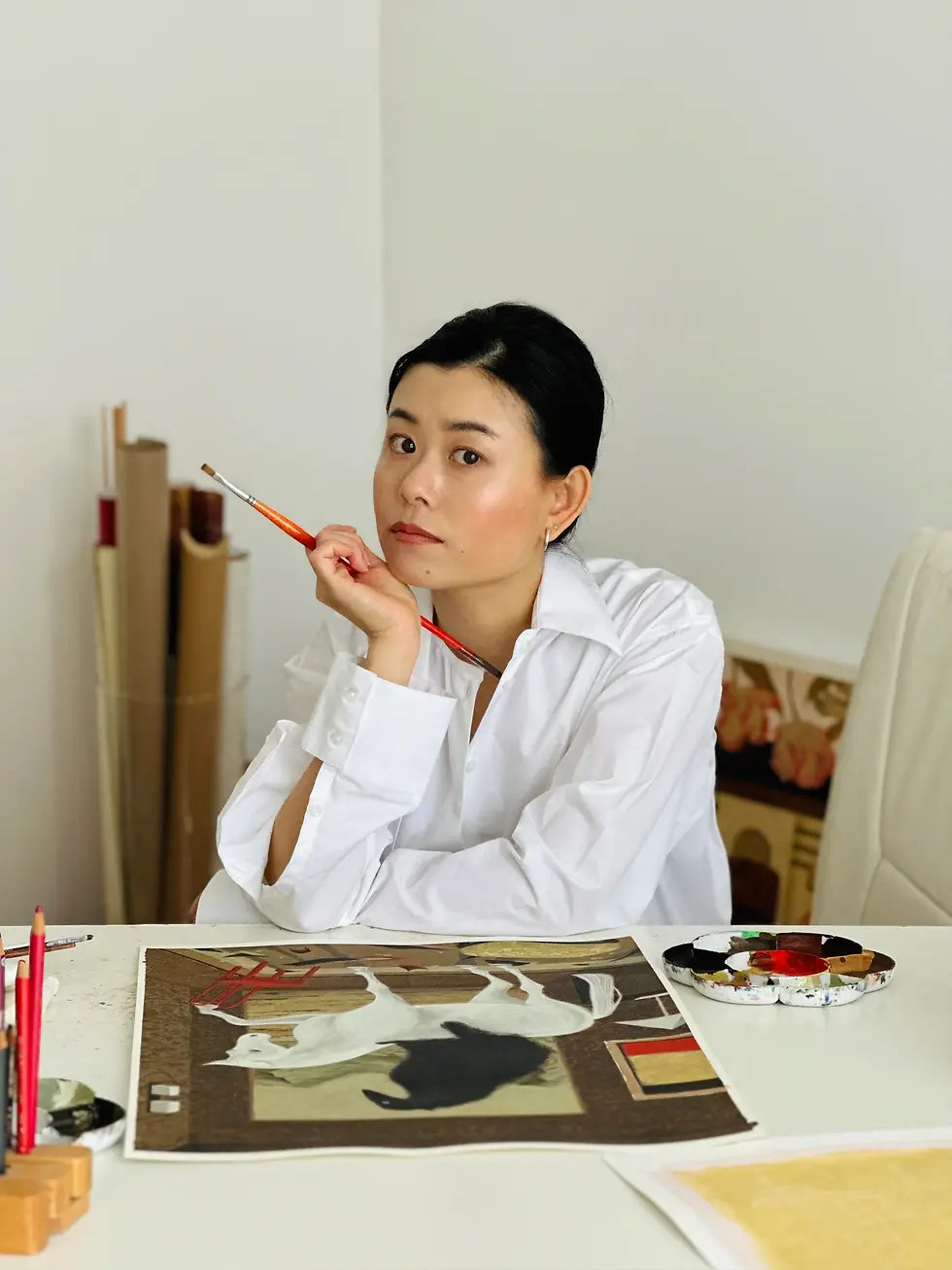
Yiming Tang
Yiming Tang is a painter based in New York. He studied at the Rhode Island School of Design and works mainly in oil on canvas. His paintings deal with solitude and emotional tension, with a contrast between calm and eruption. He often builds scenes with saturated color and distorted figures, shaped by his move from China to the U.S. and living between cultures.

Q: How did moving from Chengdu to New York change the way you work with solitude?
A: Strictly speaking, I didn’t come to New York directly from Chengdu. I first moved from Chengdu to the United States in 2016 to start my education in high school, and eventually arrived in New York after graduating from college. One thing that defines this city, in my view, is that despite its extreme diversity, its communities remain distinctly separated, and the broader social atmosphere—much like the country itself—emphasizes individualism.
Growing up in China, a largely homogeneous and collectivist society, I had rarely been pushed to consider the full meaning of the individual as an independent concept. Leaving that environment and coming to the U.S. forced me to confront what it means to live and think alone.
This experience allowed me to understand solitude in a more direct and nuanced way, and it has deeply shaped the emotional and psychological concerns that anchor my current artistic practice.

Q: How do you decide how far to push color and layering on a surface?
A: When I work with color and texture, I’m pursuing a sense of rhythm—much like composing a classical symphony: knowing when the piano should enter, when the cello joins, and when the voice rises. Throughout the painting process, I constantly arrange and reorder the combinations between different hues and surfaces, searching for a layered structure that breathes. When that rhythm finally appears, I put down the brush and acknowledge the completeness of that passage on the canvas.
Q: How do you work with control and release while painting?
A: Before I begin applying paint to the canvas, I draft a simplified color study in another medium to establish the composition and chromatic direction. Once the framework is set, I rely on pure bodily intuition to construct it on the canvas, using expressive, untamed brushstrokes to turn the structure into a complete artwork. This working process allows the tension between rational solitude and emotional release to manifest naturally within the painting. To me, it reflects the balance of control and surrender that defines my technical and conceptual approach to oil painting.
Q: What were you focused on while making "One Calm And Reasonable Pistol"?
A: I want to capture the moment just before emotional imbalance erupts—the instant when a person tries to stay rational but can no longer suppress instinct.
In my paintings, this becomes an image of uncontrolled emotional release, a breaking point after prolonged repression, and the collapse that comes with realizing that the answers to life can only be sought through an eternally solitary exploration of one’s inner world.

Q: How do you approach painting closeness between figures in "I Don't Know You But We Happy"?
A: Fate is a very particular kind of emotional bond. If life were imagined as a straight line moving in one direction—an axis that reflects the passage of time—then friendship, love, and family could be visualized as other lines that first intersect with ours, then run parallel, and eventually drift apart. These lines never fully merge with the one that represents the self, yet their presence marks the rare and precious moments in which we are allowed to touch something beyond our inherent solitude.
If I were to describe the relationship between the two figures in this work, it would be one of subtle closeness and distance—a connection defined by quiet understanding, mutual respect, and a parallel coexistence.

Q: As you continue working with imbalance and isolation, what feels important to test next?
A: In the long run, I keep wondering whether it’s possible to design or create an experience for viewers—something that allows them to truly feel my understanding of emotional imbalance, loneliness, and my aesthetic approach to form and color. Ultimately, rather than becoming only a professional oil painter, I want to be a creator of worlds, someone whose vision and sensibility shape an entire universe of meaning.
Each work I complete becomes a brick in the architecture of that world. In the future, I will likely explore sculpture, 3D printing, performance, runway presentations, and even land art to express the aesthetics of this universe. Oil painting, for now, serves as a foundational phase—an accumulation that builds the core of the worldview I’m constructing.