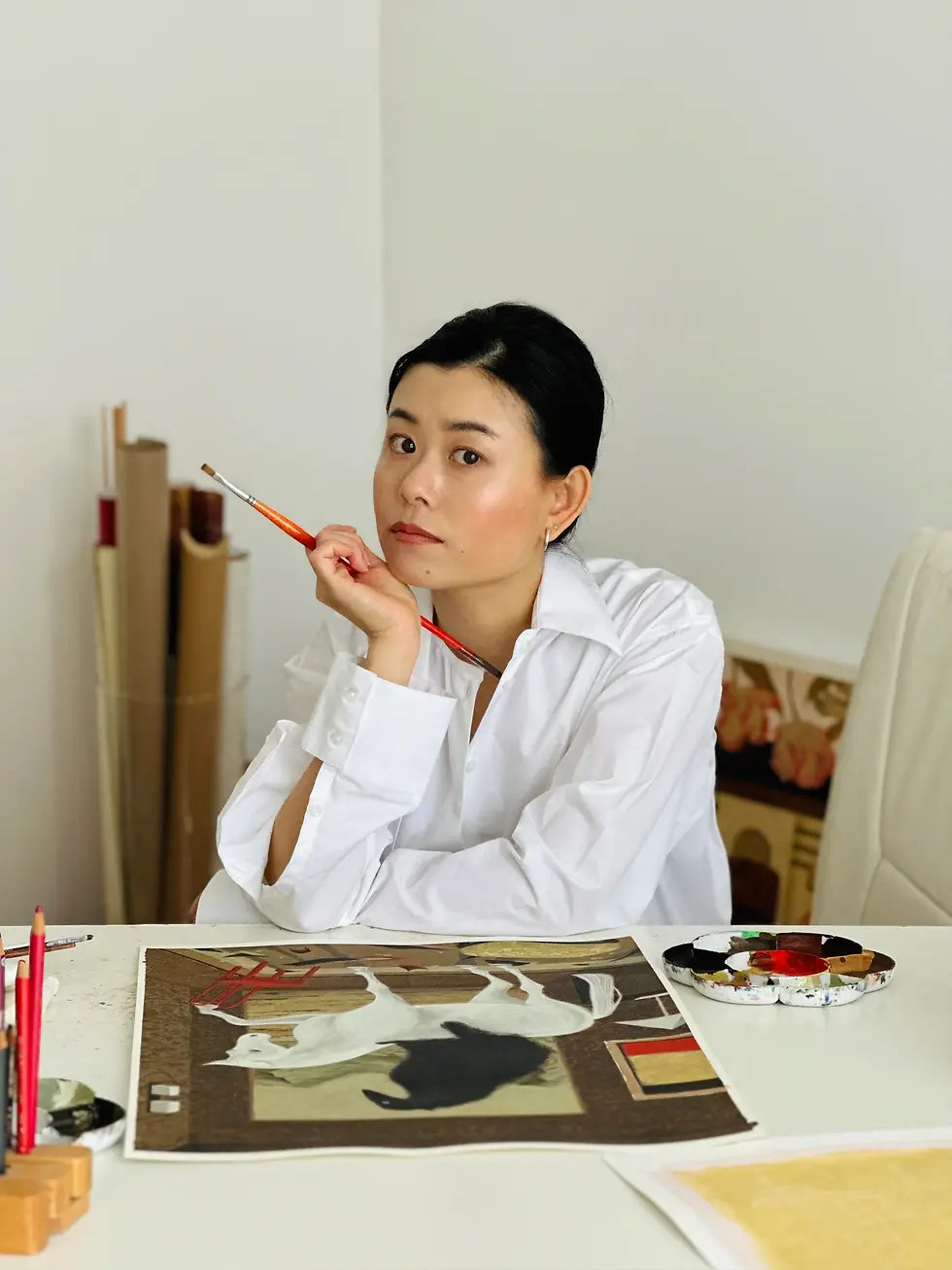
Bernara Rustambekova
Updated: Jan 30
Bernara Rustambekova is an artist from Uzbekistan who now lives and works abroad. She works from memories of everyday life at home, things seen in markets, on the street, in old magazines, and in family spaces. She keeps these images in photos and sketchbooks and returns to them when starting new paintings, collages, or ceramic pieces. The work feels close to personal experience, with small details and moments that stayed with her and still come back in the studio.

Q: What first made you want to use memories from Uzbekistan as a starting point in your work?
A: I grew up and developed within a community of Uzbek artists and creatives, whose perspectives and artistic practices had a significant influence on me. It was important for me to be part of this cultural environment and to have a visual and conceptual point of reference through the work of other artists. I began with small sketches in my sketchbook, collages, and small digital works, using a visual language that felt familiar to me, such as cut-outs from local magazines and newspapers. Looking back, I see that over the years my artistic vision was built step by step through these small moments. Later, within a more conscious practice, I clearly understood that I was intentionally choosing to work with the culture that shaped me.
I began to notice irony in everyday surroundings, and although I am no longer physically immersed in that environment, I continue to develop my ideas and push them beyond the context in which I grew up.

Q: You collect small, odd, or funny moments from your surroundings. What usually makes you stop and take notice?
A: Previously, this was part of everyday life. While living in Uzbekistan, I would notice various details during ordinary walks, like at markets, in shops, or simply on the street.
It did not feel unusual within the society I was part of. I observed what others were photographing and gradually began to notice more and more myself.
My surroundings and the people with whom I grew as an artist played an important role in shaping this sensitivity. Today, this process has become more deliberate. Because I spend less time in my hometown due to relocation, I consciously go on walks, explore new neighborhoods, and seek out unfamiliar places in order to discover new visual elements and collect as much material as possible.
Q: Many of your works start from tiny details. How do you know when one of those details is worth developing into a piece?
A: In truth, I never know this in advance. I begin working with each idea, and at a certain stage I understand whether it is developing in the way I envision and feel. If it does not, I set the idea aside, sometimes for weeks, sometimes for months. I often work on several ideas simultaneously. A structured process is important to me, careful consideration of the work, selecting imagery and color palettes, and planning the sequence of actions. At this stage, I find fully spontaneous, unplanned works challenging, as such a process feels too chaotic for me. My sketchbook contains many visual thoughts and ideas. I use it as a source of inspiration and as a starting point for new directions. Sooner or later, all of these sketches find their way into my work, and the gradual development of these ideas is a process I find particularly engaging.
Q: You work across painting, ceramics, and sculpture. What helps you decide which medium fits a new idea best?
A: Painting remains my primary practice, so most ideas are initially conceived as paintings. When working with ceramics, I focus more on the process itself, as it involves a much more physical engagement with the material, and much depends on my mindset and relationship to the process. In my recent series "S25", I relied on certain ideas that had been formed in advance and deliberately selected paints and necessary materials, while many decisions emerged directly during the making process.
Sculpture is also a more experimental field for me. I look for inspiration in exhibitions and through research into other artists’ practices. As it lies outside my comfort zone, I engage with it less frequently; however, I enjoy imagining and working within new and experimental projects.

Q: Humor and memory both shape your subjects. How do these elements show up while you’re working?
A: I enjoy working with humor and memory because the process feels personal and comfortable. I translate what I see and remember, but my works often differ from reality. I interpret moments, exaggerate them, and use irony, as this reflects how I genuinely experience and feel these situations.
Working with these themes also creates a sense of distance, an illusion that the work is merely an idea or a personal visualization, without a direct link to my lived experience or memories. As a result, the work becomes more of an image or a painting than a representation of reality.
Q: As you keep expanding your practice, what directions are you most interested in exploring next?
A: I am interested in continuing to develop my practice in painting and visual art more broadly. At the moment, I am enjoying my current practice and working processes, and I would like to continue working in this way. Ceramics and sculpture are less accessible to me at present. I work with them once every few months, and they do not constitute the core of my practice. However, I look forward to the moment when accumulated ideas can be fully realized, allowing me to engage with these mediums much more extensively.