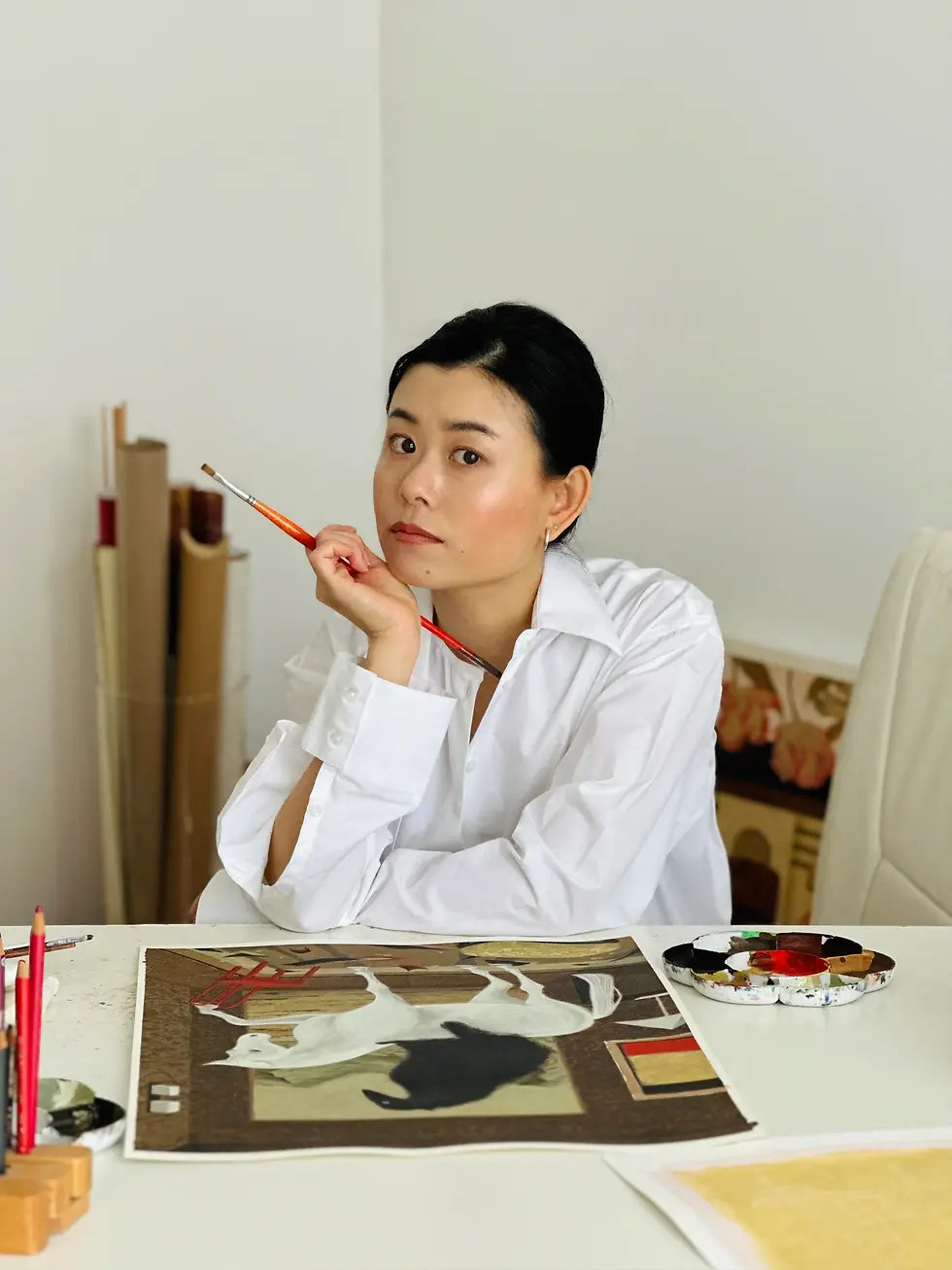
Zhiyu You
Zhiyu You is a Chinese-born illustrator and visual artist based in Brooklyn. She grew up drawing birds with her father on walks through wetlands and parks. She studied illustration at the School of Visual Arts and works with ink on paper and digital tools, moving between the two. Her subject is women's inner lives, the emotions that get internalized until they become almost invisible. She also works as a tattoo artist.

Q: You studied illustration at SVA and now you're in Brooklyn. What first got you into drawing?
A: I think I was drawn to drawing before I even thought of it as something serious. As a kid, it was just the most natural way for me to spend time. I would sit for hours sketching whatever was around me. My dad is really into bird watching, so he used to take me to wetlands and parks, and I would draw what I saw—birds, plants, small details in nature.
But even then, I wasn't just copying things. I liked mixing observation with imagination, slightly altering what I saw or turning it into something more personal. Looking back, that balance between reality and inner feeling is still very present in my work now.
Over time, drawing shifted from something instinctive to something I wanted to understand more deeply, which eventually led me to pursue formal training and build it into my practice.

Q: You work with both ink on paper and digital tools. How did that combination become your process?
A: I think the combination happened quite organically. My training started with traditional media, so drawing by hand, working with ink, line, and paper has always been the foundation of how I think. I'm very sensitive to line quality, and that's something I still rely on.
When I started studying illustration more seriously, especially at SVA, I began incorporating digital tools into my process. At first it was more practical—color editing, adjusting composition—but over time it became a natural extension of the way I work. Digital allows me to layer, shift, and refine an image in a way that feels more fluid.
Now my process usually moves back and forth between the two. For me, it's less about choosing one over the other, and more about using each medium for what it does best—keeping the sensitivity of hand-drawn lines while allowing space for experimentation and control.


Q: You're interested in what goes unspoken in women's lives, the feelings under the surface. Can you give an example of how that becomes an image?
A: I think about how certain feelings in women's lives are internalized to the point where they become almost invisible, even to ourselves. They show up in small habits, repetitions, or quiet moments rather than in dramatic ways.
When I translate that into an image, I often start from something very small and ordinary, like a quiet moment or domestic settings. An everyday scene or action, and then shift it slightly. The body might begin to merge with its surroundings, or a simple gesture becomes excessive. Visually, everything still feels recognizable, but there's a subtle sense that something is off.
I'm interested in that tension between what is seen and what is felt. Instead of explaining the emotion directly, I let it exist within the structure of the image—so the viewer can sense something beneath the surface before fully understanding it.


Q: You grew up in China and now live in New York. Does that distance change what you notice about women's experiences?
A: Yes, I think the distance has made me more aware of things I didn't question before. When I was in China, many ideas around women's roles and behaviors felt very natural, almost invisible, because I was inside that environment. After moving to New York, being exposed to different perspectives gave me a kind of distance to reflect. I started to notice how certain expectations, habits, or emotional patterns are shaped by culture, and how they can exist differently in different contexts, but also how some feelings are surprisingly universal.
That shift in perspective influences my work. I'm often thinking about what is culturally specific and what is shared, and how these unspoken experiences can move between different environments.