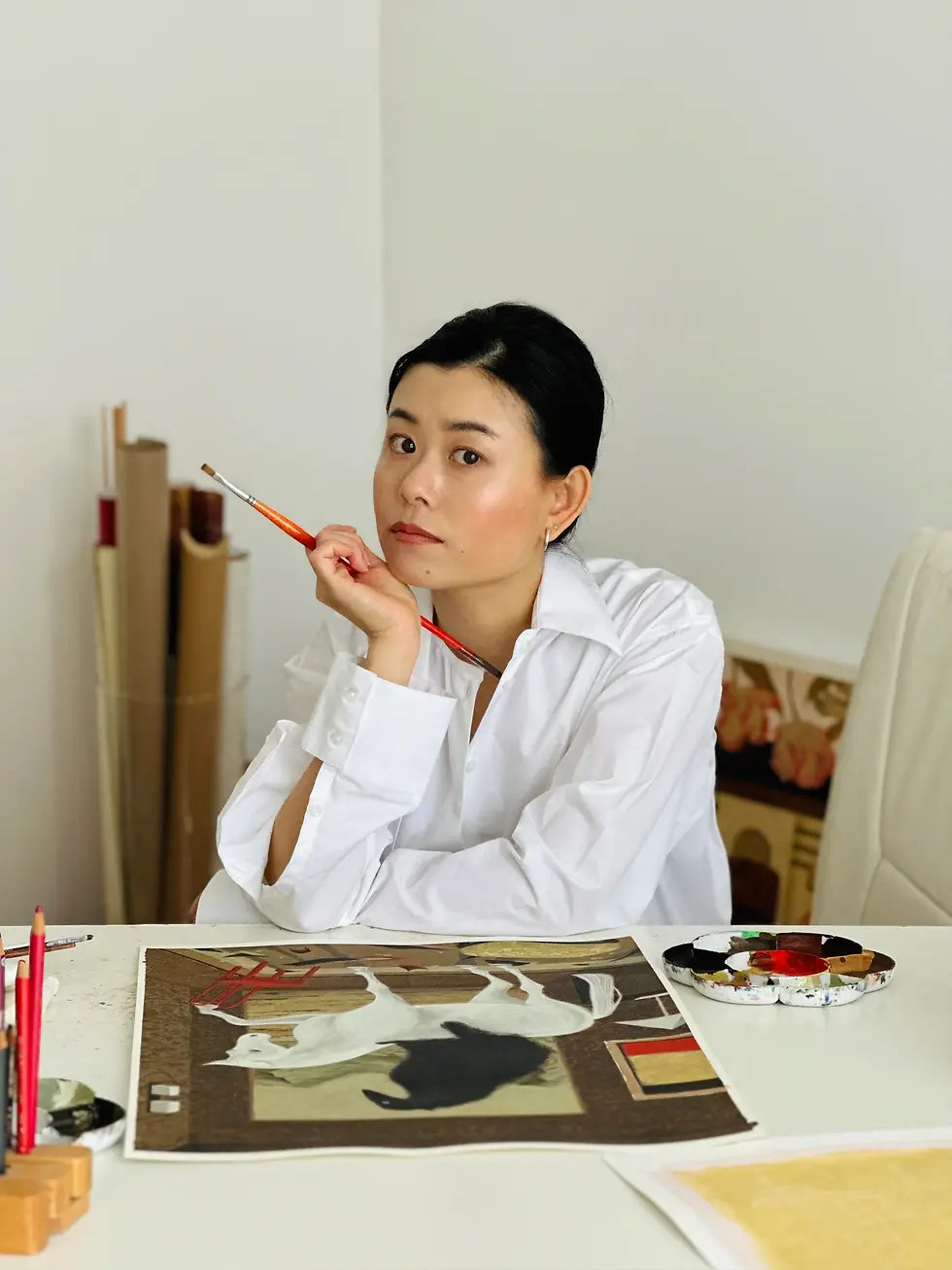
Tracy White
Tracy White is an abstract painter based in Edmonton, Alberta. She studied fine art at MacEwan University and worked in digital media for years. Her paintings start as tissue paper collages that she reworks digitally before projecting them onto raw canvas. She paints in acrylic mixed with pouring medium on the raw surface. Her palettes are bright and saturated, pulled from the same colors she used as a kid. She is represented by Maud Gallery.

Q: You studied fine art at MacEwan but you also come from a digital media background. How did those two things find each other?
A: I always wanted to be an artist, but the path wasn't straightforward. I left home at 17, so every decision had to balance financial stability. Studying fine art at MacEwan was important to me, but I worried about making a living.
I spent time finding my footing in various creative jobs that felt aligned but also paid the bills. Eventually, I chose to study digital media to build a more sustainable career in a creative field.
As a result, my fine art and digital backgrounds naturally blended. What began as a practical choice is now a key part of how I work, as I move back and forth between both methods.

Q: Your process is unusual. You start with tissue paper collages, then refine them digitally, then project them onto canvas and hand-paint. How did that chain develop?
A: I started using digital studies to save on materials. I had a tendency to overpaint, building up layers and then covering them completely, and I often wished I could return to earlier stages of a painting. Working digitally let me try out ideas without committing, and gave me time to think through direction before moving forward. I began using projection to transfer compositions accurately, which helps maintain their structure.
Over time, I felt like I was leaning too much on control. Collage became a way to loosen up. It feels more intuitive and offers a playful starting point. I value each part of my process and use them together to create balance. Digital work supports editing and problem-solving, while collage and painting allow me to reconnect with a more instinctive way of creating.
Q: You've compared the hand-painting stage to colouring as a child. Is that feeling something you're chasing?
A: Definitely. I spent hours colouring as a kid, and that feeling stays. Much of my journey is about reconnecting with and healing that part of myself. In my work, I want to make space for that part to explore and create freely. When I paint, I lose track of time. I'm not thinking about the past or future, I'm simply present. It's a quiet, focused state that feels grounded and open. I'm not only chasing that feeling; I want to hold on to it and make it part of my practice.

Q: Your palettes are very bright and very saturated. Do you ever pull back, or is that non-negotiable?
A: I use bright, saturated colours because they feel familiar. They remind me of the crayons I used as a kid, and that memory still shapes how I see colour. That sense of recognition is important to me, so I rarely move away from it.
Still, I've been trying to balance that intensity. When I layer colours, they start to mix and sometimes soften each other, especially when opposites overlap. This approach can tone down some areas without losing overall brightness, preserving the vividness that's important to my work.

Q: You work on raw canvas. Why raw?
A: I started using raw canvas to help myself hold back, avoid overpainting, and make more intentional choices. Leaving some areas exposed creates negative space and keeps the work from feeling too heavy. I like the look and feel of natural fibres, and how the paint soaks into the surface rather than sitting on top. I use a matte pouring medium with my paint to maintain that quality, keeping the surface open and the texture showing in the finished piece.

Q: You're represented by Maud Gallery and developing new work. Where are things heading?
A: I want to keep growing as an artist, with colour as my focus. I'm becoming more intentional, paying closer attention to how tone and value shift as I build colour in stages. Working with transparent and opaque layers lets me refine colour more gradually and responsively, allowing it to move between intensity and softness while staying balanced. I'm also more open to what emerges during the process, sometimes letting hints of images appear and take shape.