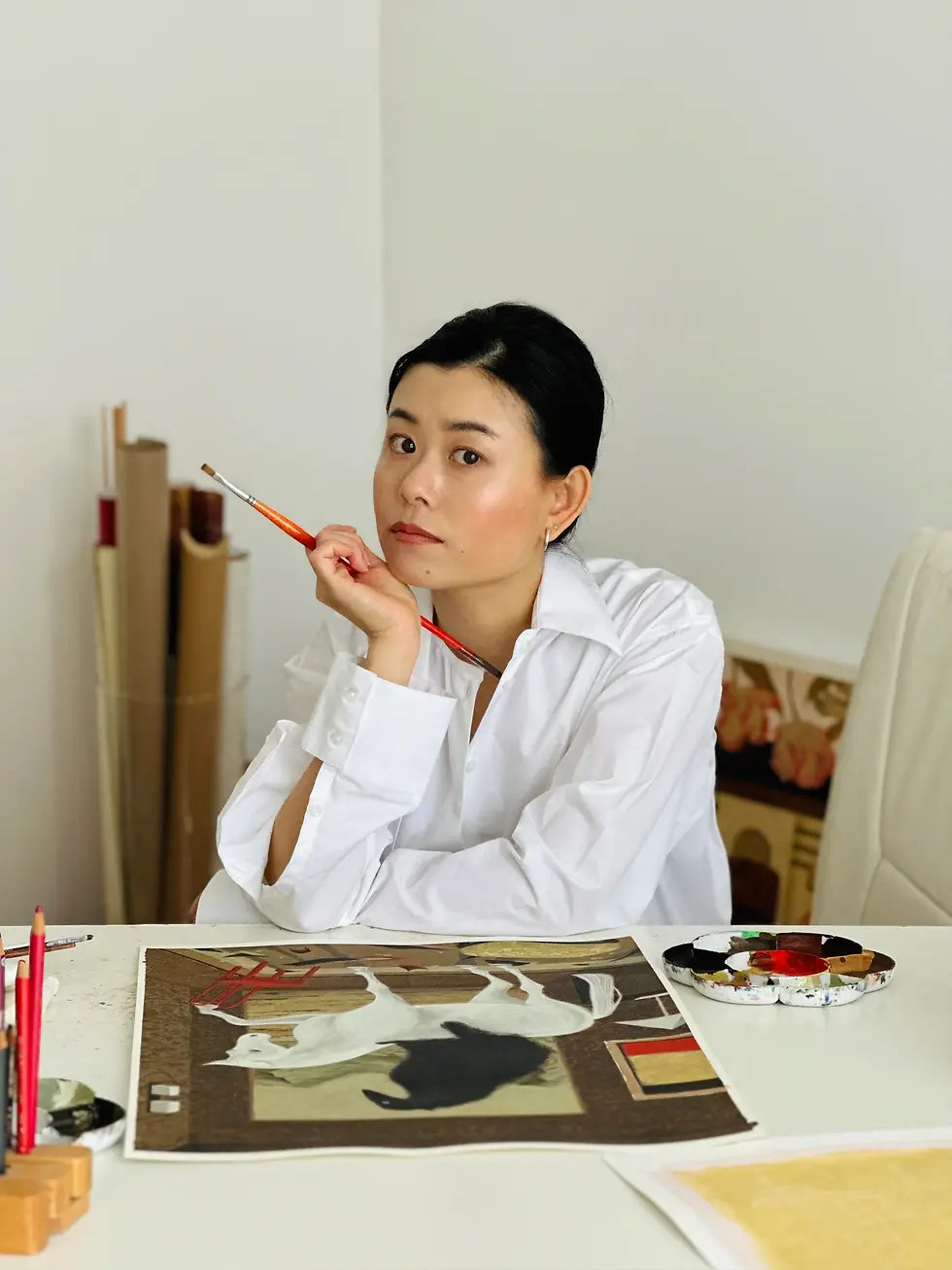
Monika Marchewka
Monika Marchewka is a painter and ceramicist based in Gdynia, Poland. She studied painting in Krakow and later worked as an animator on Loving Vincent. She paints feasts and overloaded tables, put together from 1990s lifestyle magazines and films like Babette's Feast and Marie Antoinette. She says she would love to be hosted at a table like that but would never want to cook it. She makes ceramics alongside the paintings and is represented by Artistellar Gallery in London.

Q: You worked as a painter-animator on Loving Vincent and The Peasants. What did that experience give you?
A: I worked as an animator only on the production of Loving Vincent, and later I became a supervisor, overseeing the work of other painters. However, this experience taught me above all not to become attached to the current state of a painting. During the animation process, every painted frame had to be wiped away, no matter how beautiful it was—that's what the technique required.
So now, when I paint and I'm not satisfied or something doesn't feel right, I simply erase it and start again. I have no problem with that. It's very liberating.
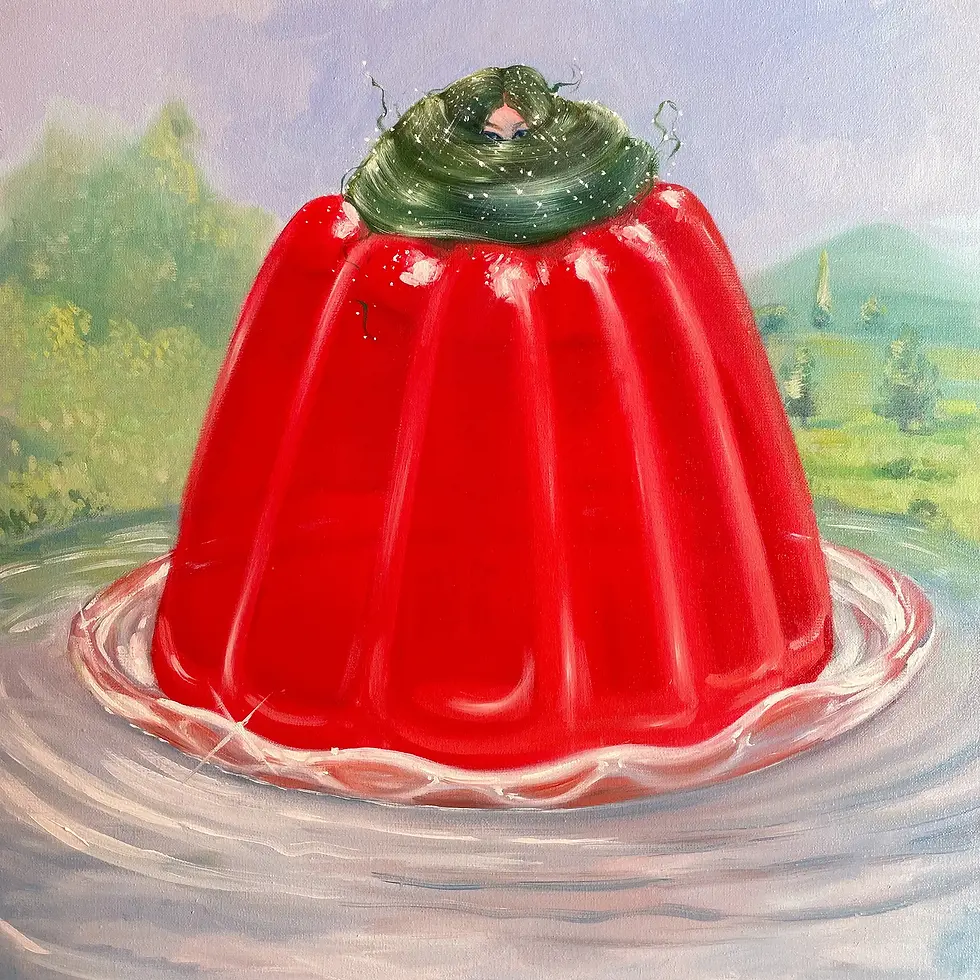
Q: Your paintings are set around these overloaded tables. How do you build those scenes?
A: I would love to witness tables and feasts like these, to sit down and taste every dish. I wouldn't want to cook or prepare it, but I would love to be hosted like that. I carry many images in my memory from 1990s lifestyle magazines about how to create a beautiful feast. I also remember scenes from films like Marie Antoinette, Babette's Feast, The Age of Innocence, and more recently The Ugly Stepsister. Whenever a table appears, I study it closely.
When I paint, I build these scenes from memory and imagination, combining different elements rather than recreating a real setting. I arrange them intuitively, letting the composition grow as I work. These visions put me in the mood to paint—I don't cook, I paint.

Q: The woman at the table is always the host and the offering. How conscious is that when you're painting?
A: That dual role is very present when I'm painting, even if it's not always fully conscious at the beginning. I often start with the idea of care—setting the table, preparing the scene, creating something for others. But during the process, the figure slowly shifts. She is no longer just the host; she becomes part of what is being offered.
I think it reflects a familiar dynamic, where the desire to please or to be accepted leads to a kind of self-editing, or even self-sacrifice.
The body becomes something arranged, almost like the food on the table. I don't plan this transformation in a literal way, but I allow it to happen. It's important for me that the image holds both roles at once—to remain generous, but also slightly unsettling.

Q: Food in your work is both literal and loaded. What is it really about for you?
A: Food in my work starts as something very literal: a shared meal, a memory, a gesture of care. But quite quickly it becomes a language for something else. It carries ideas of desire, attention, control, and also vulnerability.
I'm interested in how food can represent both pleasure and pressure. It's something we offer, but also something that can be judged, rejected, or misunderstood. In that sense, it becomes very close to how we present ourselves to others.
Food allows me to talk about relationships—about wanting to be welcomed, but also about the fear of not being accepted. It's never just about eating. It's about what it means to be seen, to be desired, and sometimes, to be consumed.
Q: You also make ceramics. How does that relate to the paintings?
A: My ceramics and paintings are closely connected, but they operate in slightly different ways. Painting allows me to construct an image—to stage a scene, control the composition, and build a certain tension. Ceramics, on the other hand, bring me closer to the physical and tactile aspect of these ideas.
Working with clay feels more direct and intuitive. It's about touch, weight, and presence. In a way, the objects I make could exist within the painted scenes—as dishes, fragments, or leftovers.
They both revolve around similar themes, like hospitality, consumption, and the body, but ceramics allow me to engage with them in a more material, almost bodily way.

Q: You're represented by Artistellar Gallery in London and exhibiting internationally. What are you working on right now?
A: I have another exhibition planned for later this year, which will continue my exploration of this theme. I remain deeply engaged with it, moving through a phase of loose, intuitive sketches and unfolding ideas. I feel that I haven't yet exhausted its possibilities. I haven't seen all the scenes I imagine, nor experienced all the variations it suggests.
There is still much to uncover, and I'm interested in allowing the work to evolve organically, without rushing toward resolution.