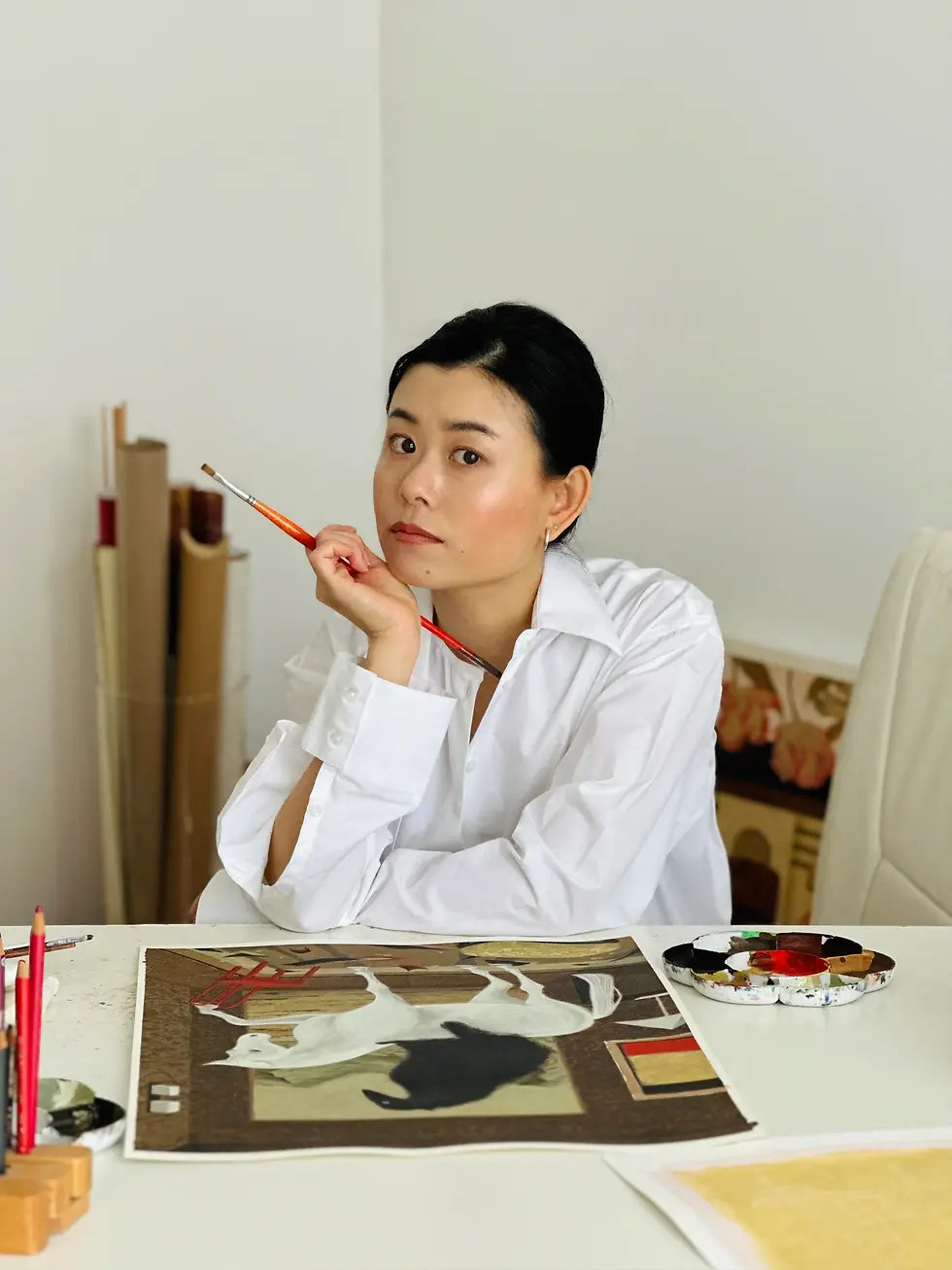
Cate Maddy
Cate Maddy is a painter based in Melbourne. Her mother was always making something with her hands, and creativity was just part of the house. Maddy trained in graphic art and worked in advertising before going back to study fine art. At university she was encouraged to try anything but painting and stuck with it anyway. She paints the Australian bushland in oil, charcoal and poured pigment on surfaces she disrupts with marble dust before she starts. She went to the outback last year and painted en plein air for the first time.

Q: Tell us a bit about how you got into painting.
A: I originally trained in graphic art and worked in advertising. After having children, I returned to study and completed a fine art degree. While at university we were encouraged to explore anything but painting, yet I remained committed to it throughout, never losing my focus. Creativity was always encouraged in my home growing up, whether it be art and craft or dancing—we were always kept busy. My mother was always making something, always working with her hands.

Q: The Australian bushland keeps coming back in your work. What is it about that landscape?
A: Landscape painting has a long and rich tradition in Australian art, and I've always admired the work of earlier generations. Living in the city, though, I often felt limited in forming my own connection to the landscape. After travelling to the outback last year and working en plein air, I discovered a renewed sense of confidence and inspiration. The vastness and subtle variety of the environment shifted my perspective.
While the bush carries a certain romantic pull in the Australian imagination, experiencing it firsthand revealed something quieter and more nuanced. Time spent in that landscape has become an antidote to the pace of modern life, offering a sense of calm and clarity. I carry that feeling back into the studio, where it continues to shape and inform my painting practice.

Q: You use marble dust to disrupt the surface before you paint. How did that technique develop?
A: I began experimenting with surface at university, incorporating collage and materials like sand and fabric—an approach I've returned to repeatedly over the years. I deliberately introduce obstacles into the process to push beyond my comfort zone and encourage a greater sense of looseness.
The disruptions break up line, build layered textures, and create pockets where paint can settle into the surface, allowing the composition to evolve in a more organic and intuitive way.
Using dots, strokes and drawn lines alongside rubbed-back passages and more fluid marks, creating a balance between control and chance. This accumulation gives the surface a sense of time, as if the painting has been weathered or grown rather than simply composed. The result is a tactile, intimate field that invites close looking, where dense and open areas move in and out of focus, echoing the rhythms and processes of the landscape itself.

Q: Your surfaces start with poured pigment, then you go in with oil and charcoal. When does a painting start to feel like it's working?
A: I'm most drawn to the early stages of a painting—the pour and those first marks made with pencil, scribbles, and loose, gestural lines. There's an immediacy and freshness there that I try to hold onto. The challenge is capturing the essence of the landscape without losing the beauty of that initial layer. It's easy to overwork a piece, and overpainting can flatten movement and diminish subtlety.
The middle phase is often the most difficult. It requires letting go of ego and staying open, even when the work feels uncertain. If something isn't sitting right, I step away and return with fresh eyes. Many paintings need to be scraped back and reworked several times before they begin to breathe again. Creating a sense of air and space in the composition is essential—once that happens, I know the work is starting to come together.

Q: You talk about abstraction as something felt more than understood. Do the paintings ever get too clear, too readable?
A: My work sits somewhere between representation and abstraction, with some paintings more literal than others. It's largely process-driven, creating a sense of distance that isn't strictly realistic.
The works move beyond a single, fixed perspective, instead layering multiple viewpoints and moments into compressed pictorial space. Botanical elements and landscape fragments are suggested rather than described, dissolving into fields of mark-making and pattern.
Up close, the surface invites attention to detail—a tactile jumble of marks and textures that evokes the dryness of bush and desert earth. It's only as you step back that a sense of space and distance begins to emerge, allowing the image to resolve itself. If I can maintain this type of ambiguity within an overall readability then I am content; otherwise I will keep going until I find that state. I aim to paint not what is in front of me but what it feels like to be in that landscape, over time, moving through it.

Q: What's happening in the studio right now? Anything new we should know about?
A: I've recently begun experimenting with collage elements and a more subdued, moody palette. While I'm naturally drawn to working at a larger scale, I'm also developing smaller pieces for an upcoming exhibition this year. I find smaller works challenging—there's a discipline in restraint, and while less can be more, I'm reluctant to lose the richness of the surface. It often feels like a process of reducing content without losing depth. I'm not always certain of the balance, but that uncertainty is what makes it interesting as an artist.