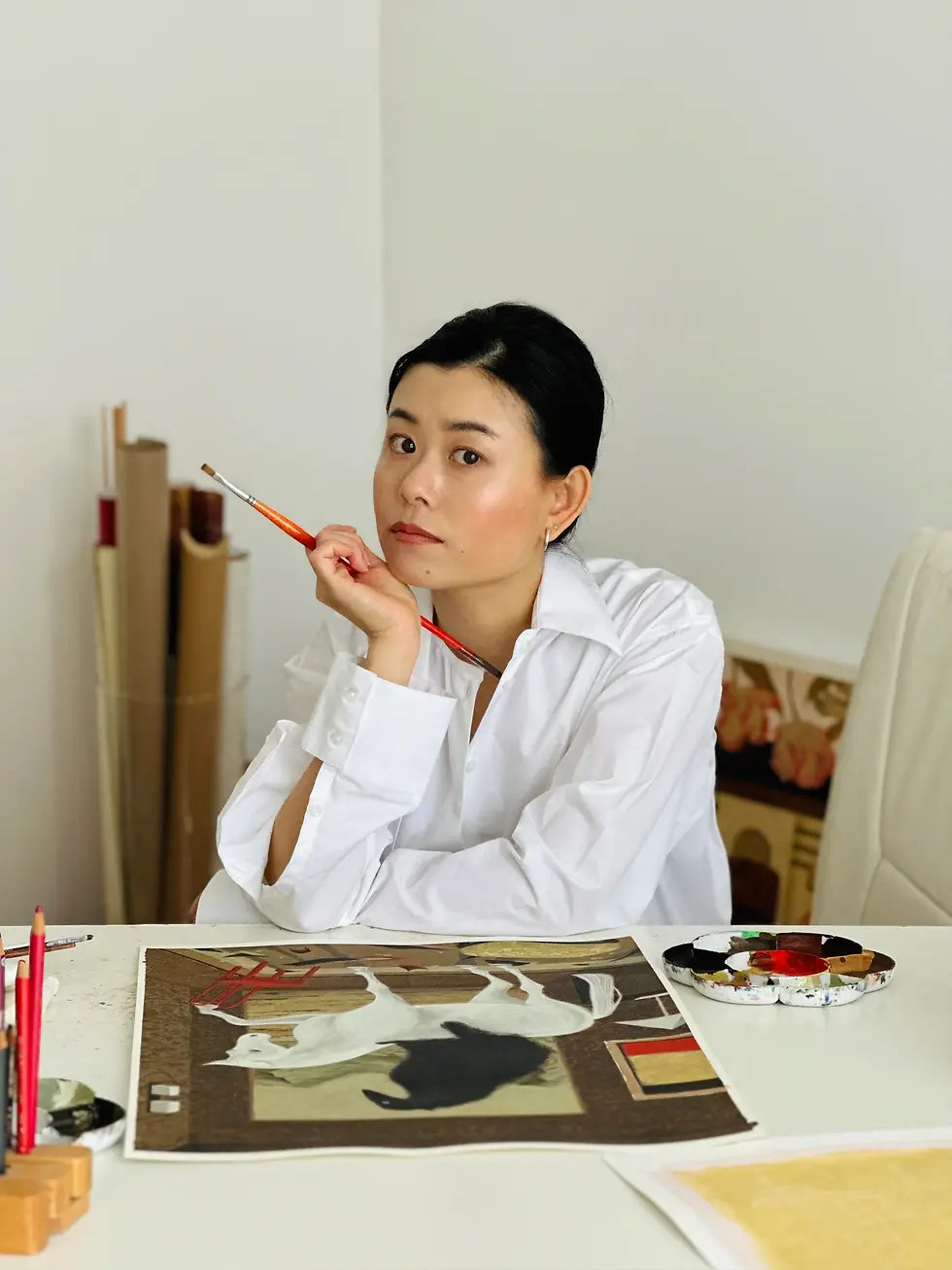
Yukang Tao
Yukang Tao is an interdisciplinary artist based in New York who works with digital tools, animation, video, and performance. He comes from an engineering background and often starts with systems like 3D software or AI, then pushes them in ways that allow mistakes, delays, and unexpected results to stay visible. Personal experience also plays a role in what he makes, especially questions around identity, the body, and how technology shapes how we see and understand ourselves. His work grows from spending time inside these processes and watching how images change when machines and human decisions meet.

Q: What first drew you to working between animation, interactive digital systems, and performance?
A: Frankly, those fluid and porous mediums allowed me to inscribe my personal, sensitive, and artistic life as braille onto my body long before I even perceived what I was doing. Coming from an engineering background and growing up within hetero-patriarchal and Confucian structures, I often experienced myself as fragmented: hyperrational on the surface, yet internally negotiating otherness, desire, and contradiction. Therefore, those mediums offer a space where contradictions could finally coexist. Rather than treating these forms as distinct disciplines, my practice insists on their permeability. Animation leaks into performance, performance is absorbed by digital systems, and interaction becomes an unstable negotiation rather than a functional interface. This continual crossing allows me to test where a medium ends and where the body begins, or where technology stops functioning as a tool and starts behaving as an extension of sensation. By refusing medium purity, I construct a practice that remains in flux—one that mirrors my own experience of existing between rational structures and embodied uncertainty. It is within this instability that my work finds its critical force: not in resolving contradictions, but in sustaining them as a method.

Q: What interests you about how technology interacts with emotion and the body?
A: I am fascinated by how technology exposes the body not as a stable, expressive whole, but as a site of mediation, delay, and haunting. Rather than simply amplifying emotion, technological systems render feeling indirectly through distortion, fragmentation, and residue. Drawing on Jacques Derrida’s concept of hauntology, I am interested in how digital technologies produce spectral bodies: bodies that persist as traces, simulations, and afterimages, oscillating between presence and absence. Technology does not simply interact with emotion; it reorganizes how emotion becomes perceptible. Algorithms, interfaces, and machine vision translate intimacy into data, memory into archive, and desire into code, often stripping the effect of immediacy while simultaneously intensifying its return as something uncanny. What emerges is an affective economy of ghosts—emotions that linger without origin, bodies that appear without full embodiment.
Q: How has growing up within Chinese hetero-patriarchal norms shaped the subjects you explore?
A: I think this experience really taught me that power often operates through softness rather than force. Regulation arrives disguised as harmony, optimism, and moral clarity; deviation is absorbed, corrected, or rendered invisible through an insistence on “positivity.” This awareness drives my refusal of affirmation as a political goal. Instead of striving for clarity or resolution, my work lingers in rupture, excess, and instability, treating discomfort as a necessary condition for resisting normalization. Within this framework, my use of vivid color functions as camouflage rather than celebration. Brightness becomes a tactic to disguise regulation and smuggle fragility, negativity, and disobedience into systems that expect compliance.


Q: Your work intertwines gender, power, society, and nature. How do you decide which of these relationships to focus on in a new piece?
A: I rarely decide in advance which relationship a new work should focus on. Control, for me, is already a form of ideology. Instead, each project begins as an unstable condition, a disturbance, where multiple forces collide and one tension gradually asserts itself. What emerges is not a theme chosen by intention, but a pressure that insists on being followed. My role is less to direct the work than to listen to what is forming through it.

Q: In “Annihilation,” you use the slaughter of pigs as a metaphor for exploitation. What led you to work with this imagery?
A: I was drawn to the imagery of pig slaughter in “Annihilation” because it condenses how capitalism renders bodies as edible material to be consumed, aestheticized, and ethically justified after the fact. The work emerges from an interest in edibility not merely as physical consumption, but as a cultural logic in which desire and violence coexist. Drawing on Amber Husain’s Meat Love, I approach meat as a symbolic site where pleasure, morality, and death are tightly intertwined, revealing how exploitation is not hidden but carefully reframed as care, necessity, or even compassion. What interests me is how capitalist systems transform brutality into a spectacle of pseudo-mercy: slaughter is sanitized, packaged, and sold as ethical choice, while the violence that sustains it disappears. Yet the work also turns inward.
“Annihilation” confronts the uncomfortable recognition that we are not external to this system—we are its participants and, often unconsciously, its advocates. This leads to the central questions of the project:
How can we escape a value system in which everything must justify its existence through productivity or consumption? Why must there always be a “loser” produced by dominant hierarchies? And where do I position myself within a structure that simultaneously repels and sustains me? The slaughtered body becomes not only a metaphor for exploitation, but a mirror that reflects our complicity in its continuation.
Q: Which part of your digital workflow feels the most unpredictable to you?
A: The most unpredictable part of my workflow is the gap between what I expect the software to do and how it actually responds. Complex tools like AI systems and 3D software often misinterpret my intentions, and instead of resisting that frustration, I’ve learned to work with it—letting those errors and surprises reshape the work in ways I couldn’t plan.