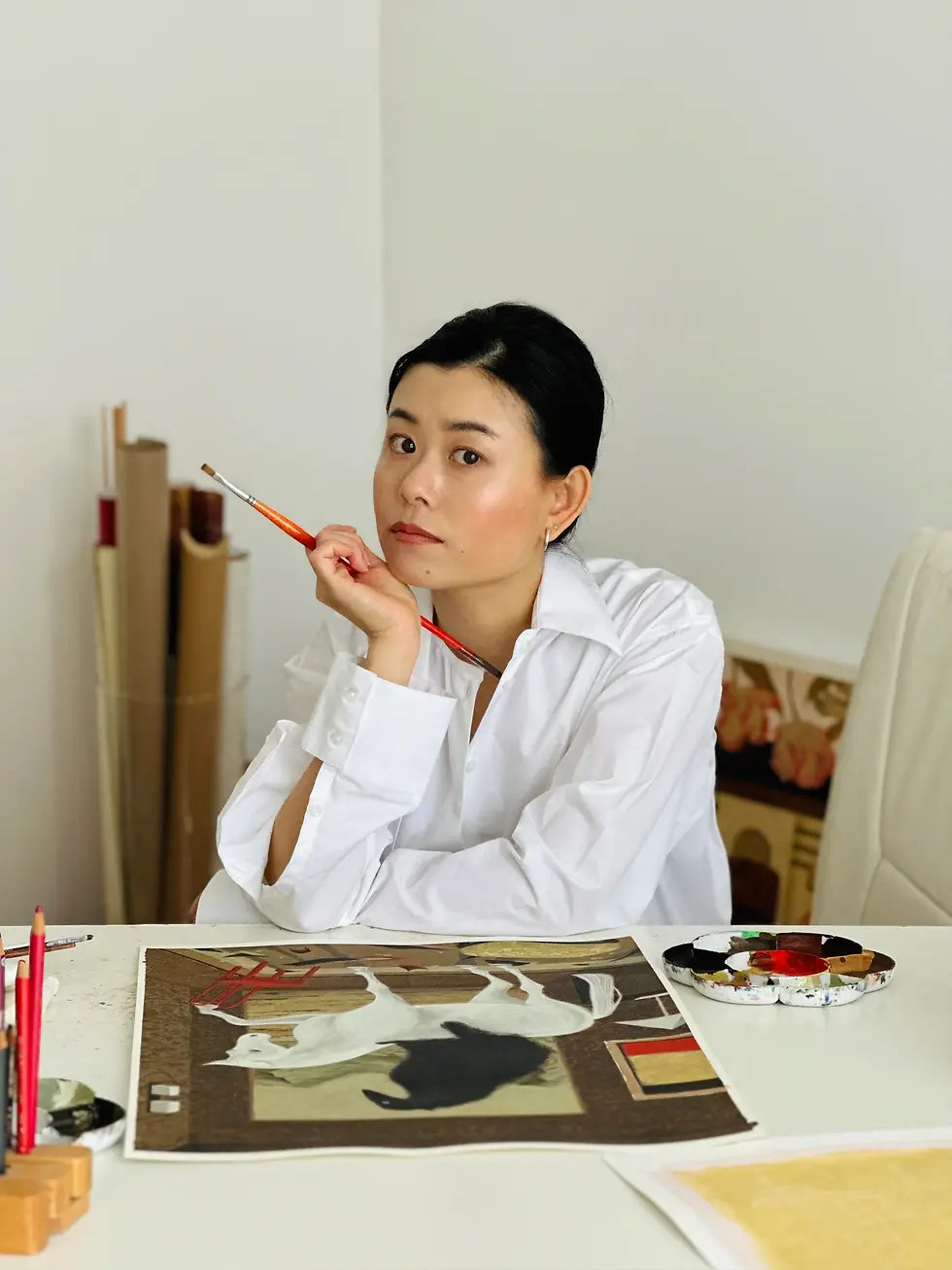
Yuelei Ma
Yuelei Ma is a ceramic artist based in Hangzhou, China, where he works in a quiet studio near the mountains. He came to clay after many years in commercial and interior design, drawn back to making things by hand and to a slower, more physical way of working. He shapes rough, unrefined clay into vessels and figures that carry the weight of touch, time, and the natural forms he walks past every day, often returning to the same piece again and again until it reaches its final state.

Q: You worked in commercial design before moving into ceramics. How did that transition happen for you?
A: Recalling from memories, “Making things with Hands” was probably a seed quietly planted in my childhood. At that time, I would often sculpt various animals and plants with river mud in the country fields and play with little friends. As I grew up, I used my hands to do some messy drawings in books with pencils at school and operated machinery to process parts in factories. These activities continuously reinforced the idea of “hands-on” skills.
In my more than 20-year career in commercial design, my understanding of environment and space is rather unique. In fact, architecture, spaces, and objects are all living things. There are conflicts and contradictions between them and humans, but there are also friendships and harmony. I believe that just as humans are sensitive to air and light, so too are objects.
They also breathe and feel, and they reflect different states of life depending on the light, position, and viewer’s angle. In previous commercial projects, I came into contact with plenty of decorative items, such as ceramic vases, sculptures, paintings, plants, and flowers. These became clues that inspired my memories and imagination, slowly awakening the seed of “Making things with Hands” that I had in my childhood.
When my career in commercial design reached a certain stage, I began to feel tired and confused. Constantly communicating with all sorts of people and projects was stressful and anxiety-inducing, while the long hours and fast pace of the work were oppressive. I started to think about what life itself should be like for a person. As I grew older, I increasingly preferred quiet solitude. The concept of “Speaking with Hands instead of Mouth” gradually took hold of my mind. I felt that only by creating tangible objects with my hands could I rebuild myself and find a real self. In fact, I never realized that this was the beginning of artistic creation at the time.
In 2021, I decided to give up my original career and devote myself to learning ceramics.
From understanding the properties of clay, to constant shaping, to mastering techniques, and gradually creating ceramic wares and sculptures. Frankly speaking, this is a tough and very long project and a major change in my life. And I don't have any grand goals in art. I think that immersing myself in creation brings peace and steadiness to my heart. This state of returning to simplicity is what I truly desire.

Q: What does working with unrefined clay allow that smoother clay doesn’t?
A: Wild clay contains sand, small rocks, and other minerals. When you start shaping it, it's not as easy to achieve the ideal form as with smoother clay. Wild clay requires more time and patience. It's also very rough, and the rock particles in the clay can make the surface look clumsy and ugly. But sometimes this clay seems to guide me in shaping some unknown “Life”.
After firing, the small sand grains and rocks in the wild clay create tiny, burst-like cracks on the surface, while the rest appears rough, with a rock-like texture. This clay carries a unique vitality. I really like the word “Life strength”; it represents a kind of resilience, a tension, for life. The works I create with this rough clay are also the concepts and emotions I want to express.
On the other hand, I think it would be better to make practical tableware with smoother clay rather than to create artistic life.
Q: How does living in Hangzhou, near mountains and water, affect your daily practice?
A: Yes, Hangzhou is one of the most beautiful cities in China; mountains and lakes are its most prominent features. My underground studio is located at the foot of a mountain, surrounded by rolling hills covered in dense forests. In my spare time, I go into the mountains to walk and photograph, observing wild plants, rocks, and streams. Sometimes I also pour tea and meditate there.
There’s no doubt that many elements related to mountains have deeply influenced me. For example, the colors and textures of rocks and tree bark are something I've always loved, and I often apply these surfaces to vessels and sculptures. The state of the plants themselves is also very exciting; for instance, some withered vines, with bizarre shapes like giant monsters, entwine around trees and rocks. They seem dead in winter, but when spring arrives, they transform into lush green miracles. All of this comes from the mountains and the earth, and nature is the most powerful artist.
Q: You speak about learning directly from natural systems. How does that way of thinking guide your studio decisions?
A: As mentioned above, my inspiration usually comes mostly from nature, or I could say I'm a naturalist. Nature gives me so many thoughts and emotions. The concept of “Time” also makes me think a lot. For example, when a piece of work is not yet finished, I have to wait until it's semi-dry before proceeding to the next step. There are also some works that, when viewed again after some time, may reveal a more surprising and delightful state. Therefore, I must practice patience and rethink the relationship between nature, time, people, and artworks.
The cycle of time, from youth to old age; from mountains, plants, climate, space, and time—everything that exists because of matter and time allows me to constantly perceive and shape a new self within the natural system. And I, and all my current creations, will become part of nature.
The idea of “Originating from nature, Returning to nature” will continue to guide my contemporary art creation.

Q: In “BLOOMING”, ideas of endurance and life energy come forward. What was driving that piece while you were making it?
A: “BLOOMING” was inspired by rocks, which are also living things. They endure wind, sun, and rain, constantly changing in silence.
Sometimes they appear grayish-white, sometimes dark brown, sometimes hard, and sometimes they crumble into dust. Perhaps this is the life process of rocks, like humans, going through birth, aging, sickness, and death.
How can this kind of life be embodied? I thought about it for a long time. Once an idea comes to mind, it often torments you. Later, when I was hiking in the mountains, I came up with the idea of making rocks bloom like plants. Their shapes would resemble rocks struggling painfully, trying to make their petals dance like people, releasing a kind of explosive force. This is the origin of that idea.
From the viewer's perspective, those rough clay pieces are merely lifeless piles of inanimate matter. But from the creator's perspective, those clay pieces are elements of life forming. I believe that most materials possess a kind of life, only needing specific environments and conditions to manifest themselves.

Q: With “STATUE of ZEN”, how do you balance stillness, emptiness, and function in one object?
A: Yes, the function of this sculpture is precisely what makes the work so ingenious.
Firstly, its “containing” function has practical value, effectively balancing the abstract nature of some philosophical theories. The head, shaped as a container, can hold water, dust, withered branches, green leaves, and flowers, or even stones or any material with metaphorical significance, representing the diverse world of all living beings. Placing different materials within it evokes different emotions and perspectives. Furthermore, the hollow structure of the sculpture makes it more stable and reduces the weight of the clay, facilitating successful firing at high temperatures in the kiln.
I'd also like to mention that I usually prefer to express emotions and thoughts through abstract forms. However, this artwork is an exception. This sculpture is one of the few figurative works I've created. My initial idea was to create a statue that I could meditate on and have a silent dialogue with when I needed to quiet my mind.
The sculpture is silent and still, without sorrow or joy, pain or pleasure. At the same time, it seems like a wise sage, all-knowing, and through gazing at it and contemplating, one can understand their current state of being. As a “Life”, it possesses the same joys, sorrows, and emotions as all sentient beings.
I have read some Zen Buddhist books, and Zen thought has influenced me. Life is not perfect, nor is the world. There are many metaphors and meanings that can only be understood after a long and tough experience. All beings and all phenomena exist in the present moment. Existence is also emptiness, and emptiness is the world. This is precisely the Zen Buddhist philosophy that the work aims to express.