Vanessa Reed
Vanessa Reed is a German artist working mainly with drawing, printmaking, and animation. She studied Illustration at HAW Hamburg and is currently completing a Master’s in Art and Communication in Osnabrück. Her work focuses on the idea of different inner parts and how they relate to each other, often built from shades of gray, architectural structures, and the human body. She also works with animation, and her short film “Lethe” was screened in Hamburg and awarded the Karl Dietze Prize in 2023.

Q: What made you want to explore different sides of the self through drawing?
A: Throughout my life, in order to understand different experiences, I would talk about them to myself. As I got older, I was introduced to Internal Family Systems (IFS) by Richard Schwartz, a method used in therapy models to establish the self as a leading role within the whole. I found this really interesting, and it connected to themes that followed me throughout my life. I also always liked to draw, and during my studies I tried a bunch of different materials, but drawing always felt the most natural. Toward the end of my Bachelor studies, with the encouragement of one of my drawing professors, I made the decision to connect the two, and it stuck with me until today. Drawing is the most direct way of putting thought onto a surface for me, and for my purposes, the most exciting medium to use.

Q: You often work in shades of gray. What makes that palette feel right for these subjects?
A: I think it's exciting to find different shades and colors within the spectrum from black to white. I feel like there is a lot of color within those shades. I like the contrast between barely visible to very strong dark lines or shapes.
It also reflects the strength and nuances of the different parts of the self. Sometimes a part is very loud, dominant, and present, while others might be more muted and hidden, but they all belong to the whole, the same family, and live between these binaries of visible and hidden.
Q: Movement and human interaction are part of your inspiration. What usually catches your eye first?
A: I'm often drawn to the contours and dynamic shapes of things. I like to look at videos and photos of dancers or people gathering together.


Q: Architecture and constructed forms appear throughout your pieces. How do these shapes enter a new piece?
A: I like to start off with a platform or a structure inspired by architecture, like floor plans for example. They usually enter a new piece first to ground me in a new drawing. I feel like it helps to then build around it and imagine what might occur in this space or where I would place this scenario in the inner world.
Q: Your marks develop through adding, removing, and reworking. What usually helps you decide when a drawing should change direction?
A: It's a tricky question. I think the best way I can describe it is that during the whole process I try to be mindful of the intention, which is letting different parts of myself come through in my drawings.
So during the process, I reflect on what part was able to shine through the most so far, and then I will change course and let another part “speak.” Then I might step in again, and so on. It also depends if I'm trying to show a place or a scenario. I usually know it's time to change course when I’ve had too much control and the page feels devoid of someone's voice.
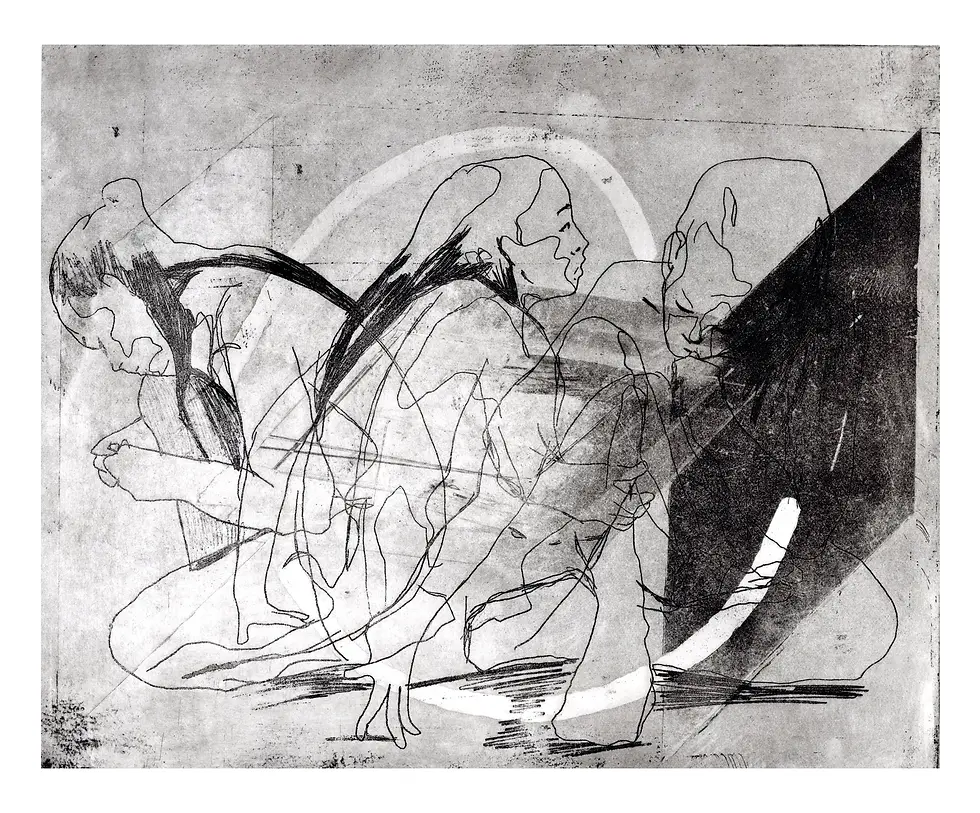
Q: You move between drawing, printmaking, and animation. What feels most different about working in each of these formats?
A: When I draw on paper, it takes longer for me to get going, and it's a lot of construction work and thinking that happens. Since I enjoy drawing in larger formats it is more focused on the body and the movement. It feels more immersive since sometimes I'll literally sit and draw in the middle of a piece. It's much slower than when I create an etching. During the printmaking process, I will usually plan and draw an image digitally and print it out, then transfer it to a plate. I don’t think about it as much because I know there are a lot of factors I can't always control. That's a huge difference, because in printmaking I know there will always be something I can't foresee, whereas when drawing traditionally on paper, I have a bit more control. When I animated my short film “Lethe,” I really loved that I could actually make the image move and have things happen as I imagine them in my mind. The biggest difference here is how repetitive it is and how patient I have to be. I enjoy all of these formats because they stimulate different parts of myself due to the dominant requirements of each medium.


