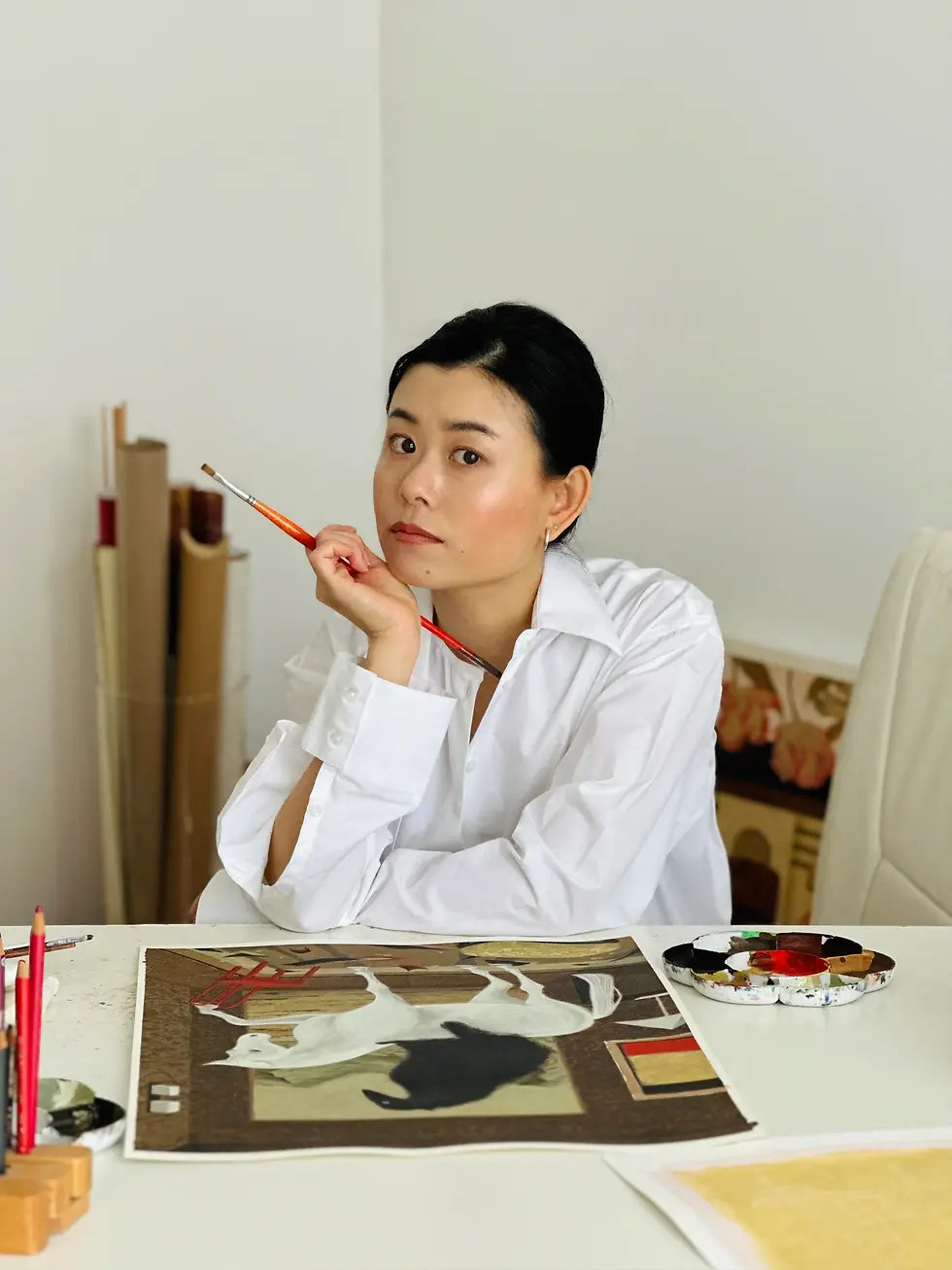
Tetiana Tretiakova
Tetiana Tretiakova is a Ukrainian artist based in Warsaw. She makes paintings, collages, and occasional video works, and personal therapy is a direct starting point for many of her ideas. Painting begins with notes, reading, and a clear image she builds step by step, while collage begins with colour and cut fragments on the table, and she stops when it feels complete. Her current focus is a long-running series about the body, linked to experiences of violence, psychological strain, and forced migration.

Q: You began working from personal therapy. When did this start to appear in your art?
A: I believe this process began from the very start of my professional artistic development, because, like any artist, I work with subjects that do not leave me indifferent. Without a genuine emotional connection, there would be no motivation or inner energy to create works dedicated to a particular theme. Personal therapy has been one of the ways through which I explore myself and encounter parts of my identity that are hidden or not fully accepted. This discovery is not always easy or pleasant, which is why, on a subconscious level, certain “unwanted” aspects can remain blocked. When that happens, art becomes a powerful source of support. It allows me to approach sensitive topics in a gentle and caring way, revealing what logic often suppresses by opening access to emotions, memories, thoughts, and feelings that lie deep within. Once I start focusing on a theme that makes me vulnerable, my attention sharpens, which is why I begin to notice similar experiences in other people. This sensitivity may be felt by those around me, as it often leads to conversations on such topics without me initiating them. The more I engage with the subject, the more attentive I try to become to the details. Gradually, it grows beyond my own experience, which leads to the development of a series.

Q: How do you decide which personal experiences stay private and which become part of a work?
A: Every time it is a separate story. For instance, last year I was travelling by train, watching trees pass by at high speed, which suddenly reminded me of female bodies. I made a very schematic sketch right away. At once, I recalled the book Women Who Run With The Wolves by Clarissa Pinkola Estés, which had left a strong impression on me. This connection inspired the idea of creating a series dedicated to female connection, and the image I captured on the train became the starting point of the planned series. Shortly after, I shifted my focus to other projects and did not have the time to further develop this direction. Looking back, I now understand that this pause was necessary in order to return to the idea with a clearer mind and greater openness.
When new sketches began to emerge, they were still connected to the original theme; however, they revealed much more than just female connection. Gradually, a broader perspective appeared, and later the male extension emerged as well. This evolution led to my current series, "Prayer For Life", dedicated to the diversity and uniqueness of each body, a theme that has concerned me for quite some time.
Q: Forced immigration is a central theme in your work. How has living in Warsaw changed how you approach it?
A: I wouldn’t say that the theme of forced immigration is central to my artistic development, yet it is highly important to me because it shapes not only my art but my entire life. This project is unique in my practice, as it is the only video artwork I have created so far. Additionally, it is special because it was developed in collaboration with Nata Litchi, the choreographer of the performance.
Once I shared my story behind the idea, along with several movements that appeared while I was reflecting on my lived experiences, she immediately sensed the essence of the concept and helped translate it into choreography. That was an exceptional moment of mutual understanding. This collaboration helped me dive deeper into both my thoughts and emotions while redefining my new reality. Relocation caused a profound shift in everything I had previously known, which led me to new experiments in art, as I started searching for my place both in this city and in my artistic path. During this process, I discovered my way of self-expression and created my first major art series dedicated to corporeality, which I have been developing for over a year. For now, it is my key ongoing project.
It continues to evolve thanks to people who interact and engage with my art, as they help expand my vision by entrusting me with their personal stories, which find reflection in my paintings.

Q: You work with painting, collage, and digital tools. What usually sets the medium for a new piece?
A: The process largely depends on my inner state, as there is a significant difference between how I approach painting and collage. In most cases, my paintings begin with an idea: thoughts, written notes or diary entries, conversations with people around me, and reading. In this sense, logic comes first. Once an idea captures my attention, I start seeing images in my head. Sometimes, I “fish” these ideas from the state between wakefulness and sleep. Unfortunately, many of these images vanish by morning, but occasionally I do remember them. Some of these visions are still waiting for the right moment to appear on canvas.
When working on paintings, I also tend to conduct research to find something meaningful both for myself and for those who engage with my work. This process is completely different when it comes to collage. When I seek a deeper connection with myself, when I am searching for hidden thoughts or emotions, I turn to collage. It is an entirely intuitive process that I do not try to control.
I never consciously decide when a collage is finished; I simply look at the result and know, as if each collage decides on its own when I should stop working on it. Once I reach that moment, a narrative behind it immediately begins to unfold. There was a case when a collage became the starting point for a painted series that I had postponed and am planning to return to next year. In this way, collage allows me to move beyond established approaches and discover new forms of non-standard visual expression.
Additionally, when I feel overloaded with thoughts about a current series and need distance from it, I often switch to collages. Sometimes this helps me recharge; at other times, it helps me find a missing piece of the puzzle. Both mediums are essential to my practice, and it is precisely this combination that provides inspiration for future projects.
Q: How does a piece typically begin for you in the studio?
A: When I am painting, the idea is always the beginning. Usually, it is a story or a state that I want to express. Once it is formed in my mind, I start searching for references and combining them to find the exact image I want to paint. When I have a clearly composed picture in front of me, I move directly to stylizing it on the canvas. From there, I proceed with corrections and adjustments to refine details and nuances. When I am satisfied with the sketch, I begin finishing the work. The most challenging part of this process is finding a befitting title that reflects the whole story I want to tell. I must admit that I am not always as confident in this area as I would like to be, but I hope that with more practice, this skill will continue to develop.
As collage creation is more intuitive for me, it starts differently. I browse cut-out pieces and search for new materials, focusing on colors, images, and forms that resonate with me at that particular moment. Mixing and combining elements that are not always compatible feels playful, as if I am breaking rules without causing harm. Sometimes this “game” results in a finished collage, but not always. At times, the process needs to be paused and returned to later, allowing space for a new perspective or approach to emerge.

Q: From your current themes, which one feels most pressing right now?
A: The series that currently occupies most of my attention is dedicated to corporeality, so I would say it is the central theme of my artistic practice at this stage. There was a moment when I felt ready to move on to a new subject; however, after one exhibition where I had the opportunity to discuss the ideas behind my paintings with visitors, the reactions were deeply emotional. Many people shared that it was important for this theme to be addressed and that the way it was presented resonated with them. Some found support, others felt heard, and some finally felt safe. This emotional feedback gave me a strong impulse to continue the series, as I realized how important it is not only for me. It encouraged me to tell more of the stories my paintings hold in silence, while carefully respecting the privacy of those who entrusted them to me. At the moment, I feel ready to complete a few more works within this cycle before moving forward. I do not plan to abandon the theme; rather, I intend to continue exploring it from different perspectives and searching for new forms of visual expression. I see this process as the creation of new series that remain closely connected to the same subject. I enjoy planning, which is why having a clear direction ahead feels important to me, while at the same time understanding that nothing ever unfolds exactly as planned. For this reason, I remain open to how the work transforms through the process, and to how the original plan may shift in response to questions that become more relevant along the way.