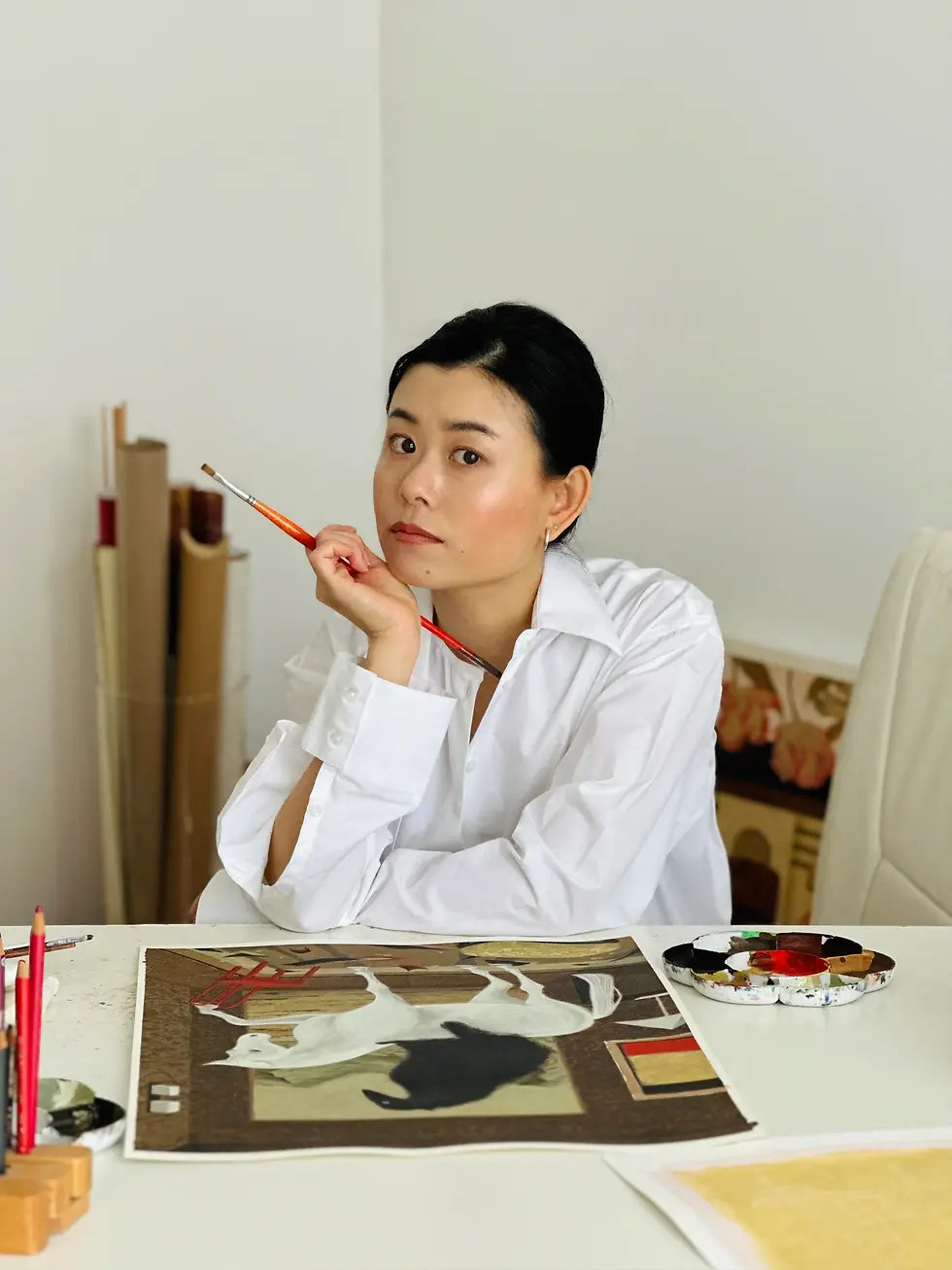
Suzana Vulovic
Suzana Vulovic is a Serbian-born artist and curator based in Belgrade and London, working with painting, drawing, installation, performance, and text. Writing is part of her daily routine, and poems or handwritten notes often appear directly in the work, placed next to images or worked into them. Living and working in different cities and languages keeps questions of memory, belonging, and personal history close to her work. She often starts from notebooks, dreams, and personal records, and returns to them in different projects and formats.

Q: You often use your own text in your works. At what point does writing become part of the image?
A: Yes, often in my work I integrate the physical act of creation with the physical act of writing. In recent years, my poetry and diaristic writing have become an integral part of my visual practice, as the emotions and thought processes moving through different media are the same. The visual field creates a space in which words can echo and be felt differently, while poetry gives inner resonance to the images; it is a way to show that art is not one-directional, but a multilayered communication. Text and visuals are already in a causal relationship, intertwining and shifting into one another, yet remaining very individual. Like parts of a polyptych, they function as different impressions of one experience, which sometimes repeat from work to work and throughout the entire research process of a given series.
Q: You move between Belgrade and London. What do these two places give you differently in your work?
A: Movement taught me how profoundly place, community, and artistic dialogue can transform one’s work, and how movement can offer new vocabularies, new solidarities, and new ways of listening.
Growing up in a small town in southwest Serbia, pursuing art meant leaving home early. From my studies in Kraljevo, Trebinje, and later Belgrade, my work developed a deep dialogue with landscape, slowness, and inner observation. These places shaped my sensitivity to nature, memory, and introspection, grounding my practice in painting, material research, and bodily experience. London, however, shifted my work toward collaboration and interdisciplinary engagement. My practice expanded through working with my art collective (Fruzsina Nagy and Uroš Ranković) on projects such as “Triptych of Thoughts” and “Phthalo Sky Silently Falls.” These works invited audiences to reflect on migration, transition, and invisible connections through immersive, multi-sensory environments that foster kinesthetic empathy.
Alongside my artistic practice, I started working as a project coordinator and artist lead with Art Voyage Biennial in London, where we delivered projects that intertwined workshops, public art, and summits.

Q: How does a personal experience first become part of a new piece for you?
A: The writing and creating process evoke and connect memory and experience with the present moment. By colliding past and present moments, things and materials find new meaning; they can echo archetypes found in myth, nature, human experience, and cultural identity.
When we use personal history, we need to make a distinction between memories. Louise Bourgeois said a beautiful sentence about memories: “If you are going to them, you are wasting time. Nostalgia is not productive.
If they come to you, they are seeds for sculpture.” Next to this she also said, “I need my memories, they are my documents,” which means that all our conscious creation exists between the unconscious and the now. Through the years I learned that when the most vulnerable and honest parts of experience are articulated through art, they transform into collective recognition, opening dialogue, empathy, and space for reflection.

Q: Water appears in your work as a metaphor. How do you decide when it enters a piece?
A: It’s more an intuitive process than a decision. In the “Beyond Uncertainty” series, it functions as a central symbol and a feminine principle, a way of sustaining an ongoing dialogue with nature. It recurs as a metaphor for memory, emotion, and transformation: nurturing yet destructive, transparent yet enigmatic, a mirror of the subconscious, movement, and change. Water first appeared to me through a vivid symbolic dream after I moved to London in 2023. In that dream, I found myself alone on an island during a silent storm beneath a low phthalo-blue sky. I sat on a chair holding myself as a little girl in my lap, comforting her for a long time.
This dream opened questions of belonging, origin, and identity in constant transition. From that dream first came writing, then a series of drawings and paintings, and eventually the work culminated in a performance called “Phthalo Sky Silently Falls.” Since then, water has often become a symbol that repeats in my poems and artworks, holding vulnerability, transition, and emotional depth that cannot be fixed, only carried.
Q: What made “Beyond Uncertainty” different for you from earlier works?
A: Through this series, my practice expanded both materially and conceptually, moving from personal reflection toward investigating the materials and sensory conditions that shape how memory is formed, carried, and transformed through art.
It explores how different states of transition—emotional, psychological, or physical—are held in the body and translated into material form. The project became a space where the fusion of different media, interdisciplinary conversations, and constellations of practices with other artists opened new pathways for exploration. This cyclical process allows emotions, thoughts, and images to repeat, echo, and shift across drawing, text, sound, and performance, creating layered spaces of remembrance that differ fundamentally from the more singular or linear approaches of my earlier works.
Q: At what point do you decide that something stays as research, and when it becomes a public work?
A: For me, research and public work exist on a continuum. Some ideas mature quickly, while the creative and research process might last for years. I keep works private while research is still shaping me—when it is exploratory, unresolved, or too intimate to offer to others. Once it stabilises into a form capable of carrying meaning outward, when it no longer depends on my inner process alone but creates a structure that invites dialogue, I share it. This decision is intuitive but also ethical: I only share work when doing so expands the conversation rather than exposing something still in formation.