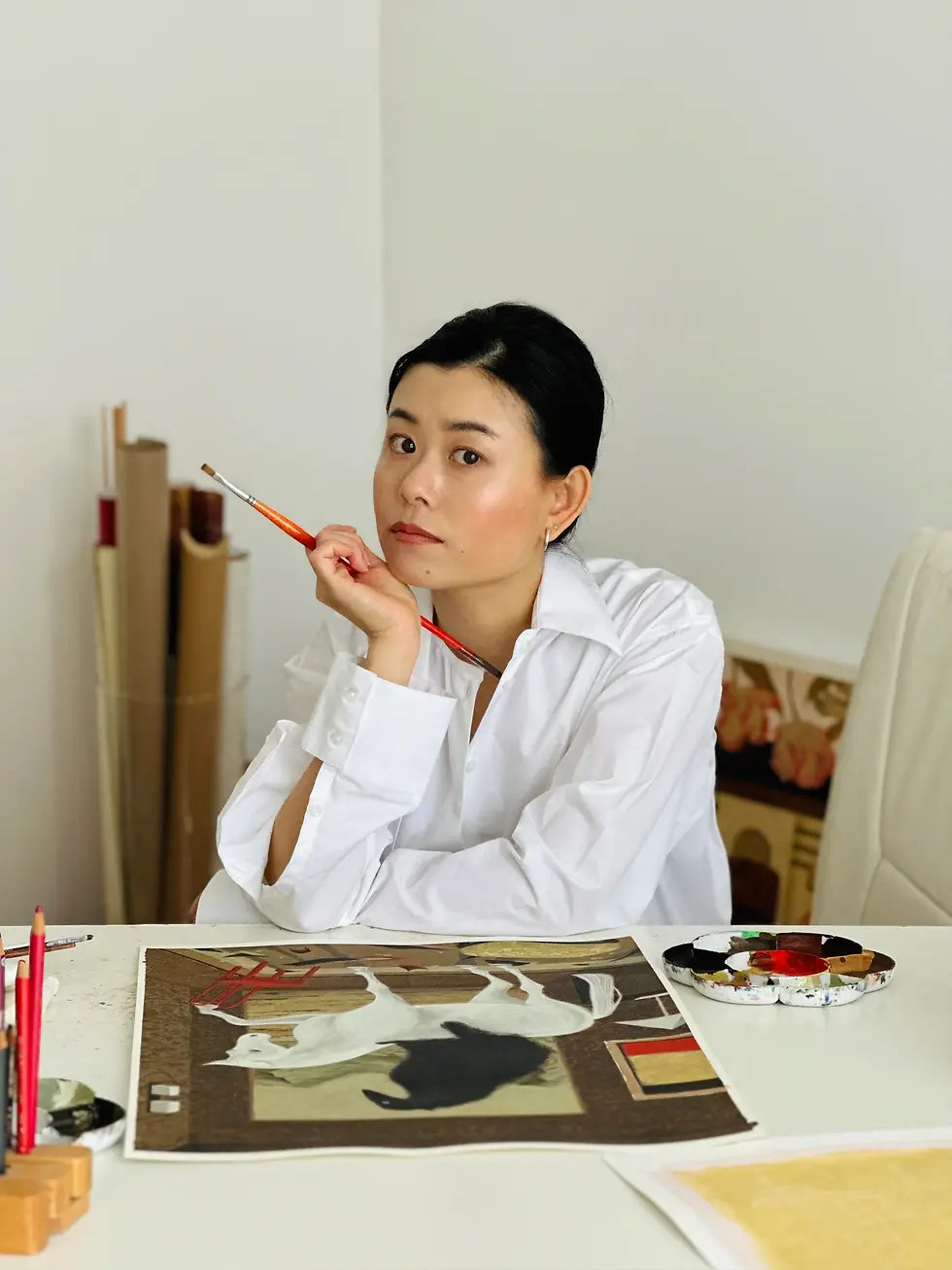
Suphawan Kanta
Suphawan Kanta’s paintings often begin with a sketch in her diary, where everyday objects, books, and fragments of memory take shape. Her canvases use bright, vivid colors influenced by Matisse and Fauvism, while the stories inside them stay personal. Works like “L’atelier Lundi” remember her grandmother through the color yellow, while “Lazy Seine Day” reflects the atmosphere of Paris and the Seine. Her process brings together observation and memory, arranging people, rooms, and details into scenes that feel both familiar and quietly dreamlike.

Q: What draws you back to the small details of daily life in your work?
A: On ordinary days, we often seek happiness in the little things, to help us get through the weariness of daily life. That’s why I want the painting to capture the essence of an everyday moment, arranging small details like books, paintings, and chairs—objects filled with memories that hold a special place in my heart. Through this, I hope to evoke a sense of joy, tranquility, and nostalgia that will remain not only in the artwork but within me, always.
Q: In "L’atelier Lundi" yellow almost takes over the canvas. How do you decide when a color becomes the main voice?
A: I want the yellow color, which represents brightness and vibrancy, to symbolize my grandmother. The amount of yellow, therefore, covers almost the entire background. When I finished painting this piece, I realized that the yellow I chose conveyed a sense of strength, becoming the main tone I wanted to express. It reflects the warmth of childhood memories and, even now, whenever I think of my grandmother, that yellow still coats my feelings of longing, making me feel good every time.


Q: Your paintings often mix memory with observation. How do those two meet when you’re working?
A: I love creating scenes in my artwork. When I need to mock up a scene, the arrangement of elements often comes from my memories, personal experiences, scenes from movies, or images from magazines I enjoy. These are then blended with the main characters in my work—people who are inspired by my daily observations. Their postures, facial expressions, and clothing all come together, creating a fusion of memories and observations that meet on my canvas.

Q: In "Lazy Seine Day" space feels freer, almost playful. What changed in your approach there?
A: This painting was created at the end of last year, as part of a series where I wanted to leave more open and free space in my work. If you look back at the past 2–3 years of my artwork, you'll see that they were full of patterns or other elements, with no free space left. This was due to my lack of confidence in my own painting skills. But when it came to this series, I wanted to capture moments of people, the Seine River, and the atmosphere of autumn. So, experimenting with a more open composition felt right for conveying what I wanted to express in this art piece. By then, I also felt more confident in my skills.
Q: Writing and sketching are part of your process. How do they shape what ends up on the canvas?
A: Before starting the process of painting on the canvas, I often sketch the ideas that have been brewing in my mind into my diary or sketchbook. These ideas might not capture every detail, but they serve as the first draft on canvas. From there, I build upon them in the painting process, adding details that sometimes come to me unexpectedly, and applying colors based on my thoughts and imagination. Through this process, I refine everything until it becomes the final image I’m aiming for.
Q: Fauvism and Matisse echo through your practice. How do you keep that influence alive without repeating it?
A: For me, the essence of Fauvism and Matisse always lingers in the background of my paintings. It’s the concept of deconstruction of people, objects, or patterns to their simplest form. I use colors that are relaxing, vibrant, and uplifting, avoiding anything that feels gloomy. With these principles in mind, I adapt them to suit the different series of paintings I work on.