Stein Henningsen
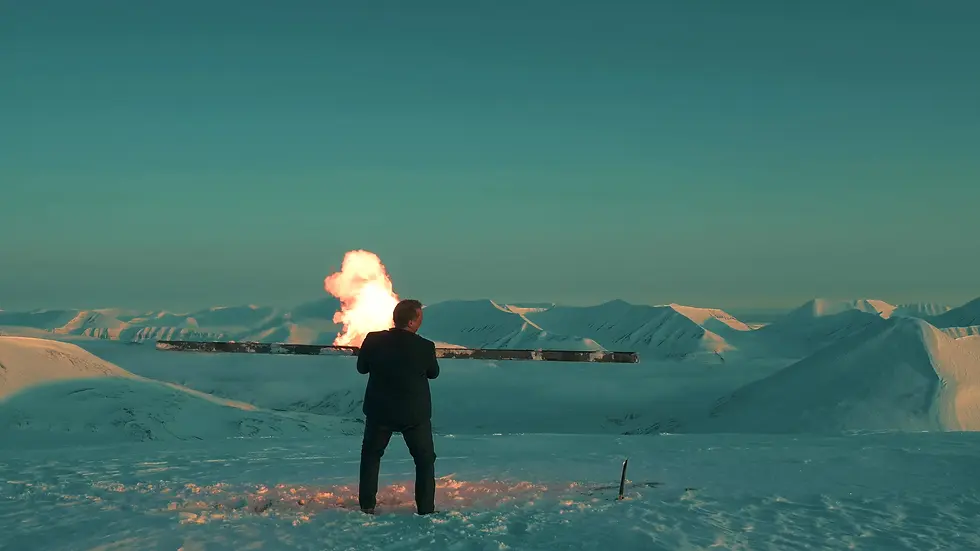
Stein Henningsen is a visual and performance artist based in Longyearbyen, Svalbard. He grew up there and works directly in the Arctic landscape, using his own body in actions such as standing in storms, dragging ice, or rowing a small boat with fire burning inside it. He has a background in engineering and international marketing, and he founded the Arctic Action International Performance Festival, which brings artists to Svalbard for site-based work in the region.

Q: How did growing up in Svalbard affect the way you work today?
A: Growing up in Svalbard in the 1960s and 70s shaped my art in ways I did not fully understand until I returned there as an adult. Longyearbyen was then a small coal-mining settlement. Life revolved around the mines, and the future seemed limited to becoming either an engineer or a miner. Art felt impossible, almost unthinkable—until a friend and I began experimenting with his first camera, trying to recreate images we saw in magazines. Still, it would take decades before that spark turned into a path.
Thirty years later, I left a career in international marketing to work as a photographer. This eventually led to my first major art project, "Crosses of Liberty", a temporary installation: a cemetery made of life-size white crosses like those found in cemeteries near the beaches of northern France. I installed the work in cities across European countries participating in the war against Iraq, addressing Europe’s involvement in the conflict.
The first installation took place in Oslo. At one point, I physically entered my own cemetery—lying down beside the one original marble cross—and something shifted. Members of the audience began to place their bodies on the ground beside the replicas.
In that moment, I understood something fundamental: I needed to work through performance, in public space, with full physical presence, allowing my energy and vulnerability to become part of the work.
After several years working internationally as a performance artist, I returned to Longyearbyen in 2009. Coming home transformed my practice again. The rapid changes in the Arctic—melting sea ice, collapsing glaciers, unstable weather—made the climate crisis immediate and visceral. I began working with elemental materials: ice, fire, wind, and endurance. These forces became both my tools and my challenge.
Growing up in Svalbard taught me humility before nature. The landscape made me feel small, vulnerable, and alive. The contrasts—beauty and danger, cold and warmth, life and death—were constant companions. Without realizing it, I had been training my entire childhood for the performances I create today: standing in storms, handling fire, working with melting ice, pushing my body into situations of risk, fatigue, and exposure.
My art is simple, direct, and stripped down, because the Arctic must be experienced the same way. I aim for one clear action—one image—supported by multiple layers of meaning. The wilderness shaped my sense of responsibility and sharpened my awareness of time, fragility, and human impact. I return to Svalbard because I am rooted there, and because my work speaks from that place. The land tests me, and I test myself through the work. Growing up in the High Arctic did not just influence my art—it formed its core.

Q: Many of your performances start from one simple action. How do you find that starting point?
A: Many of my performances begin with a simple action, but that action is never random. A performance only works for me if I can be fully present—physically, mentally, and emotionally. I need to feel the work in my body. That is why I choose materials and actions that awaken something in me: tension, risk, endurance, discomfort, or a sharpened sense of being alive.
If the action does not challenge me, it cannot challenge the viewer. When developing a new piece, I usually begin with either the material, the site, or something happening in the world that demands a response. From there, I shape the work on paper. I draw to understand the visual structure—how the action looks, moves, and reads. I often work with a narrative form: a beginning, a middle, and an end. The central action is usually the middle—the core—and then I search for the right opening and closing to frame it. This can take days or weeks. A performance only becomes real when the structure holds.
The process is never rigid. I have arrived at festivals with fully developed concepts and abandoned them instantly because the site, atmosphere, or energy demanded something else. The work must fit the place and the moment. I have changed pieces the day before, the hour before, or even during a performance if necessary. Sometimes I talk with fellow artists to untangle an idea, or I work backwards from the ending to find a new beginning.
Often, the true starting point is a single charged image or moment—a sense of danger, uncertainty, beauty, or prolonged struggle that I am willing to give to the audience. Once I find that moment, I build the performance around it. The final work will always evolve, but it grows from that essential impulse: a simple action loaded with meaning, presence, struggle, and risk.

Q: You often work with your own body in extreme natural conditions. How do you prepare for a performance like this?
A: I prepare for extreme performances by drawing directly on my life in the Arctic. That experience gives me a physical understanding of cold, wind, water, and exposure—how they act on the body and shape movement. Before any performance, I imagine the conditions as precisely as possible: the weight of the cold, the resistance of water, the force of wind, the fatigue that will come. I study risks, anticipate consequences, and learn from earlier mistakes. When working in icy water or extreme temperatures, I always ensure that someone is present to pull me out and help me warm up if necessary.
My clothing is simple and consistent: wool. It keeps me warm on land and in water, and it does not melt or burn when I work with fire. These details are critical; small mistakes can have serious consequences in the Arctic.
I research thoroughly when entering new territory, but I never rehearse a performance fully. Over-testing drains the work of tension, and without tension my focus and presence weaken. The first execution is when the work is most alive—for me and for the audience. I test technical elements, but never the full action.
If I rehearsed something difficult and found it too painful or dangerous, I might soften or abandon it. That would diminish the work. The strongest performances carry genuine uncertainty—“will he make it?” That uncertainty keeps me fully present and draws the audience into the moment. It makes the action real.
Preparation, for me, is not about eliminating risk. It is about understanding it—and choosing to meet it.
Q: In "My World", "Red Drum", and "The Boat", the action repeats or goes against the given direction. How do you arrive at that choice?
A: Repetition and moving against an obvious direction emerge in my work as ways of making contradiction physical. In "My World", "Red Drum", and "The Boat", the actions are simple, but they place the body inside situations where survival, knowledge, and behavior collide.
In "My World", I am standing on an ice floe—on the very surface that keeps me alive by separating me from the freezing water below. The repeated hammering is not accidental. I am actively trying to destroy what keeps me afloat. The action becomes a closed loop: the floe drifts on, I return, and the destruction continues. I am both aggressor and victim, locked into a cycle where persistence replaces reflection. This repetition reflects a human tendency I recognize deeply: continuing harmful actions even when their consequences are obvious, even when they threaten our own survival. In "Red Drum", the logic becomes even clearer.
The arrow on the drum indicates the correct direction—knowledge made visible. By deliberately pushing the drum the opposite way, I enact what Peter Sloterdijk calls cynical reason: the condition in which we know exactly what must be done, yet continue to act against that knowledge. The gesture is quiet, almost mundane, but it mirrors how most damage is done—not through dramatic refusal, but through everyday misalignment. The repetition of the wrong movement becomes an image of collective failure.
In "The Boat", the contradiction reaches its most extreme form. I set fire to the boat—the only thing separating me from the ice-cold sea and certain death—and then continue rowing. The vessel that keeps me alive is the same vessel being consumed from within. I am fully aware of the danger, yet compelled to move forward. This is one of my clearest meditations on the conflict between insight and inaction. Fire burns, water presses in, time passes. I do not stand before nature; I submit to it. The body becomes a measure of consequence.
Across these works, repetition and resistance are not symbolic gestures but lived situations. They transform abstract ideas—crisis, denial, responsibility—into physical reality. I arrive at these choices by asking how contradiction can be felt in the body rather than explained.

Q: The gap between knowing and acting appears in your work. How do you work with that while making a piece?
A: The gap between knowing and acting is built into my work. I always start with a plan, but once the performance begins, control is limited. I don’t perform a role, and I don’t pretend to know how things will end. The work only becomes real when I step into it and accept uncertainty.
Early on, I relied on physical strength. I pulled heavy chains, carried marble crosses, ran through brick walls, and lay under massive blocks of ice. The weight was real, and so was the struggle. You could hear it, see it, feel it. The body was the material.
Today, my body is older. Repeating the same physical extremes would weaken the image rather than sharpen it. That forced a shift. Instead of relying on brute force, I work more with environment—especially cold. In the High Arctic, cold is not symbolic. It hurts. It demands respect. If I manage time and limits correctly, I can endure it.
Mental focus is the hardest demand. Physical endurance and environment matter, but without concentration and willpower, they mean nothing. The real challenge is deciding to stay longer, go farther, push slightly more. Often the difference lies in seconds, meters, or a slightly greater risk.
This is where knowing and acting collide. I know when to stop—but I also know when I can continue. That decision is made in the moment, under pressure. It’s not theoretical. It’s physical, mental, and immediate.
Each performance is about tightening the work, making it more precise, and pushing it a step further than the last. That tension—between awareness and action—is where the work holds its ground.
Q: You also run performance projects in the Arctic. What does that give back to your own practice?
A: Running performance projects in the Arctic has become an essential part of my own artistic practice. I initiated the International Performance Festival "Arctic Action" in Svalbard in 2015 after years of being invited to festivals around the world. Through those encounters, I realized that very few artists could imagine what it means to live and work in an archipelago close to the North Pole. Arctic Action grew out of a desire to share that reality—and to see it through other artists’ eyes.
"Arctic Action" is conceived as an alternative to traditional performance festivals. Most works take place outdoors, directly within the Arctic landscape. The project focuses on one artist at a time, giving them the time and conditions needed to engage deeply with the environment. This slow, concentrated approach allows artists to move beyond surface impressions and create works that are genuinely shaped by the place. The Arctic demands attention, patience, and respect—and the festival is structured to reflect that.
The project has given back to my own practice in multiple ways. Watching artists from different backgrounds work in my landscape has sharpened my understanding of both art and performance.
It has shown me how others read the Arctic—what they see, what they fear, and what they respond to. Through this, I have gained clearer insight into what formed me as an artist and why my work looks the way it does.
"Arctic Action" has also taught me how to support artistic processes—how to guide, collaborate, and document performance in extreme conditions. The emphasis on high-quality digital remediation has strengthened my understanding of filming and photographing live work, extending the life of performances beyond the moment itself.
Equally important are the human connections. The project has created strong friendships, long-term collaborations, and a shared responsibility toward a fragile environment under increasing climate pressure. Arctic Action is not only about producing art—it is about building a community that respects nature, shares knowledge, and communicates a common urgency to protect the planet and its diversity.


