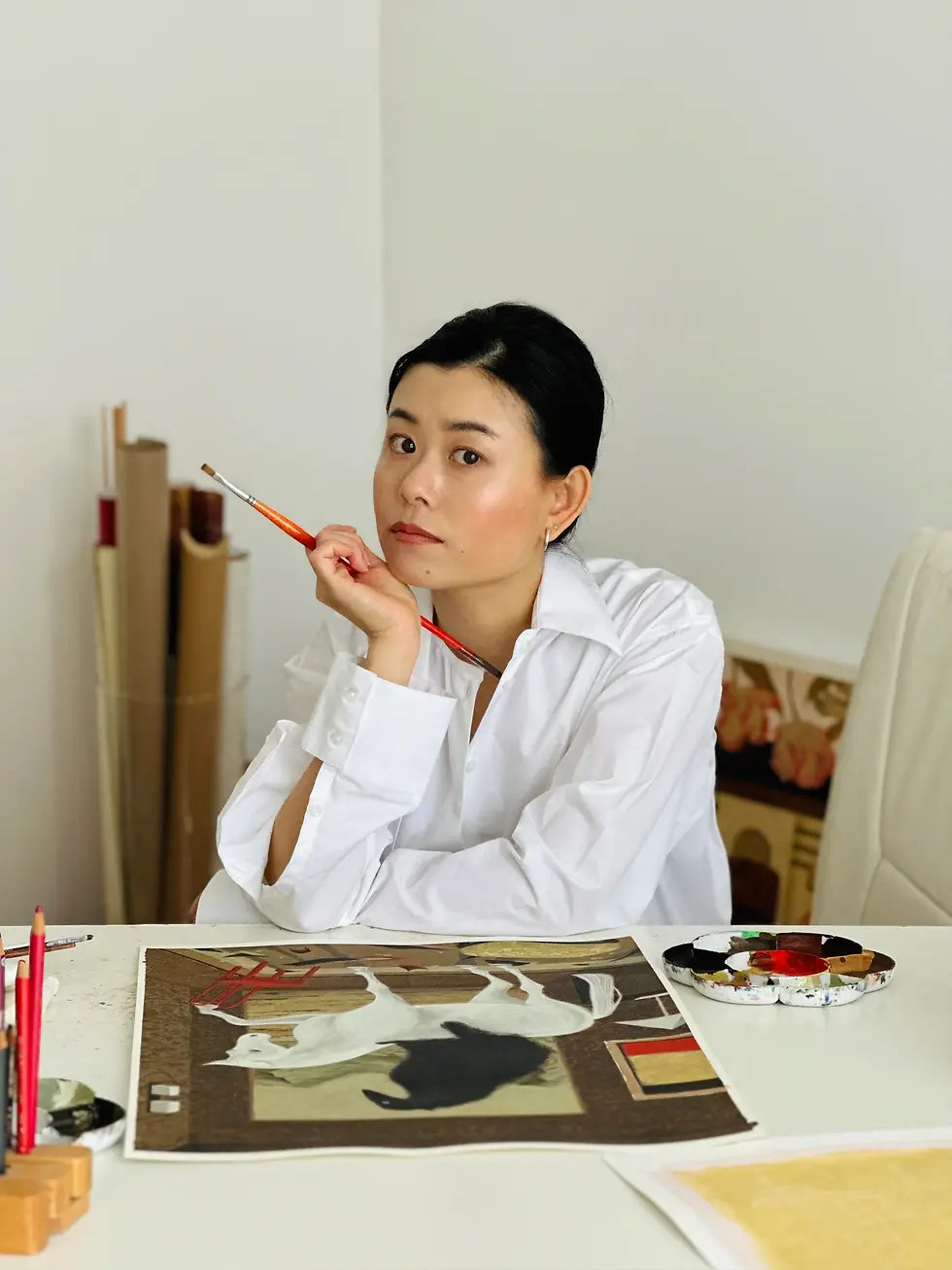
Sonia Markova
Sonia Markova is an artist from Moscow who now lives in Lisbon. She often starts with simple scenes from everyday life. Her focus is on tables set for meals, neighborhood gatherings, and the small details of daily routines. Her background in photography and design influences how she captures these moments, giving them a direct and calm presence. Her interest in food culture and local traditions appears in many of her paintings. In pieces like "Feminine Urge" and "Santos Populares (Sardines)", she paints the simple joy of ordinary life.

Q: Your paintings turn everyday rituals into something almost cinematic. What draws you to these small, private moments?
A: I believe there's beauty in everything, even in the simplest moments of life. In our fast-paced world, it’s easy to overlook them, but my work encourages slowing down and observing — the subtle details that make ordinary life extraordinary.
By cherishing the seemingly mundane, I hope to highlight the significance of these intimate rituals that define our daily lives, turning them into stories worth noticing and celebrating. It’s about finding wonder in the familiar, allowing viewers to connect with the quiet, personal beauty that exists all around us.
Q: There’s a strong sense of warmth and imperfection in your work. Do you see beauty as something that comes from flaws rather than perfection?
A: Absolutely. I believe that perfection can be the death of creativity because it limits the natural flow of expression. In my work, I embrace imperfections because they bring character and life to the piece. Just like food, which resists perfection — a twisted vegetable is far more interesting and authentic than a perfect one. Nature itself designs with personality, not precise geometry, there are no perfectly straight lines in the natural world. Perfection is often boring, it lacks the personality and spontaneity that make art engaging and full of soul. Embracing flaws allows us to celebrate the unique and the authentic, which is where true beauty resides.

Q: Living in Lisbon seems to play a big role in your art. What did this city give you that Moscow couldn’t?
A: Living in Lisbon has profoundly influenced my art by infusing it with a sense of lightness and warmth, and allowing me to embrace a slower, more reflective pace of life.
Lisbon's rich history, diverse cultural influences, and the connection to the Atlantic Ocean inspire a more relaxed, expressive, and spontaneous approach to my work.
Moscow, as a bustling metropolis, is characterized by a relentless energy and a competitive spirit, while Lisbon offers a different rhythm — one that emphasizes “family,” “community,” and the beauty of taking time to observe and reflect. This environment has given my art a more intimate, soulful quality, allowing me to explore themes of connection and harmony and embrace a softer, more fluid artistic voice.

Q: In “Feminine Urge,” freedom feels intimate, not loud. How do you think independence shows up in quiet spaces?
A: I believe that sometimes independence is about reclaiming personal rituals and moments of solitude — those private rituals that affirm our sense of self beyond societal expectations. It’s in the quietude of these settings that one finds the space to reflect, to indulge, and to assert independence in a way that feels authentic and unforced. Whether it's enjoying a favorite wine and food or listening to the old cassette player or reading a favorite book, it's about finding joy in creating your own space. The quietness of this space allows for a personalized sense of freedom, one that is about appreciating small, everyday acts of self-love and solitude rather than loud expressions.
Q: You mix realism with a touch of naivety. How do you find the balance between honesty and playfulness on the canvas?
A: Finding this kind of balance involves embracing a sense of childlike wonder and curiosity. I believe it's important to stay a bit of a child, to see the world with fresh eyes and a touch of naivety. This perspective allows me to convey genuine emotion and truth in my work, while also infusing it with a playful quality that invites viewers to engage and explore without judgment. The naivety keeps the artwork honest and unpretentious, serving as a reminder to approach life and art with openness and a sense of discovery. This balance creates a space where authenticity and whimsy coexist, making the art both sincere and lively.
Q: “Santos Populares (Sardines)” captures community and celebration. How do you move between painting solitude and togetherness?
A: I see both solitude and togetherness as fundamental aspects of human experience, each offering distinct forms of meaning and fulfilment. I’m often inspired by real events or memories — whether it’s a large community celebration like “Santos Populares,” or enjoying a quiet dinner with a friend, or sipping champagne alone. Each of these moments holds its own significance, and I believe that authentic engagement with them enhances the depth of my work. I like to capture the sense that both celebration and solitude are essential parts of life, and are vital to understanding the full spectrum of human experience.