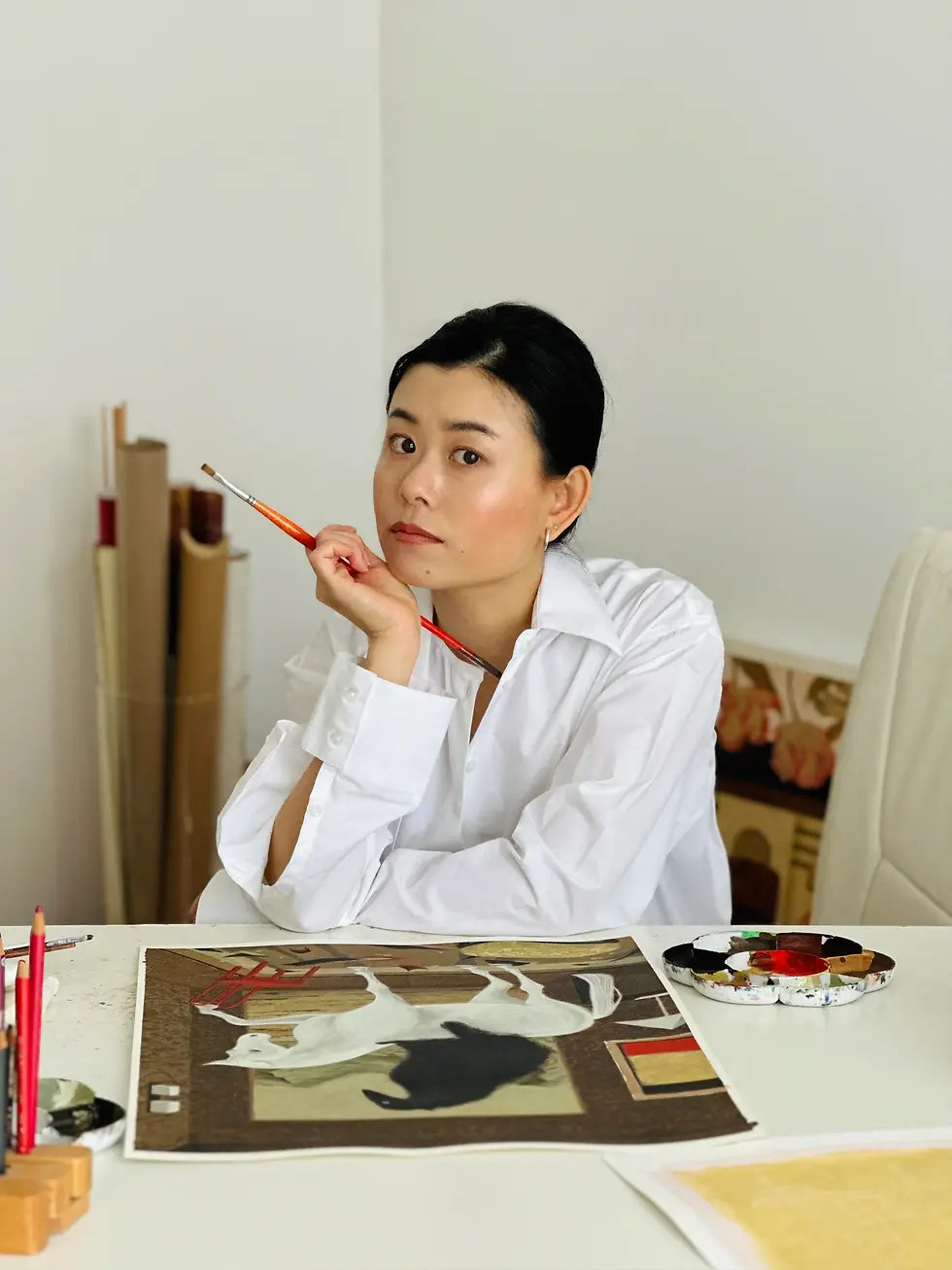
Sofía Mac Gregor Oettler
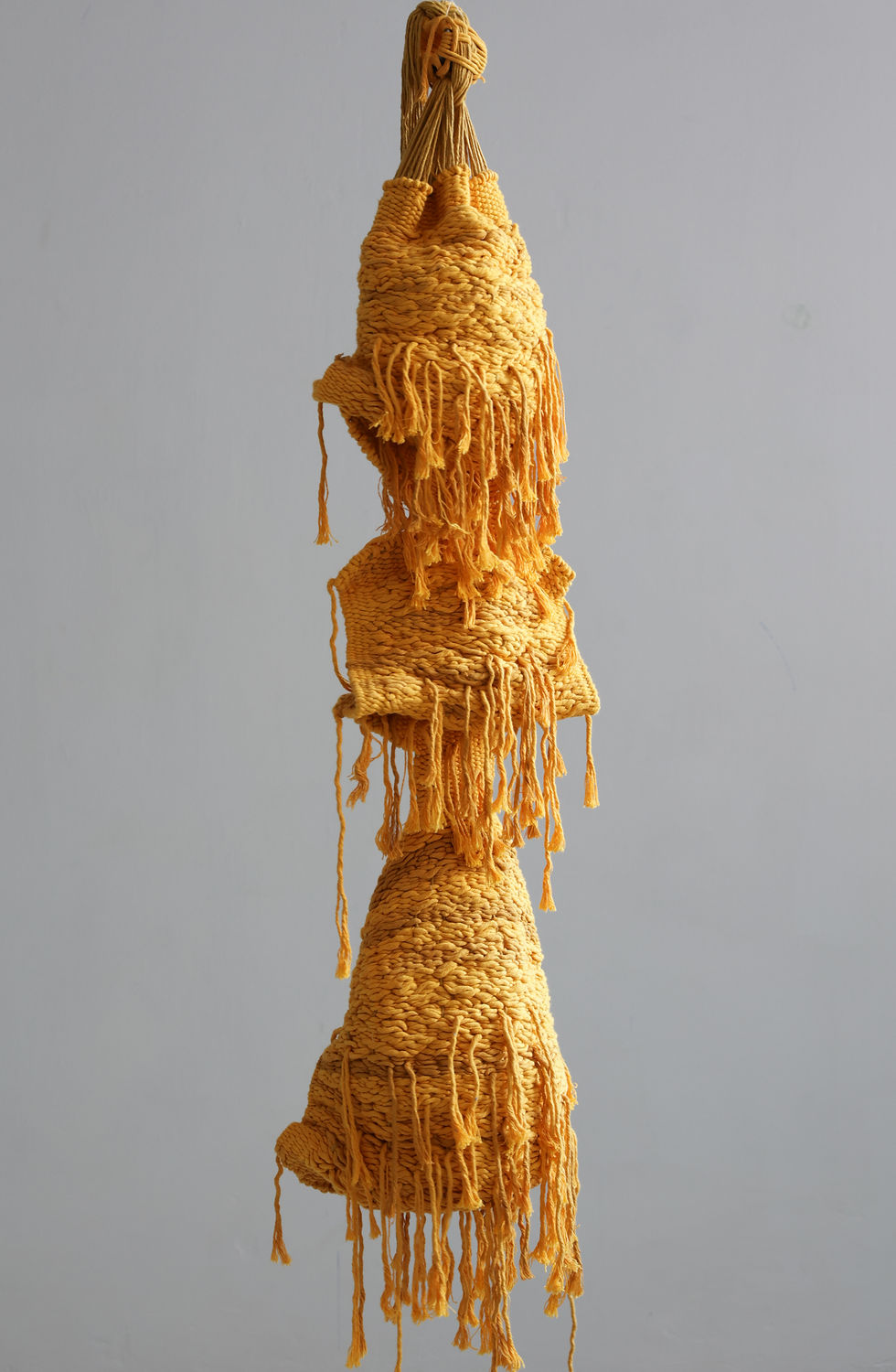
Sofía Mac Gregor Oettler is a Mexican textile artist based in Barcelona and Mexico City. She studied economics and public policy before she walked into a Teresa Lanceta exhibition at MACBA in Barcelona and decided to learn how to weave. She enrolled at a weaving school a few weeks later and has woven almost every day since. Her Nidos are nest-like sculptures woven on an ancestral vertical loom and suspended in space, built on one question: what if care flowed toward women rather than always away from them.

Q: You studied economics at ITAM and public policy at Stanford. How did you end up weaving?
A: I never imagined I'd end up a weaver. It all started a few years ago when I visited a Teresa Lanceta exhibit in the MACBA museum in Barcelona, and I was awed by her experimental tapestries. I remember thinking, "How does one learn this?" I decided to enroll in a weaving course in Tèxtil Teranyina a few weeks later, and have woven almost every day since. So I'd say it was all a bit serendipitous. Still, in many ways, my background in policy and economics is interwoven in my art practice. As a policy researcher, I studied the social fabric, how it erodes, and how it can be transformed to be more equitable, particularly for women. Today I'm exploring the same themes but materially—with actual tissue.

Q: You learned tapestry at Escola Tèxtil Teranyina under Olga Hernández. What did that training open up for you?
A: It opened up everything! Olga's mentorship was crucial because she's not only very technically skilled in traditional and contemporary tapestry, but she's also great at teaching students how to follow their material intuitions. For me, as someone with such an analytical background, an intuitive way of creating was completely new. Weaving felt like a great medium for me because its foundation is very structural and mathematical, and therefore very logical. Olga understood this from the beginning and always encouraged me to investigate and test the boundaries of the weft's and warp's structural properties. For me, the deeper I understand the loom's foundational structure, the more intuitive it feels to weave, and the freer I become in the creation process.
Q: The Nidos are nests, woven and suspended. What made you want to build something that holds a body?
A: The Nidos installation investigates the thread as an architectural unit through which the gender dynamics of care take a material form. Weaving is typically associated with the production of care objects made by women: scarves, blankets, and tablecloths. In this installation, that logic is inverted. What if care flowed toward women rather than always away from them? The thread no longer produces objects for others; instead, it serves the opposite function. The nests symbolize suspended spaces where women are cradled and supported by an external framework: sites for rest and recovery. For now, the Nidos are symbolic, but hopefully one day I will make them large enough to actually hold a body.

Q: You showed at Mexico's National Museum of Anthropology as part of Design Week. How did your work land in that context?
A: My work was presented in the Visión y Tradición exhibit in the National Anthropology Museum in Mexico City. That exhibit showcased the work produced during a residency with the same name, organized by Design Week Mexico, in which two people are partnered to co-create a piece. In my case, my creative partner was Josefina Ruiz, a master weaver from Teotitlán del Valle, Oaxaca. She is a 7th-generation weaver who only works with ancestral processes, both to dye the wool and to weave. We created a piece that embodies the passage of time in the valley, dyed with plants from Oaxaca that bloom across different seasons: añil, pericón, mahrush, granada, and cempasúchil. The collaboration process was very inspiring, and I learned a great deal from Josefina's processes and approach to weaving.

Q: Each of your pieces takes many hours of hand-weaving. Is the time spent part of the meaning?
A: Time is a central part of my practice. First, because there is no way to rush the process, I need to embrace that some pieces can take over 100 hours of manual work. This comes naturally to me because when I weave, I enter a very special mindspace in which time is bent and deformed, in the most positive of ways. Spending hundreds of hours doing something playful and exploratory, focusing on creative inquiry, feels necessary. As women, people take our time for granted when we dedicate it to caregiving tasks and to endless lists to sustain those in our households and communities. Women spend so much time, visible and invisible, doing things for others that we rarely see them spending extended periods of time doing something just for leisure or enjoyment. For me, foregrounding the duration of my pieces is important because I reclaim women's right to spend time in ways that are playful and enjoyable.
Q: You have a residency at the Vermont Studio Center this year. What are you planning to explore there?
A: I want to explore site-specific installations that respond to architectural structures—where the thread doesn't hang in a space but grows and adapts to it.