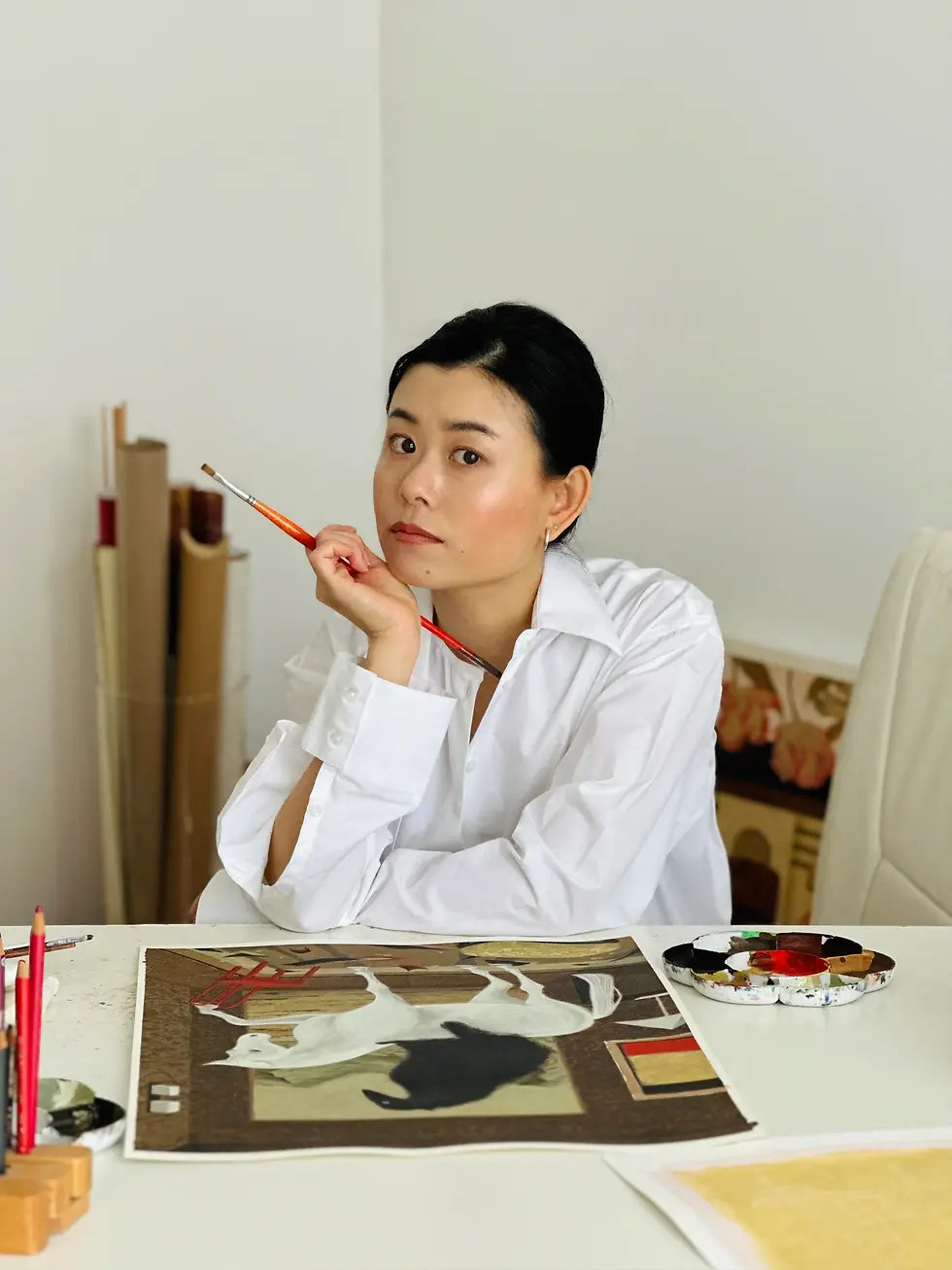
Shawn Marshall
Shawn Marshall creates layered, mixed media works that reflect on memory, architecture, and personal experience. With a background in architecture, she brings a spatial sensibility to her compositions, often drawing from religious and institutional settings. Her work explores what it means to occupy space—physically and emotionally—especially as a woman in environments shaped by power and tradition. Using collage and paint, she builds structures that feel both precise and unsettled, allowing presence, absence, and tension to exist side by side.

Q: What first draws you to a structure—its history, its shape, or something else entirely?
A: I’m drawn to structures not just for how they’re built or what they look like, but also for what they hold emotionally, historically, and symbolically. Sometimes it’s the geometry or repetition that catches my eye, but more often it’s a sense of residue it carries—traces of human presence, abandonment, or embedded memories. Spaces marked by shifting light and shadow hold my attention because they suggest moments in time, stories, silences, and the unknown. Further, I’m interested in how religious spaces carry authority or sacredness and how we internalize that information. I work to reframe what spaces are considered “sacred.” For example, by replacing a cathedral ceiling with open sky, I suggest that sacredness isn’t confined to built structures; that the sky itself can hold that same reverence.
Q: Your work often holds tension between stillness and transformation. Where does that tension come from for you?
A: That tension mirrors the spaces and experiences I’ve moved through in life. My memories of architectural and religious spaces are layered with tension—they were places where I often felt overlooked or out of place. Attending architecture school in Kentucky in the late 1980s meant being one of only a few women in the program, and that sense of being on the margins continued as I went on to work in the field for nearly two decades. Despite designing spaces, I often felt peripheral to the environments I helped create—present, but not fully acknowledged or accepted. Growing up in a strict religious family carried similar undercurrents—I was present, but always aware of the limits placed on me. That friction between presence and marginalization continues to echo through my work.


Q: How does your background in architecture shape the way you think about emotional space?
A: Architecture taught me to think spatially, to consider how bodies move through, inhabit, and respond to space, light, and form. I naturally think about how the viewer will “move through” the space in my collages as I am assembling them. My training in architecture also informs the way I approach composition. I think in terms of structure, rhythm, and spatial relationships—how forms balance or disrupt one another, how negative space carries weight. That architectural mindset helps me create visual tension and cohesion, even in abstract or fragmentary arrangements. Over time, I have become even more interested in what can’t be measured—emotional residue, comfort, discomfort, silence, presence, and absence. I’m not trying to recreate architecture, but to evoke an emotional state of being using elements of architecture and light.
Shadows, walls, thresholds, stairs, doors and windows, etc. become metaphors for inner experience and potential transformation.
Q: What changes when you introduce feminine figures into institutional or sacred spaces?
A: It shifts the energy. Many of these spaces—churches, schools, government buildings—were historically shaped by and for male authority. By placing feminine figures there, I’m quietly questioning that legacy. It’s not about confrontation as much as presence. Sometimes the figure is small, even ghostlike, but her visibility alters the structure, suggests a rewriting of the narrative, or a reclaiming of space. Their presence also serves as a reminder of how often women’s visibility remains contested—especially in the context of the current political climate.

Q: Do you see collage as a way to reframe memory—or to rebuild it?
A: Both. Collage allows me to sift through fragments—personal, architectural, cultural—and decide what to preserve, what to obscure, and what to imagine. It’s a way of reconstructing memory with intentional gaps. I’m not aiming for a complete picture, but for a layered impression that feels emotionally honest. I think of each collage as a still—a cinematic freeze-frame that captures a fleeting emotional truth. Each piece holds the potential to suspend time, inviting a brief pause between the tension of what’s visible and what’s withheld.
Q: How do you know when a piece has reached the right balance between control and openness?
A: It’s intuitive. I know I’ve gone too far when the piece feels overworked, too neat, or the space is too filled. I want the viewer to feel like they’re peeking into something in flux, where not everything is explained. Over time I’ve learned to stop when something feels slightly unresolved.
That openness is what lets the works have multiple meanings. I also intentionally leave certain mistakes or imperfections—tears, misalignments, uneven edges—because they add texture and speak to the handmade nature of the work. These flaws are reminders that the piece wasn’t generated or manipulated digitally; it was assembled thoughtfully and slowly, by hand, through trial and error.
Those remnants of process create a kind of honesty that’s just as important as the composition itself.