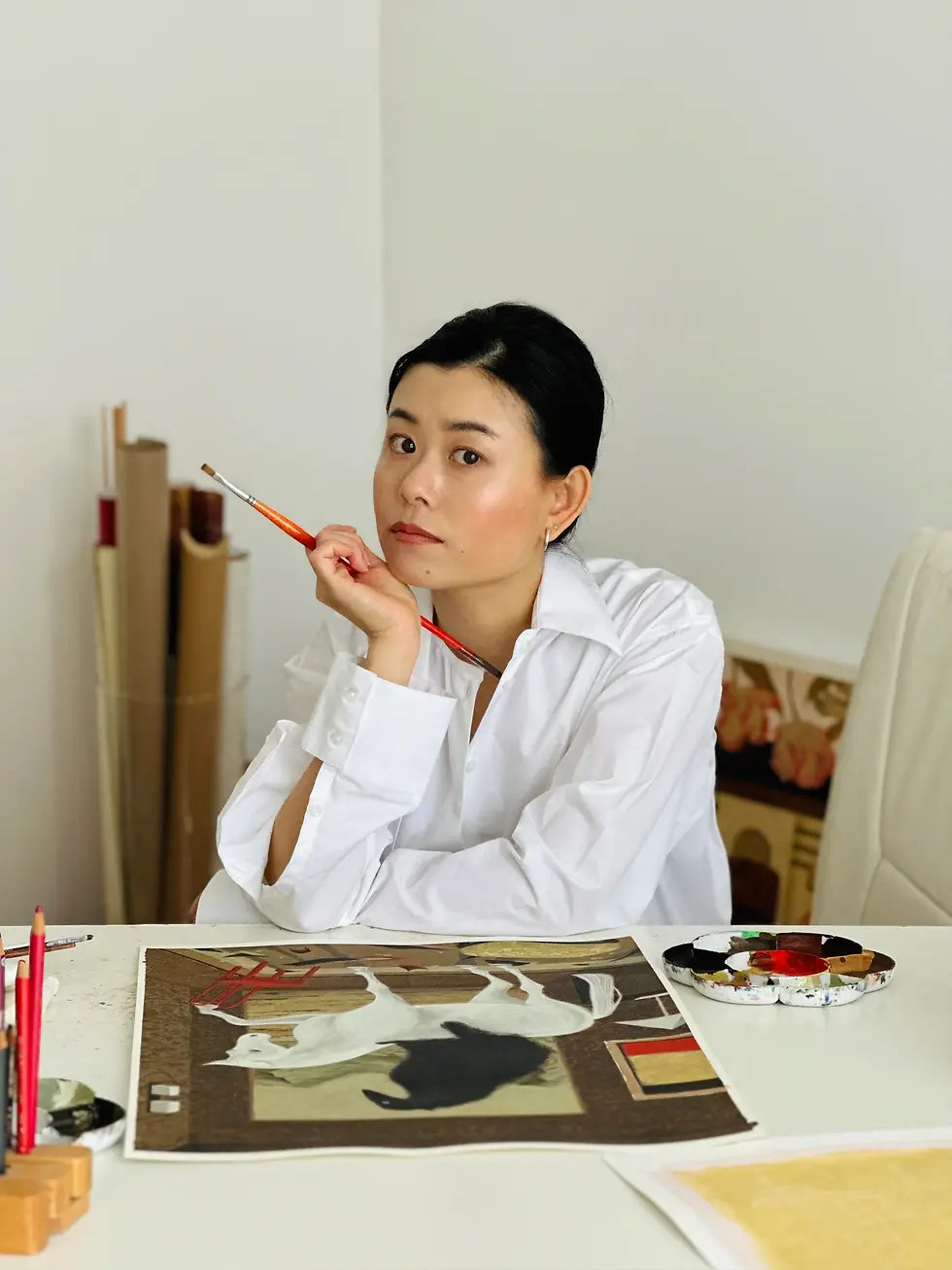
Sarah Delaney
Sarah Delaney is a Vancouver-based artist working with painting, textile collage, and installation. She studied at the University of Victoria and the Vancouver College of Art and Design, and has shown work across North America, including the Toronto Art Fair and Art on Paper in New York. Her pieces are built through layering pigment and fabric, using hand-made marks and repeated reworking, with a clear focus on material and surface.

Q: What early experiences from growing up in Kenora feel most present in your work today?
A: Growing up, I always felt a strong connection to the past. In a small town where change comes slowly, buildings from my parents’ childhood still stand and spark stories about local landmarks. I learned where my grandparents were born, studied, and worked. I felt connected to those who came before me, who gave historical context to the place — imagining the old oak trees had been planted by Anishinaabe or Métis peoples, and the fields on the outskirts of town farmed by Swedish settlers. I have always been conscious that I am one present-day branch on a very old family tree.
Exploration and adventure are at the core of both my memories and my work. Kenora, set in the boreal forest among hundreds of freshwater lakes, was an endless playground for outdoor discovery. I remember hours spent in the sandbox, assembling Lego worlds, building forts in an old spruce, and writing and illustrating my own stories.
As a child, I invented mysterious, nonsensical worlds only accessible through that particular innocence, and I dreamed on a scale larger than the Earth. As far back as I can recall, I have been trying to make sense of the world—examining details like comparing the southern sun’s angle between summer and winter, or the changing water lines left on the granite rock, or tracing the V-shaped formations of migrating geese.
In my practice, I emphasize shifting perspectives—both in the places I explore and in the studio through the mark-making techniques I employ.

Q: Your paintings begin with fluid washes that follow the natural slopes and folds of the canvas. What draws you to let the material lead the first movements?
A: I move between the conscious and the unconscious, letting curiosity steer the process. There is a direct link between unconscious thought prompting immediate action. I am guided by the material and how it reveals itself on the canvas.
Generally, I’m not precious about the first marks; I am more concerned about what follows. Working in the moment, I use paint and mark-making, each gesture registering a connection and a departure. These small reactions accumulate into a map, with paths of my process, and in turn form a visual narrative.

Q: You often work with traces of time. How do you know when a painting has gathered enough of this history?
A: As I layer responses to earlier gestures across the canvas, I’m continually problem-solving—overpainting, stitching, and collaging to address what unsettles me. Time is woven into the very fabric of construction: through deliberate assembly, repetition, and process, the paintings become vessels of memory, until finally there is nothing left to “fix.”

Q: Layered additions like crayon, pastel, and embroidery extend the surface. What guides your choice of which material to bring into a piece?
A: While researching time, I realized how deftly writers manipulate its flow: a single moment can fill a chapter, or an entire sequence can unfold in a single sentence. I aim to translate that same compression and expansion into painting.
I select media for their particular properties and ask them to record their own histories, each material serving as a marker of time. Layered crayon, pastel, and embroidery counterpoint pools of pigmented water, their textures and tempos set against one another. Paint requires long, slow time to dry and cure, while handheld media respond almost instantly; fast time is evident in the brief and tangible interval between thought, gesture, and mark.
Q: How does your sense of internal time influence the way a painting unfolds?
A: Time, in my work, is not measured in spatial units or linear progression. Instead, it is durational, and unfolds as an internal rhythm, which is mutable, qualitative, and felt—reflecting the irregular rhythms of life.
The power of persistent memory and its ability to evolve and exist beyond itself. In the process of creating these paintings, time is marked by the drying of paint, unpredictable and dependent on the heat of the day. With no predetermined path and open to uncertain conditions, a puddle of watery paint pigment is encouraged to take form upon the slanted studio floor in which it lies. My methodology is instinctual, and the trajectory of each work is influenced by environmental effects. It invites time as a medium and glorifies slow, everyday action. And yet, it is also informed by (muscle) memory and the (learned) intuition of an artist trained in her practice. In duration, the past influences the present, not as a static state of affairs, but as dynamic processes.
The paintings are built of many layers. The gestural markings, overlapping shapes, transparent layers of shades of white, and thick textures in my paintings become a portal into the sequential stages of their development. The viewer’s participation allows the paintings to exist into the present. Like a story, you can read the journey the painting has taken. This highlights the liminal spaces and interstices between moments, while hinting at our unfixed position in temporal space. Time is identified as being in flux.
While examining traces of the past, it is clear that they too are impermanent and evolving.

Q: What questions feel most present in your practice right now?
A: How can I deepen my practice to forge a stronger connection between my work and the land?
In what ways can I extend my art to engage more directly with landscape, ecology, and place?
What methods, materials, or site-based strategies could I use to make my practice more rooted in place?
How can I adapt my process to respond to particular sites, soils, climates, and local ecologies?
How can I involve local communities and land-based knowledge to deepen my art’s relationship with place?
How can I cultivate space for quiet reflection and presence?
How can I more fully investigate fleeting impermanence and shifting perception? How do we witness? How do we perceive?