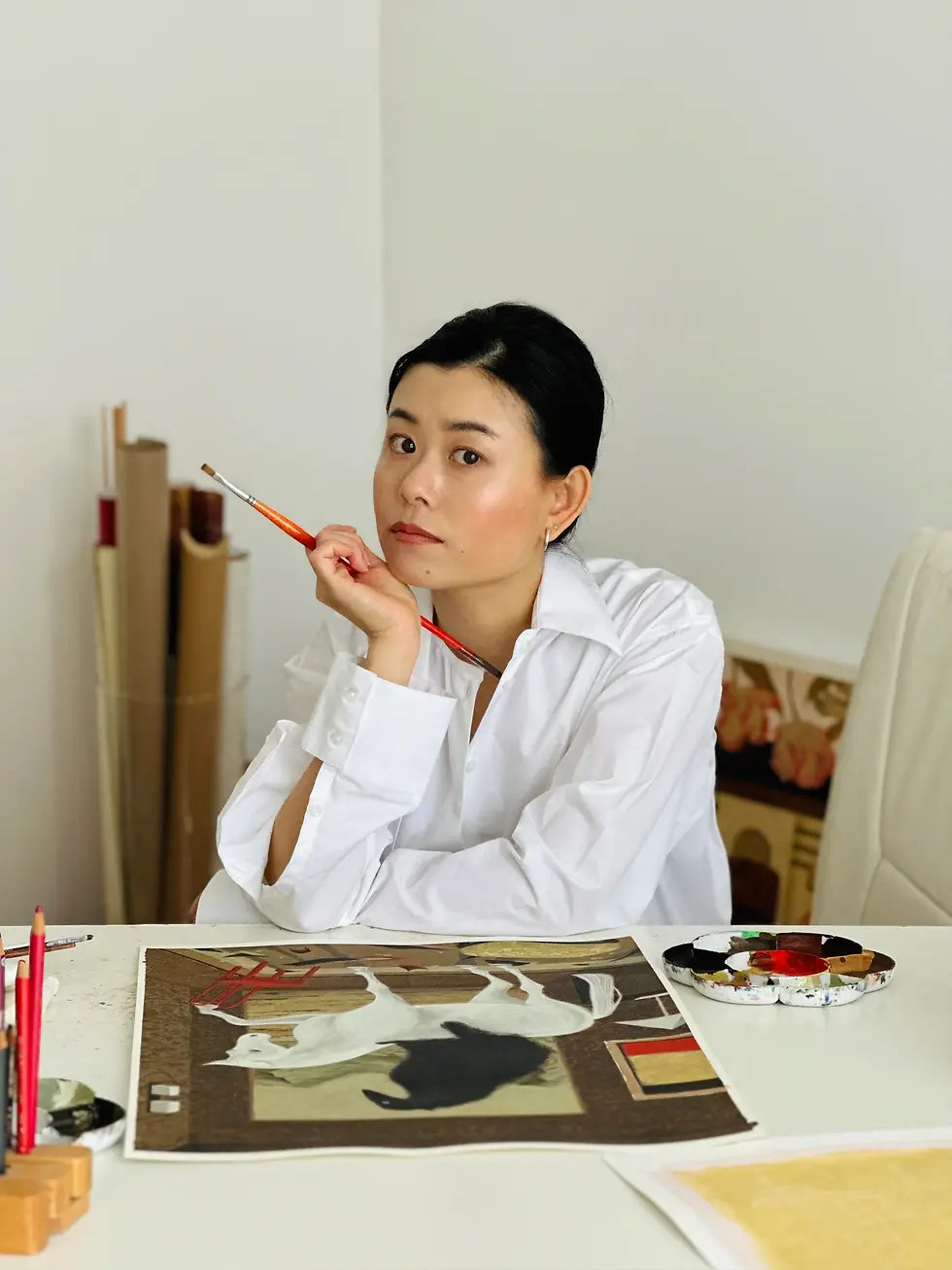
Ruben Orgye
Ruben Orgye is a painter born and based in Barcelona. He studied at La Llotja and also runs a business alongside his practice. He paints faces as masks, not portraits. In The Embrace he left the mouths out entirely. He works in acrylic and oil, sometimes both on the same canvas, acrylic when he needs speed and oil when he needs density. His recent work Onna Oni comes from Japanese mythology.

Q: You studied at La Llotja and also run a business. How do art and entrepreneurship coexist for you?
A: For me, art and entrepreneurship coexist as two complementary ways of creating and sustaining a body of work. Running a business has taught me discipline, structure, resilience, and long-term vision; painting is where those tools are redirected toward a more personal and symbolic language. I do not experience them as a contradiction, but as two different rhythms that inform each other.
Entrepreneurship helps me understand how to build projects over time, while art keeps me connected to intuition, depth, and emotional truth. In that sense, one strengthens the framework and the other gives it meaning.

Q: The mask keeps appearing in your work as a metaphor for the ego. When did that become your subject?
A: The mask became central in my work when I began reflecting more deeply on the ego, the false self, and the way identity is shaped by the need to be accepted, desired, or validated. It was not an immediate decision, but something that emerged gradually through painting and through personal observation.
After going through periods of intense anxiety, I became more aware of how much of ourselves is performed, protected, or edited for the outside world. Since then, the face stopped functioning as a portrait for me and became a psychological surface: a place where vulnerability, defense, and social construction all meet. The mask, in that sense, is not only concealment; it is also the structure through which we try to survive emotionally and socially.
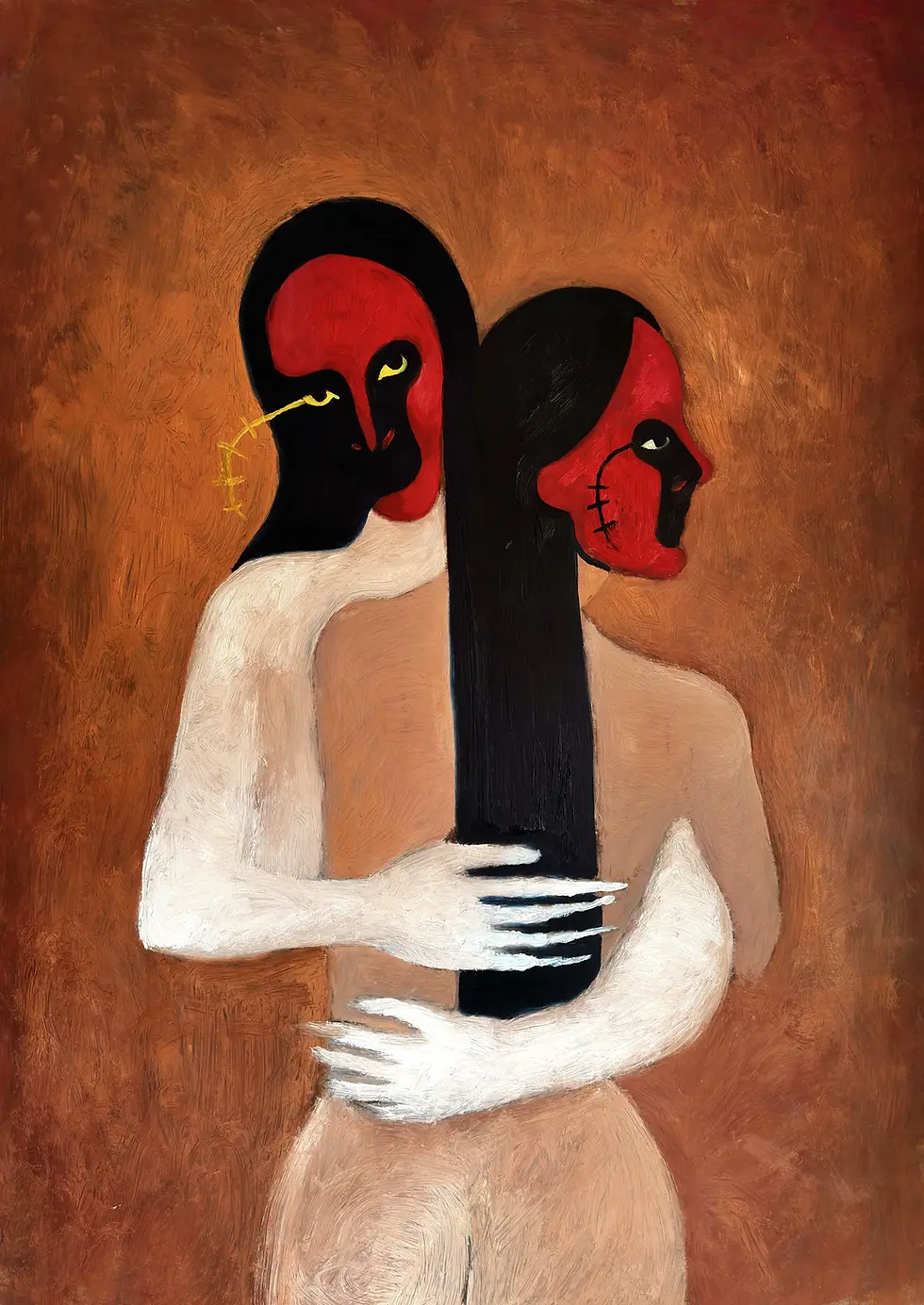
Q: In The Embrace, you deliberately leave out the mouths. Everything goes through the eyes. Why remove that part of the face?
A: In The Embrace, removing the mouths was a deliberate way of shifting all expressive weight toward the eyes. The mouth is one of the most direct elements of communication, so by omitting it, the image becomes less descriptive and more tense. I was interested in creating a space where tenderness, vulnerability, and ambiguity could coexist without being explained too clearly. In that painting, the eyes hold everything: intimacy, protection, uncertainty, and the pressure of being seen. The absence of the mouth also reinforces the idea of the mask, where something essential is withheld and expression becomes more psychological than narrative. What is not shown becomes as important as what is visible.
Q: You use acrylic for urgency and oil for density, sometimes in the same painting. Is that a rule, or does it depend?
A: It depends entirely on what the work asks for. Acrylic gives me speed, immediacy, and a more instinctive energy, while oil allows for density, depth, and a slower psychological construction of the image. Sometimes I use them separately, and sometimes I let both coexist within the same painting if that tension between urgency and density is necessary. It is not a fixed rule but a material decision linked to the emotional structure of each piece. I am interested in how the medium itself can embody conflict: what is fast and exposed versus what is layered, resistant, and more inward. The materiality is never secondary for me; it is part of the meaning.
Q: Onna Oni brings in something from Japanese mythology. What's the connection to the rest of your work?
A: Onna Oni connects naturally with the rest of my practice because it expands my ongoing interest in masks, identity, and emotional tension through another symbolic tradition.
I have long been drawn to Japanese mythology, as well as to Japanese culture and art, for the way they hold beauty, ritual, force, and psychological depth within highly charged forms. In this work, the female demon is not simply a mythological reference, but a figure through which seduction, power, concealment, and inner fracture can coexist. It also opens a possible future direction for my work: a deeper exploration of masks within Japanese history and visual culture, reinterpreted through my own language and artistic sensibility. In that sense, Onna Oni is fully connected to my practice, but it may also be the beginning of a new series.

Q: You had a solo in Barcelona and showed in Paris in 2023. What's coming next?
A: What comes next is a decisive stage of consolidation. I am continuing to develop The Gaze while moving the work toward a more singular and recognizable language. At the same time, I am beginning an exciting new chapter with the representation of a new contemporary art gallery in Barcelona, alongside some of the best international artists, which gives the work a stronger structure and a more ambitious context for growth. From there, the natural next step is international projection, and it is very possible that this process will lead me to participate in fairs such as Art Basel Hong Kong in 2027. So what comes next is not only more visibility, but clearer positioning, a stronger body of work, and a more defined international presence.