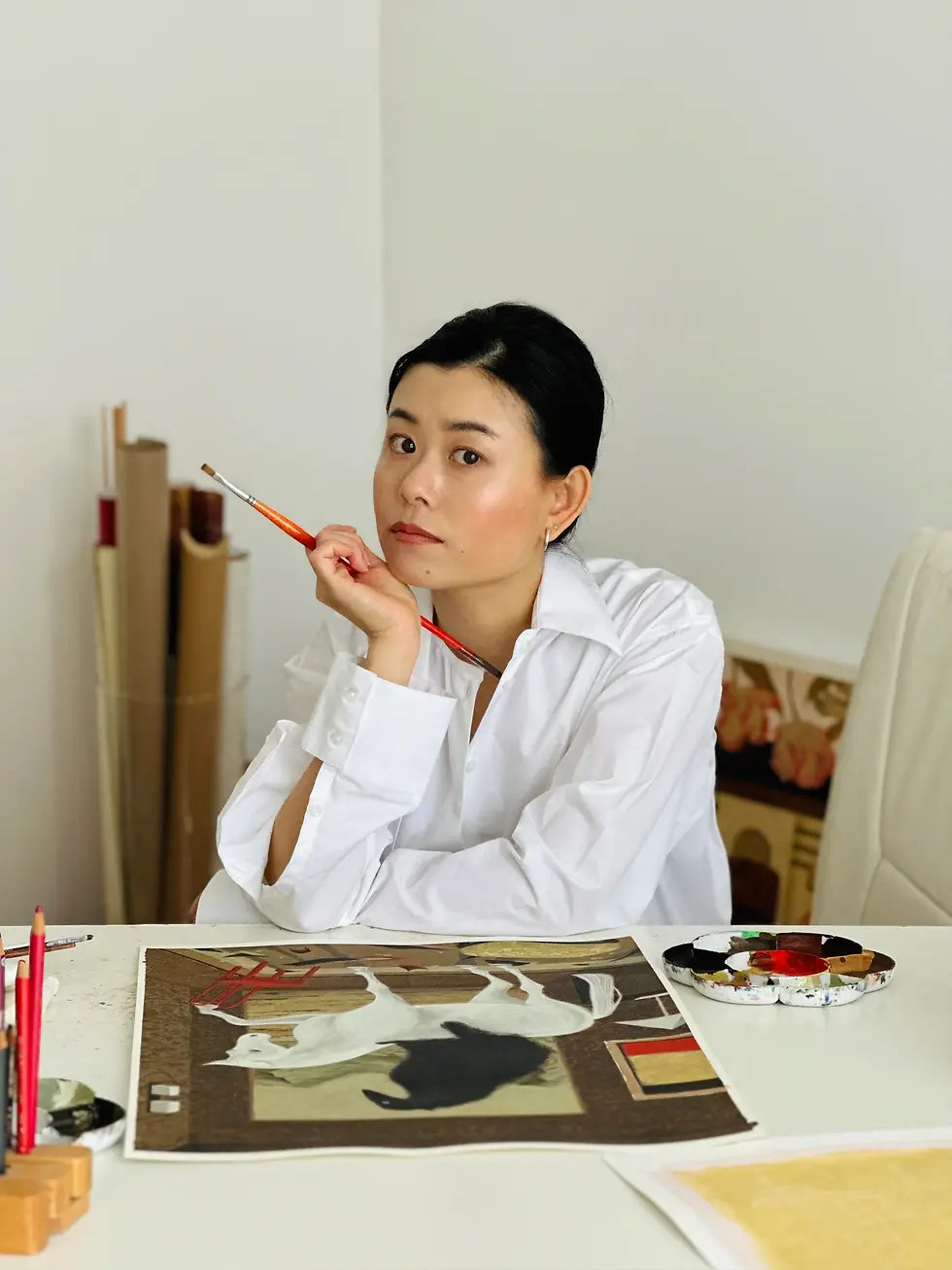
Phillip Staffa
Phillip Staffa works across sculpture, sound, and installation, often using simple, everyday objects as his starting point. In works like "Candies," he enlarges small sweets into monumental forms, bringing attention to details that might otherwise be overlooked. In "Dropped Cones," he captures the moment of an accident, freezing it as a reflection on loss and hope. Humor runs through his practice, opening a space where fragility and memory can be felt in unexpected ways. Experimenting with materials is central to his approach, and collaboration plays an important role too, allowing ideas to grow through shared projects and collective work.


Q: In "Candies" you turn something small and sweet into something monumental. What drew you to that shift in scale?
A: I love the "Candies" for their veiling—the promise, the secret they keep, yet how attractive they appear. And the pure joy they radiate. I wanted to shift these innocent symbols into a scale that could resemble an animal, something alive. The larger scale accentuates and magnifies every fold and twist of the wrapping, allowing you to immerse yourself in the details. I have been obsessed with Christo and Jean-Claude for a long time, their fascination with wrapping might have led me there. Also, this shift in scale transforms something small and innocent into the sculpture it always was. Often overlooked despite its unique shape, we might have never seen it that way.
I have always been fascinated by such forms—like candies or ice cream cones—that everyone has a personal connection to. They are everyday designs, contemporary totems, that, over time, have grown into part of our collective consciousness.


Q: "Dropped Cones" freezes a fleeting accident. Why did you want to give permanence to something usually forgotten?
A: Because it freezes the moment of loss. This very instant you topple, fall, when everything slips away from you. This moment contains something deeply human to me: mourning, drama, a new beginning, hope, and the possibility of change. It is a moment you usually would hide rather than highlight. But I realized I find so much humanity in that. I am fascinated by discarded and dropped objects. I actually browse the streets in Berlin for them. They tell stories. I had messy-like hoarding phases already when I was a kid.
Q: Humor and absurdity run through your work. How do they connect with fragility and loss?
A: As hinted above, I was quite an anxious child. I hoarded things I loved because I couldn’t bear to let them go. I was heavily overweight and felt outsiderish, luckily discovering art and music as a way of being and expressing myself. I drew obsessively and played the guitar. Later I studied and worked too hard for my dreams, often driving myself into overwork and frustration. In many ways, I was an absolute late bloomer when it comes to lightness and joy.
Only in the past few years I realized how much I need them, how much I always loved and longed for them beneath everything else. A moment of pure humor or absurdity is, for me, an encounter that releases tension. It’s universal, connective. It utterly makes you smile, provokes an immediate reaction, and reveals fragility and loss not as heavy burdens, but as parts of being human.

Q: You move between sound, sculpture, and installation. What changes most for you when shifting medium?
A: Often I am surprised myself how closely sound and sculpture work together. Over time I realize I am less interested in how they do it than in what they do.
I love learning and experimenting, and I deeply love materials. Music and sound also have the qualities of a material for me—harmonic structures, melodies, rhythms. It’s all malleable. I look for the magic moments within them, not the medium itself.
This interconnectedness is something I am still discovering. I often have ideas and visions in different mediums, also mediums I am not already an expert in—and I imagine it will continue like this for the rest of my life. My hope is to develop a vocabulary that is not tied to a single medium, but a language that can express itself in many ways and forms but still be recognized as mine.
Q: Everyday objects often slip into the extraordinary in your practice. How do you know when you’ve found the right object to work with?
A: It’s a feeling I get. A feeling of excitement beyond reasoning, an excitement that is there for itself. I then partake in that excitement and become a recipient myself. That’s when I know I should follow it. I guess it’s more about getting myself out of the way in a moment of wonder, as to me it happens in the most unexpected situations. But only if I am tuning in to that, if I manage to stay receptive.
Then the object, the symbol, the thought, the idea or whatever it is can suddenly transform into something else, slowly beginning to manifest itself.
I manically take notes of everything that strikes me, and keep collecting things to this day. Still, I can’t predict when or where the magic will happen next.
Q: Collaboration seems central to your projects, from MONAS Collective to joint sound works. What does working with others give to your process that you can’t reach alone?
A: Simply put, I’ve learned that my own ideas are never the end of the line. There are always angles I would miss if I only worked alone. My collaborators challenge me and my beliefs—especially the things I take as fixed or unquestionable for any reason—and in the end I realize how much my horizon has expanded.
Working with my band HOPE for fifteen years taught me to trust and be part of other people’s creativity, their tempos, their ways of thinking, feeling. To hear their thoughts and ideas. They are often very different from my own, and that difference is a gift. To see ideas spun further and answered by others, and to then create something together that I could never have imagined alone is magic on a different level. Each idea grows out of an individual process, but the exchange and communion between them feels essential to me. It is how becoming happens.