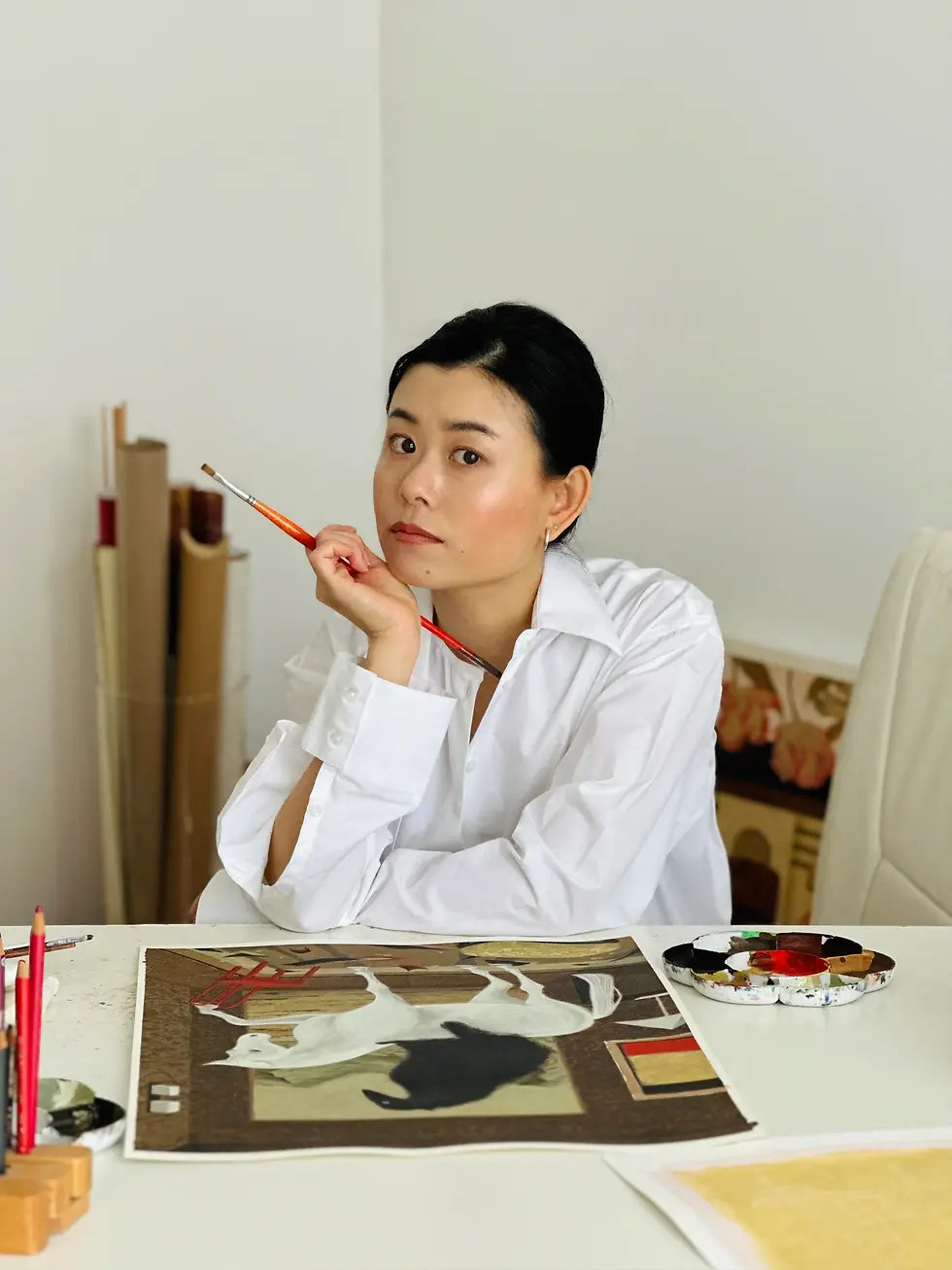
Olga Burkard
Olga Burkard is a Swiss–Mexican artist based in Geneva who works with drawing, painting, and digital tools. She builds her images from very simple elements like lines and dots, repeating and layering them until they form dense, organic structures. In the studio, she moves between a screen and a table with paint, adding texture and small irregularities by hand. A personal loss first led her to look closely at natural patterns, and that focus still shapes how she thinks about growth, connection, and order in living systems.

Q: What first made you start looking closely at natural patterns and living systems?
A: It began with a deep fascination for life itself. After experiencing a personal loss, my world shifted into an urgent quest to understand and celebrate life in all its forms. Art became the space where I could visualize that feeling — where looking closely at living systems, their rhythms and patterns, helped me reconnect with the beauty, fragility, and persistence of life.
Q: You begin with very simple elements like lines and dots. How do these grow into full images for you?
A: I’ve always been amazed that organic forms often emerge from very simple building blocks. A dot and a line — not so different from the binary code of 0 and 1 — can, through repetition and transformation, begin to feel alive. I repeat, distort, and overlap these basic elements until they grow into forms that evoke something organic, something that breathes. It’s a slow, patient evolution, much like nature itself.

Q: You work with both digital tools and paint. How do you move between the two while making a piece?
A: In my studio I have two tables: the “dry lab” for digital work, and the “wet lab” for paint. I move back and forth between them intuitively. The digital side gives me precision and structure, while the painted layers add tactility, gesture, and imperfection. They may seem like opposites, but together they create an ecosystem — a reflection of our own daily reality, where the digital and physical coexist and shape one another.

Q: Repetition is a big part of your process. What does repeating a form give you visually?
A: Repetition is inherent to nature. You see it in a leaf, and again in a forest; in microscopic arrangements and in large-scale structures. Repeating a form allows me to depict that continuity across scales, to echo how life organizes itself. Visually, repetition becomes a bridge between the microscopic and the expansive — between what we can barely see and what surrounds us completely.

Q: Your work balances structure and intuition. How do you decide which to follow while you’re making a piece?
A: It’s rarely a conscious decision. One form calls for the next, and I follow. It’s an iterative, almost conversational process where I’m guided by the image as it grows. Interestingly, the digital parts often evolve into more organic shapes, while the painted sections tend to become more geometric — the opposite of what one might expect.
This duality keeps appearing in my work: opposites complementing each other, coexisting rather than competing. It mirrors the idea of an ecosystem — everything connected, nothing isolated.
Q: After “Living Systems,” what are you working toward next?
A: For now, “Living Systems” is still expanding. It’s becoming richer and more complex, with the digital and painted worlds intertwining more deeply. My celebration of life will continue to be present in everything I create. I haven’t clearly defined what comes after, but today I imagine moving into other techniques within the same conceptual universe — perhaps an interactive digital world or a full immersive installation. These are dreams for the future, but they grow from the same root: exploring the systems that shape life and our place within them.