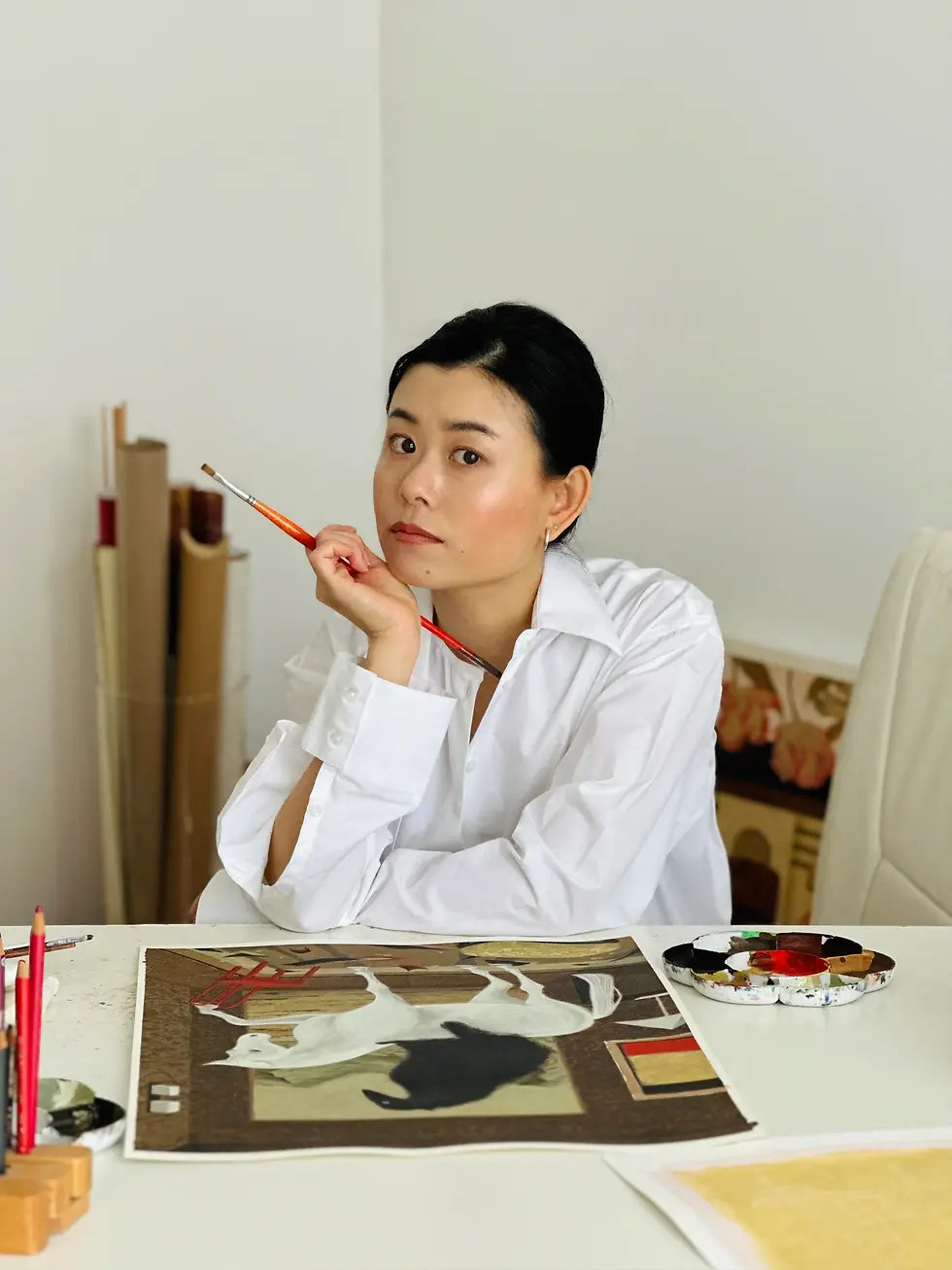
Olesya Gonserovskaya
Olesya Gonserovskaya is an interdisciplinary artist working across installation, video, drawing, and performance. Her practice is shaped by an interest in ecology, social care, and the symbolic language of materials. She often works with organic and low-tech elements like compost, solar energy, or thread, allowing them to act as active collaborators in her projects. Her work revisits outdated systems, rituals, and visual codes, asking what they still mean today. Based between Georgia and Armenia in recent years, she has been reflecting on ancient alphabets, oral histories, and the early functions of language. Whether through public interventions, embroidered documents, or mirrored signals aimed into space, her projects trace the quiet but persistent influence of forgotten or overlooked forms.


Q: You call some of your materials “sensitive matter” — ink, plants, compost, even solar energy. What draws you to substances that seem to have a life of their own?
A: For me, it’s the greatest phenomenon: life. Nothing has ever revealed even the smallest clue to answer “why?”, “what for?” or “what comes next?” I’m also mesmerized by complex systems made of many interacting agents whose behaviour is unpredictable.

Q: In "Peace Signal" you literally sent sunlight into space using mirrors and Braille. What made you want to turn a gesture like that into art?
A: There were several reasons I made "Peace Signal." One was despair at the growing number of wars in the world. I believe in free will (even though Dr. Robert Sapolsky takes a different view), and I was thinking about its dark side: choosing to break the rules or corrupt the game. That choice may benefit the offender, but it harms everyone else. What struck me was how careful humanity can be about calculating the exact travel time for a light signal to an allegedly inhabited planet, while the time it takes us to reach real consensus on Earth feels like an eternity. Turning the gesture into art let me make that contrast visible: a small, absurd act of hope sent out into vast space, and a way to point attention back to our failures and possibilities here at home.
Q: Living between Georgia and Armenia, you’ve been surrounded by ancient alphabets. How has being close to these languages shifted the way you think about symbols and meaning?
A: It was, and still is, a mystery: how, long ago, someone decided that a particular mark should stand for a specific sound or meaning. Thinking about that made me realise that the process is ongoing; a language can never be completely “finished.”
If it were, it would be dead. I often find myself contemplating what language really is. It’s not only the words we speak or write; it also includes the little signs around us, such as the symbols on appliances, public icons, and labels. Once, I saw the inscription “I fell” on an air-conditioner remote, and it made me shiver for a moment: Who is speaking? Who is feeling? What is being felt? Small, accidental inscriptions like that make the boundary between symbol and voice feel very thin.
Q: In "Lifespan Report, Embroidered" you turned personal documents into textile. How does making something so private public change its weight for you?
A: I’ve always been (and still am) a shy, even reticent person. Over the years I began to ask myself why I keep returning to the same personal patterns in my life and work. In "Lifespan Report, Embroidered" I tried the opposite approach: instead of protecting private documents, I transformed them into a public textile to see how visibility re-contextualizes intimate data and redistributes its social meaning.
I wanted to test how culture shapes what we consider private. In many Western—and especially Eastern—contexts, sexuality and health are treated as strictly personal, not to be discussed openly. Yet everyone has a body and personal relationships; making those intimate records visible exposes the social choreography behind secrecy.
Maybe people preserve privacy precisely to have something to hide and to cherish only with a selected group. Turning private documents into public fabric changes the weight of those records for me: it strips away some of their secrecy, but it also enlarges their meaning by placing them in a shared, visible field.
Lifespan Report Embroidered 1,2,3 - Mesh, thread, 2025
Q: Your work often questions what is useful or outdated. When do you feel art itself becomes useful?
A: I enjoy finding something forgotten and dusted off that still could carry meaning. For me, deciding when art becomes useful is an ongoing, personal negotiation: I judge art’s usefulness by its capacity to provoke thought or action in a given moment. Context matters: what’s useful today may be irrelevant tomorrow. I use a few practical criteria when I assess social value: whether the topic is part of a current public controversy, or whether it has been unjustly forgotten or censored; whether the work provokes conversation, offers new perspectives, or helps people act differently. But beyond those practical checks, I also believe usefulness is a slippery concept: in the long run there may be no clear “advantage” or “disadvantage.” We are all travelers through time and space with little sense of the journey’s beginning or destiny, so the ultimate effects of art are often unknowable.
Q: Projects like "Root Directory" and "Vanished Words" deal with memory and loss in language. Do you see these works more as excavation or as invention?
A: I see them as both excavation and invention. My approach is more amateur and emotion-driven than strictly academic. I don’t pretend to conduct highly rigorous investigations, and I’m fine with that because different kinds of reflection are valuable. Those informal excavations of lost words and usages often become fertile ground for invention. For example, they inspired me to develop my own pictogram/emoji alphabet.