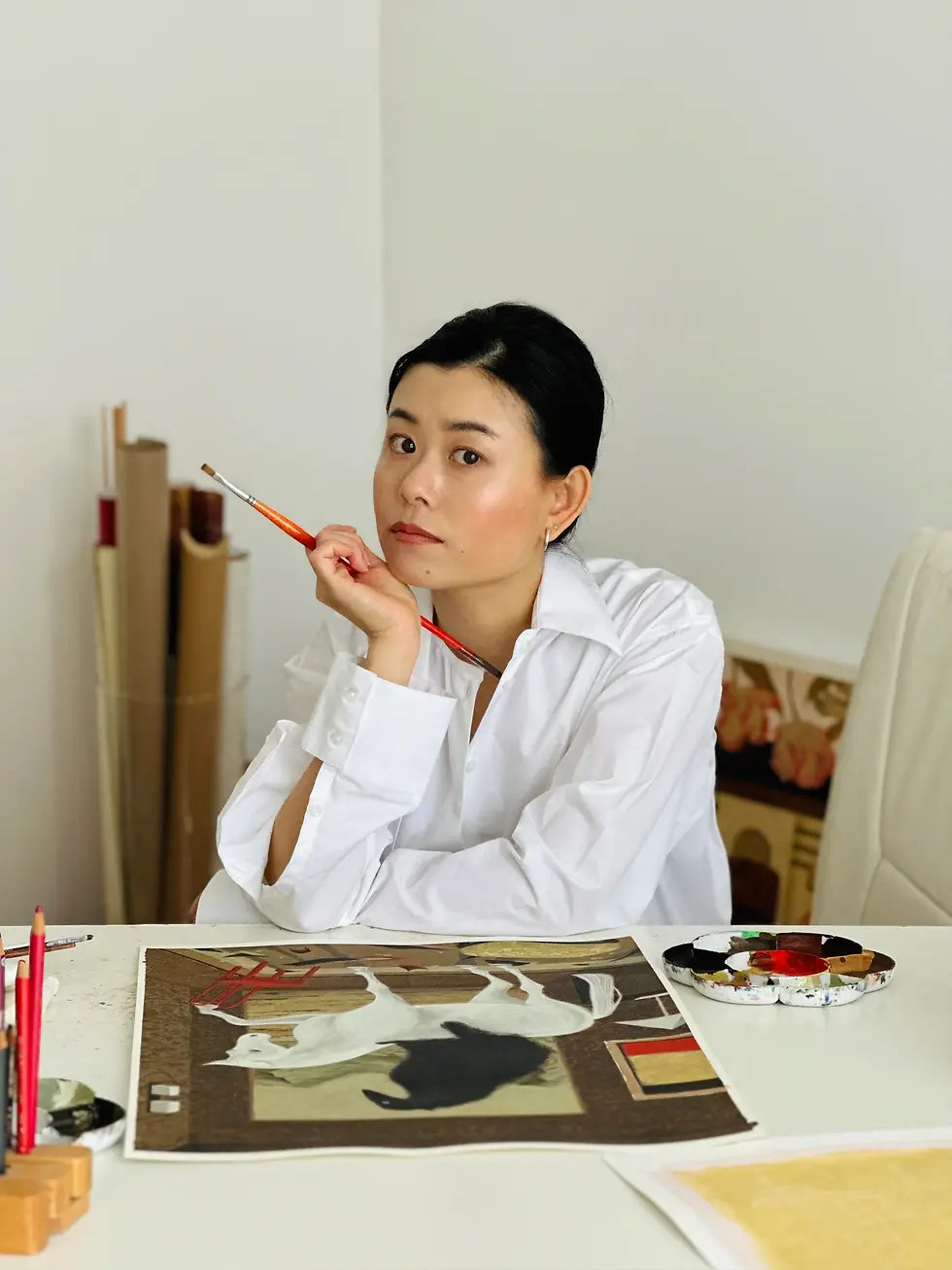
Nuno Alexandre
Nuno Alexandre is a painter and architect based in Sintra, near Lisbon. He usually begins in notebooks, writing and sketching before moving to canvas. The places he has lived in or passed through often stay with him, from gardens and courtyards to quiet landscapes and everyday buildings. Music is usually playing in the studio while he works, and these notes, memories, and surroundings slowly find their way into the paintings.

Q: What kind of places stay with you long after you’ve left them?
A: The places that linger in my mind after I have left them are those that evoke a sense of nostalgia or hold a special connection for me. I often associate certain locations with memorable experiences, whether positive or negative. Even now, there are particular spots that stir a sense of melancholy because they played a pivotal role in my life, especially during my adolescence. Adolescence is a significant period of change, filled with intense emotions, feelings, and thoughts. We often perceive it as an endless phase, living each moment to the fullest. There are places I wish to share and explore with my daughter, wanting her to understand their importance to me. These places provide comfort during both the happiest and saddest times. I have realized that I often channel the emotions tied to these places into my notes, drawings, or paintings. I find it impossible to separate them from my memory, especially landscapes such as untamed beaches, rural areas, exotic locales, mountains, and romantic, picturesque scenes. Such places have left a profound impression on me. There is always an inexplicable mystery about them, yet I can incorporate them into my work and imbue them with personal significance.
Q: How do memory and daily life find their way into a piece as you work?
A: It is impossible for me to separate my memory from my daily life. The in-betweens are very important and relevant to my work. It is the “between the various situations of everyday life” that I use and that make their way into my pieces. In general, life provides us with agendas and timelines: waking up, showering, eating breakfast, working, eating lunch, working, eating snacks, working, spending time with family, eating dinner, resting, and sleeping. The in-betweens—the promenades, the time spent running for the bus, car, or train, waiting for a doctor’s appointment, driving to see a friend or family member, those specific moments in specific spaces between tasks—are what I focus on. I started a long time ago to stop paying attention to my smartphone and instead pay attention to what is happening around me.
While everyone is scrolling, I observe sounds, people, and their actions, and sometimes this translates into strong subjects or themes. Artistically, this has led me down a different path. I used to focus on everyday themes through quick sketches, drawing objects around the house and distorting them, but over time I began to use daily life differently—exploring new paths and aesthetics, developing new landscapes, places, and universes with more time and patience. I now use memory and daily life not to practice or produce specific paintings, but to introduce myself to new ways of painting and to better understand what I want from painting and drawing.

Q: What do your notebooks and early sketches help you test before moving onto canvas?
A: My notebooks hold a special place in my life, offering support during challenging phases of work. Writing is essential for organizing my thoughts, emotions, feelings, and ideas. It serves as a way to confront both myself and my work. I often reflect on past activities, evaluate their significance, and consider my current plans. Writing sometimes acts like sketching, but in a unique manner. I explore topics such as art, the experience of painting, its meaning and purpose, my connection to art history, and occasionally poetry. Sketches usually come after writing, but I have realized that writing has become more crucial for transitioning to the canvas than sketching. It helps me reflect on my artistic state, decide what to pursue, and channel ideas onto the canvas. My notebooks and sketches are tools for self-testing, challenging myself, and overcoming the intimidation of blank pages or blank canvases.
Q: How do you work with the balance between apparent chaos and inner order while a piece is forming?
A: I am uncertain if I can claim there is an inherent order when I paint.
There is definitely chaos, which feels unavoidable. Chaos helps me arrange and rearrange my workspace, the canvas itself. Finding the right balance between order and chaos can be challenging.
Perhaps every painting begins with chaos, especially in my mind, and then I start to organize and make sense of it. Often, my thoughts and ideas are as unclear as a foggy autumn morning by the lake—that is how I define my chaos. There are times when I never see the sun, and that is all right. There are also moments when I embrace these vague ideas and begin working with them. Somehow, something starts to take shape, emerge, appear, and grow, and that is when I know I am working with the right balance.
Even when things seem orderly, chaos can unexpectedly arise. Working between these two states is unstable, but in my opinion, and speaking for myself, it is inevitable. They are both part of the process. One does not survive without the other.

Q: When you use photography as a reference, what role does it play compared to memory and imagination?
A: Photography is crucial when I aim to capture a moment or object that I consider significant for a specific project, painting, or drawing. Often, I am unsure of what will unfold, but when I have a clear concept and want to include certain objects or landscapes, I rely on photography to capture their essence, mood, or form. Unlike memory or imagination, which can sometimes be misleading, photographs provide clarity. We might remember something as blue, purple, or yellowish, when it may actually be whiter, redder, smaller, or taller than we recall. Photography allows me to cross-check memory and imagination while painting or drawing. Occasionally, I revisit old photographs to inform new paintings, aiming to capture a specific moment, memory, place, or emotion that I feel is important to include.

Q: What do you find yourself returning to most within landscape and architecture right now?
A: At the moment, landscape represents a pivotal focus for me. Certain events in my life make me yearn to escape to different places, worlds, and settings. I have always been captivated by how 18th- or 19th-century Romantic painters perceived landscape—those awe-inspiring, sublime scenes that felt grander than imagination and deeply touched their minds and souls. Landscapes have the ability to shift our perspective and separate us from the rest of the world. Above all, they reveal truth. They are honest.
They instill humility and remind us that life is a brief journey, a fleeting walk through specific times and moments. Architecture sometimes intertwines with landscape—a structure, a church, or a form can enhance the surrounding environment. I believe I will continue exploring this relationship, as there is still much to build and dismantle, reflect upon, question, and perceive through it. Nature holds this power over us. It propels us and prompts us to question our purpose. I began painting a long time ago, but only recently have I started to grasp my true connection with painting. It feels as though I need to erase much of my earlier work and begin again. Nature, landscapes, courtyards, atmospheres, natural light, memories within spaces, and human nature are themes I will continue to explore.