Nadine Karl
Updated: Jan 31
Nadine Karl is an artist based in Düsseldorf who works with installation, sculpture, and photography. She grew up in a small mountain village in Bavaria and later spent several months in Iran, which made her think early on about how different realities can exist side by side. She often uses materials like sand and glass and spends long periods in the exhibition space while building, adjusting the work as the setting takes shape. Her background in theatre set design still shows in the way she plans and constructs space.


Q: When did the line between fiction and reality first become something you wanted to work with?
A: I believe there was an intrinsic motivation very early in my life to probe and recalibrate the boundaries of reality. I grew up in a small, secluded mountain village in Lower Bavaria, a circumstance that inevitably led me to engage intensely with myself because of the remoteness.
As a result, I spent a great deal of time with books, in the forest, and immersed in imagining different, initially childlike realities. This early imaginative capacity has had a lasting influence on my character and my way of thinking.
Later, this disposition intensified through an eight-month journey to Iran. In my early twenties, this experience offered me profound insight into how far individual realities can diverge. The conscious decision to address these boundary formations artistically developed gradually: through my training as a theatrical sculptor, my subsequent work in theatre contexts, and finally my studies in Fine Art.
My central realization was that even the space I design can be a fictive one, and that reality thus becomes a completely malleable material. Since then, I have worked primarily in an installative manner.
Q: You often work with sand. What made you start using this material?
A: For me, sand is a paradoxical material: fragile and resistant at the same time. It exists on the same level as the dust of the earth—within this lies, for me, a mysterious virtue. Sand is formed through continuous movement, through abrasion, through time.
I am also interested in its social ambivalence: some sands are considered valuable resources, others entirely useless—yet sand is essential to countless everyday objects. In my work, it becomes a cipher for fragility and solidity.
I can control it only to a limited extent: through different sand mixtures, I create an artificial rigidity that is never fully stable. The sand resists quietly and continuously—this is precisely what fascinates me.
In the film “Nostalgia de la luz,” Patricio Guzmán asks what lies above and beneath the sand of the Atacama Desert. This is a question I also pose in my installations—and equally, what is stored within the sand itself.


Q: Your installations don’t follow a clear timeline. How do you think about time when you’re building a space?
A: I do not understand time as a linear sequence, but as a subjective and mutable construct. My own perception of time shifts depending on my state of awareness and the surrounding context. When designing a space, I am therefore less concerned with chronology than with the simultaneous coexistence of different temporalities.
Whenever possible, I spend extended periods within the exhibition space itself. For me, the temporal arc of an exhibition encompasses not only its presentation, but also the processes of installation and dismantling as essential components. This allows me to understand the space more deeply and to observe how far atmospheric shifts can be shaped. I am particularly drawn to timescales beyond the human: geological processes, animal perceptions, or cosmic dimensions. They relativize the idea of a singular present.
In my installations, spaces become condensations in which past, present, and future interweave. Time functions less as an organizing principle than as an atmospheric field.

Q: Books and films are important references for you. What kind of scenes or moments tend to stay with you?
A: I am less interested in concrete narratives than in atmospheric states, especially in film, in visually dense sequences in which much is conveyed through imagery, rhythm, or tone. Key figures for me include, for example, Leo Carax and Apichatpong Weerasethakul, to name just two particularly important influences. Lyrical texts, precisely placed pauses, and a multilayered range of moods shape my thinking. What is decisive for me is the interplay of rhythm, context, perception, and certainly also my own state and interests.

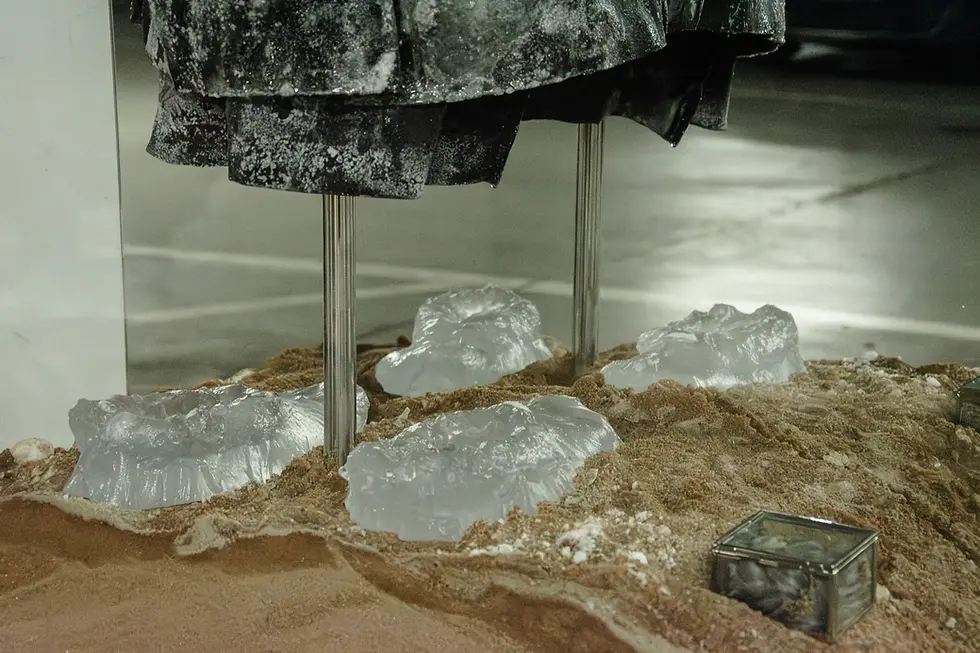
Q: Your works often include sound, smell, or atmosphere alongside visual elements. How do you decide what to include?
A: These decisions are process-oriented. I select only those elements that are necessary for the spatial conception. I would never force an olfactory or acoustic layer; it must emerge organically from the overall structure. I am interested in subtle nuances and the internal logic of a space, not in the additive accumulation of effects.
Q: What are you interested in working on next?
A: My work exists within an ongoing process in which conceptual, spatial, and material questions increasingly intertwine. Right now, I am planning another journey into a desert landscape, a place where time, body, and perception condense in an existential manner. On a personal level, I also feel very at ease there and sense an inner threshold within myself that allows me to think in new directions.
At the same time, I am working more intensively with the material glass, whose paradoxical properties—between transparency and resistance, fragility and duration—particularly interest me. Otherwise, I am reading and spending a great deal of time inwardly focused.


