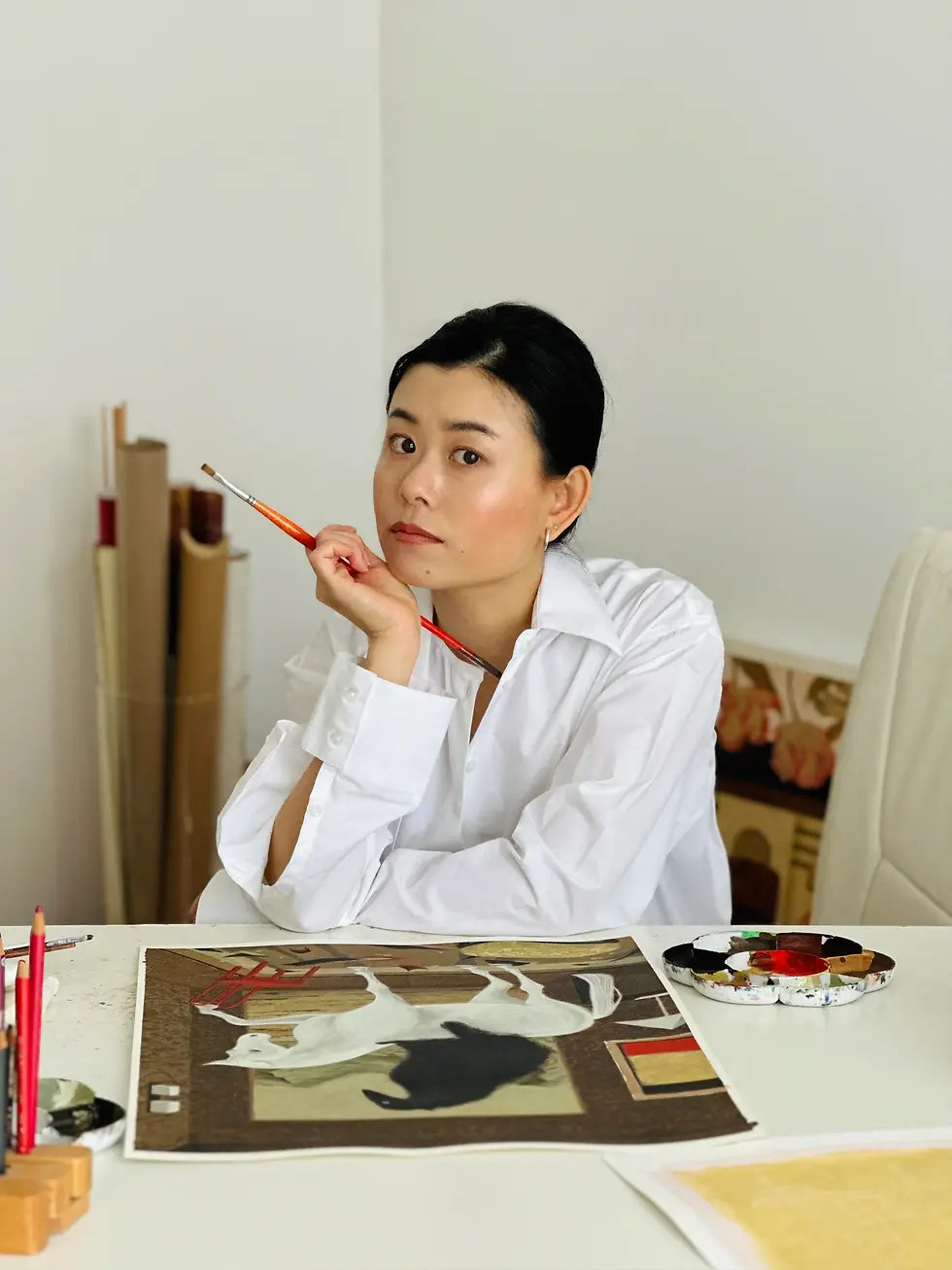
Mona Sultan
Mona Sultan works with found photographs, collage, and mixed media to explore how memory shifts over time. Her process involves cutting, layering, and disrupting images to test what they can still hold or suggest once pulled out of context. Drawing on her background in design, film, and fashion, she builds carefully composed works that balance image and fragment. Based in the UK, Sultan sees photographs not as fixed records but as unstable objects, always open to reinterpretation.

Q: When you work with a found photo, what usually makes you pause on one and not another?
A: The photographs that draw me in usually have two qualities: composition and a sense of narrative. Compositionally, I’m often attracted to images with a lot of negative space and a strong focal point. That breathing space around the subject not only creates balance but also leaves room for the imagination. I think of it almost like in cinema, where the framing becomes part of the storytelling; the negative space gives the image an openness, a certain aesthetic, and a sense of possibility.
Narrative is just as important. I’m drawn to photographs that I sense suggest a story but never fully reveal it. I believe all photographs conceal something, but when that ambiguity is heightened, when the image feels like it’s holding an extra little something back, it becomes more compelling to me.
Those are the photographs I want to work with, because they already carry a greater sense of mystery that I can then emphasize and expand through my practice.

Q: Cutting and collaging feels like taking an image apart to see what else is hidden in it. What drives you to keep doing that?
A: David Campany once described collage, in relation to John Stezaker’s work, as “a love of images and a desire to destroy them,” and that resonates deeply with me. I’ve always been fascinated by the complex nature of images, and that’s what drives my practice. Cutting and collaging feels like a way of probing that fascination: taking an image apart not only to see what might emerge in the process, but also to push it toward greater complexity. For me, it’s about a balance between aesthetics and responding to the tension between what an image shows and what it withholds, between what I can see and what I can never fully know.
That gap becomes a kind of fuel, generating more questions, more unknowing, and that state itself is compelling to me. I think of it as an absurd condition, similar to what Albert Camus writes about in "The Myth of Sisyphus." We have this deep desire to find meaning, through experience, through others, through images, and yet we are confronted with the impossibility of fully understanding. Photographs embody that paradox: they suggest stories but refuse to explain them. Camus argued that this tension need not lead to despair, but to revolt, to live fully in spite of uncertainty. My process works in that same spirit. I don’t seek to uncover a photograph’s original story; instead, I embrace and even amplify its gaps, treating uncertainty not as a lack but as a space to dwell in and work from.
Q: Paint in your work often interrupts the photograph. How do you know when to stop disrupting and let the image breathe?
A: My aesthetic naturally leans toward minimalism, and my design background makes me highly aware of balance, space, and composition as I work. When I intervene with paint, it’s always a careful negotiation between revealing and concealing. This act of disruption allows a new visual form to emerge from what is hidden. By concealing parts of the image and altering familiar structures, I create fragments that feel both recognizable and incomplete. The viewer is invited into the gaps, encountering ambiguity and open-ended possibilities. In this way, the disruption doesn’t erase meaning; it amplifies the photograph’s inherent instability, its selective memory, and its vulnerability to reinterpretation. I know to stop when the photograph’s authority as an archival trace has been destabilized, when perception begins to shift and meaning is no longer fixed but fluid and open to ongoing interpretation.


Q: Glitches run through your practice. Do you see them more as accidents you welcome, or as a language of their own?
A: Glitches in my work operate as a language. My analog processes intentionally mimic visual glitches, pushing images to the edge of recognition and unsettling expectation. They function not only as formal gestures but as conceptual tools that question the photograph’s assumed authority.
That said, while the idea of the glitch is deliberate, I always leave room for chance. For example, in the series "On the Way There," I knew I wanted the aesthetic of glitch to emerge from cutting photographs into thin strips. But once those strips are stacked and laid out, I handle them loosely, allowing chance arrangements to appear. From there, I shift and spread them until a certain visual tension feels right. Even in the gluing process, often involving multiple fragile strips, the material introduces new, unpredictable disruptions that I embrace as part of the work.
Gerhard Richter once described chance as “a found object,” something that arrives unexpectedly and beyond the artist’s control. That resonates with me, it feels liberating to let go and allow chance to become a collaborator in shaping the final image.
Q: You talk about photographs as unstable objects, always vulnerable to change. How does that sense of fragility affect the way you handle them in the studio?
A: Found photographs are fragile in every sense: physically, materially, and conceptually. As objects, they carry the wear of time: creases, fading, or torn edges that speak to their vulnerability. But there’s also a deeper fragility at play, the fragility of meaning. Susan Sontag states in her book "On Photography" that “a photograph is only a fragment, and with the passage of time its moorings come unstuck. It drifts into a soft abstract pastness, open to any kind of reading.” Once removed from their original context, photographs lose their fixed narrative. They become unstable, their significance shifting depending on how they are seen, where they are placed, and the hands that hold them. In the studio, I don’t try to “protect” them from this fragility; instead, I work with it. Each mark, cut, or interruption I make acknowledges that instability and I see their fragility as what keeps them alive, always open to change. By resisting the urge to resolve or stabilize the image, I allow it to remain porous, ambiguous, something that holds space for both presence and absence.
This is central to how I think about photographs: they’re not fixed records of the past but delicate, shifting sites where memory falters and transforms. For me, fragility is what gives photographs their power, it keeps them alive, unfinished, and always open to change, it keeps meaning fluid and endlessly open to reinterpretation.
Q: With your background in design, film, and fashion, what habits or instincts from those worlds still slip into the way you compose an artwork?
A: Design continues to inform the way I work as an artist, for one, the grid—something I joke will always haunt me—is embedded in how I interact with my work. Years of using programs like Photoshop, Illustrator, and InDesign have trained me to work with layout, alignment, layering, rhythm, and balance with the logic of a designer, and I believe this has become central to my aesthetic language.
Reproduction is another element I carry over from design. I’m always excited by the ability to scan, enlarge, and reproduce images, and how that process allows me to extend the conceptual possibilities of my practice. By working with found photographs, images already removed from their original context, I continue that cycle of transformation, letting new meanings emerge with each iteration and intervention.