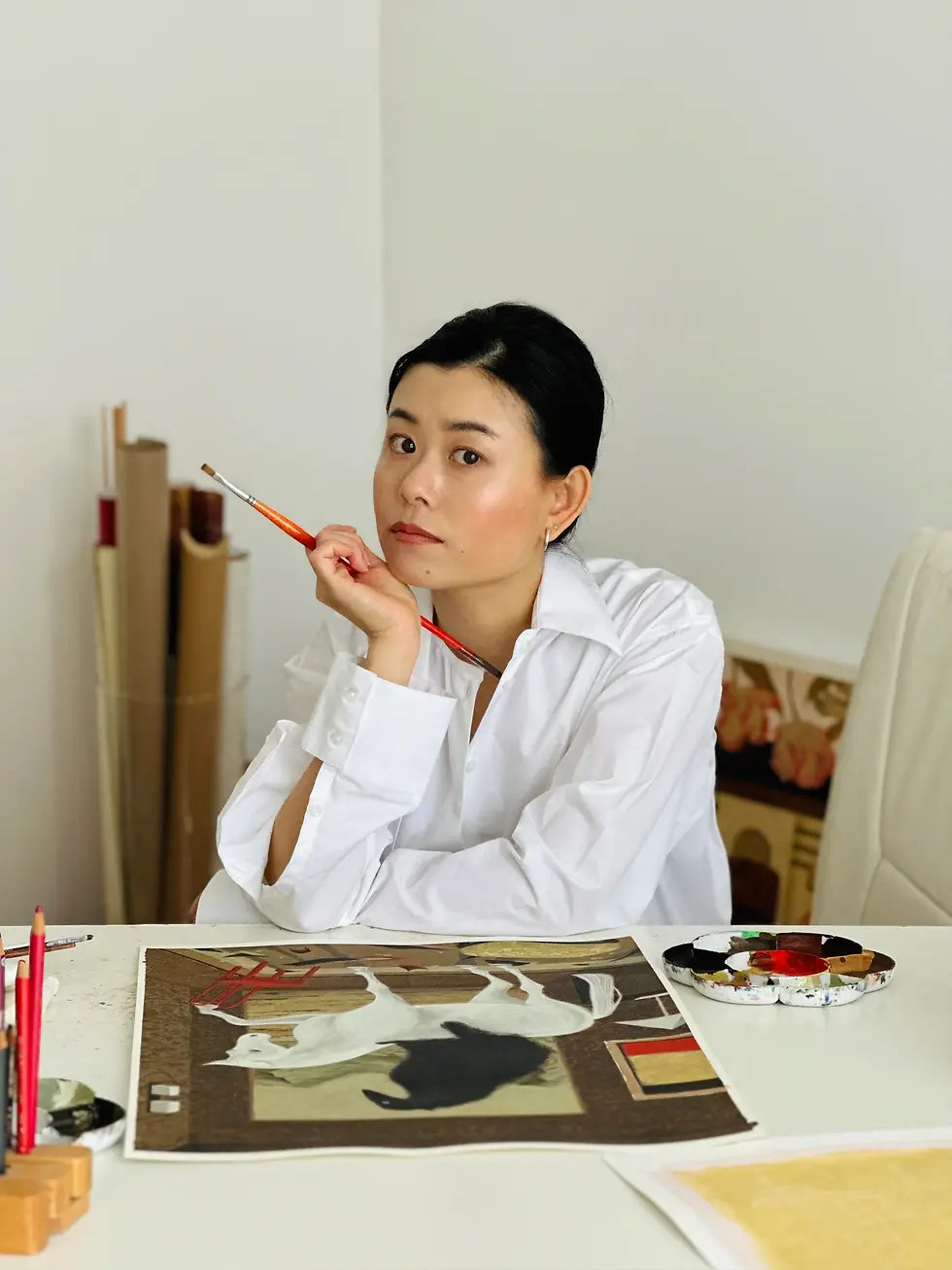
Minerva Skyttä
Updated: Jul 1, 2025
Minerva Skyttä’s work blends personal history with material experimentation. Drawing from a box of family letters and old photographs, she creates sculptural knitwear that carries traces of memory, place, and time. Her pieces reference the sails of Chinese ships, paper textures, and the physical aging of ink and fabric. With a background in fashion design from Aalto University and a parallel interest in politics and communication, she approaches her practice with both technical focus and conceptual clarity.

Q: What was it like opening that box of letters for the first time—did something shift in you?
A: In 2018, I received a box of letters from my grandmother. The brown, neatly folded letters contained stories spanning approximately one hundred years. My grandmother’s mother had kept the letters for decades, and after her passing, they were passed down to my grandmother.
I immersed myself deeply in the letters. I selected six from the box, each of them inspiring me in different ways as I worked on my collection. The writers of the letters, as well as the people mentioned in them, were a part of my grandmother’s life either briefly or for many decades. The six letters I chose feature my ancestors Hannes and Ellen Sjöblom and their children Paavo and Anna-Liisa—my great-great-grandmother—as well as Anna-Liisa’s friend Annastiina.
The lives of the Sjöblom family were filled with startling twists and turns, some of which are revealed in the selected letters. Their family life was marked by escapes, mental health struggles, financial difficulties, rumors of infidelity, deaths, wars, and illnesses.
Some of the letter writers were as close to my grandmother as my own grandmother is to me today. I carried that sense of closeness while reading the letters. As I’ve listened to my grandmother’s countless stories about my relatives, it felt as though I personally knew the people who wrote them. This connection affected the way I interpreted the letters.
Due to the emotional bond, I couldn’t approach the material entirely objectively. I had my own image of who my relatives were, shaped over time through my grandmother’s stories.
The intimate nature of the subject came with its challenges. The emotional weight brought on by my personal connection created pressure on how to approach the material. I wanted to honor my ancestors and create something meaningful.
Trying to create art from the contents of the letters often felt superficial, and the pressure to succeed was, at times, paralyzing.
At the same time, I knew that simply choosing my own relatives as a source of inspiration was already a form of respect—and that whatever I ended up creating, my grandmother would be proud.
Q: How do those old family stories shape the way you think about fashion today?
A: I began the collection by embarking on a journey into the lives of my relatives. In the end, I also found myself embarking on a journey within. I reflected on how a personal connection to the subject of inspiration influences fashion design and searched for ways to approach fashion as art.
Through this collection, I challenged myself both mentally and physically—questioning my values and ways of thinking, re-examining everything I had learned, and constantly seeking more efficient and meaningful ways to knit. Along the way, I deepened my professional identity and came to understand that, above all, I am an artist. From the very beginning of the process, I wanted to be independent and free, to express my own skills and work like a painter—without excessive explanation or justification.
Under pressure, I broke down, and toward the end I began seeking approval. I strove for perfection, and it felt incredibly important to meet all the expectations and goals set from the outside. I remember asking myself whether I was creating the collection for myself or for the evaluators.
My old family stories taught me to see fashion not just as clothing, but as a carrier of memory, history, and emotion.
They showed me that garments can hold intimate meanings, that they can tell stories just like letters do. Knowing how my ancestors lived, travelled, made things by hand, and adapted to change made me appreciate slowness, imperfection, and intention. I no longer see fashion only as a response to trends or market demands—I see it as a personal and cultural archive.

Q: Do you see your pieces more as personal narratives or responses to bigger questions?
A: I have long been contemplating whether fashion can be considered art—and whether it should be approached as such. Fashion is a form of visual expression that can evoke emotions or offer aesthetic experiences. At the same time, it often carries commercial and functional purpose. It is a vast global industry that produces significant carbon emissions and microplastic waste.
Fashion is also inherently tied to the culture and society in which it exists. As such, fashion moves along the border between art and everyday life, which makes approaching it as art a complex task.
For me, treating fashion as art is a way to highlight its creative and aesthetic dimension. In this light, fashion is not merely an act of exploiting natural resources, but an act of creating meaning.
Designing this collection was a unique opportunity for me to express myself. I was free to approach it in any way I wanted. My knitwear pieces are like sculptures, where practicality is not the starting point.
I was not aiming to meet commercial criteria—my goal was rather to create something that cannot be repeated.
I did not make detailed sketches or prototypes; instead, I developed my ideas through the process of knitting itself. Knitwear is exceptionally versatile: thanks to the elastic loop structure and the compounding weight of the material, the garments drape gently around the body, and the shape of the armhole, for instance, is not as critical for fit as it is in woven garments.
Letting go of prototypes and sketches was liberating. I was able to follow my own interests and keep moving forward.
I shaped the garments and adjusted the fit as I progressed. I made folds and directional changes in the pieces at random, and the forms emerging from the knitted structures were unpredictable.
In this way, my knitwear was created in the moment and reflects my current skills, lived experience, and know-how.
Each piece was like a conversation with the material—a slowly evolving dialogue that gave rise to something I could not have pre-planned. It felt important to give space for slowness and allow chance to guide the process.
Experiencing a single piece of work as art does not, of course, solve the global issues tied to fashion. Yet I hope my work inspires other designers and artists to see fashion as one form of making art—a way to express, to question, and to feel.
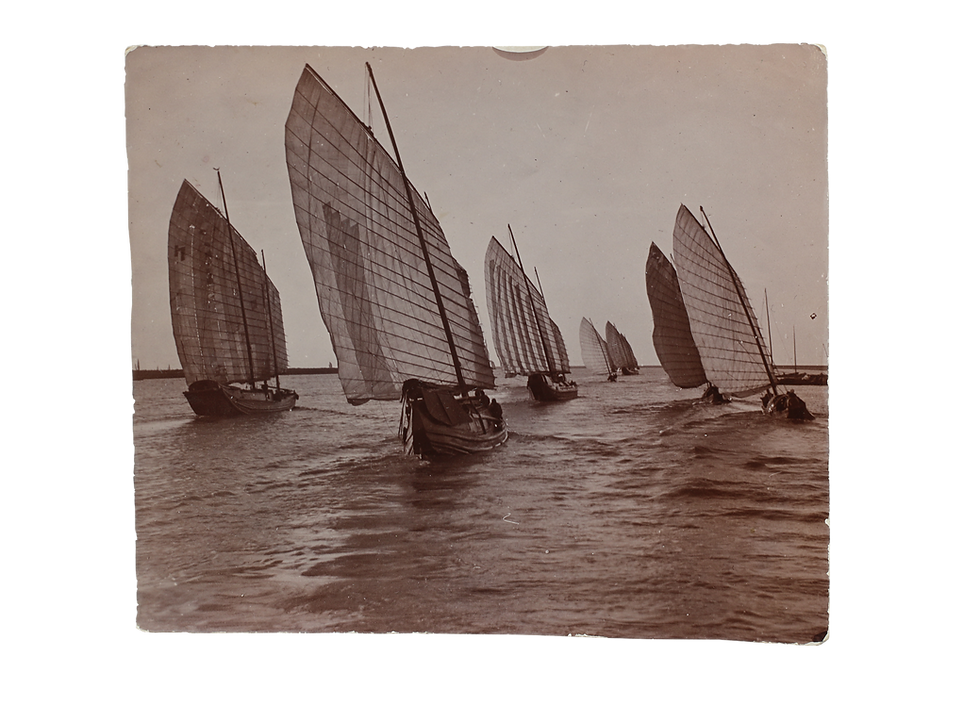

Q: What drew you to the sails in your great-great-great-grandfather’s photos—was it their shape, their history, or something else?
A: The photographs of sailing ships are, in my opinion, the most striking of all the pictures taken by Hannes. The ships travel with the wind, carried forward by their massive white sails toward an empty horizon. The tall wooden masts make them particularly memorable. It’s no surprise, then, that the shapes of these sails are reflected in my knitwear as well. The white, curved surfaces and fragmented paper yarns resemble miniature versions of the sails on Chinese ships.
As I examine my collection, I notice how the stories in the letters and the life situations of the people featured in them influenced the shapes of the garments, sewing techniques, and accessory choices. In his diary entries, my ancestor Hannes Sjöblom writes how his wife, Ellen Sjöblom, sewed the couple’s clothing by hand while they were in China. I realize this information has influenced my own decisions in the making process of the collection.
I sewed almost all the seams by hand and transferred stitches one by one from needle to needle using a manual knitting machine.
My knitwear carries a strong sense of craftsmanship. The shapes of the skirts resemble the silhouettes of Chinese robes from the early 1900s. My knits are fastened with hooks, the same kind that were used in women’s dresses, skirts, and aprons in the early 20th century. I also searched for early 1900s suitcases to use as accessories for the collection.
The suitcases symbolize the constant state of travel experienced by the people in the letters.

Q: You often work with delicate materials like paper yarn—does that fragility mean something more to you?
A: From the very beginning, my goal was to create knits that resemble letters—imitating the fragility, texture, yellowing, stains, and wear of paper. As the process went on, my artistic work became increasingly intertwined with my source of inspiration: the letters and the stories they contain.
After long periods of experimentation and failure, I eventually succeeded in bringing elements and characteristics of the letters into each outfit. The knits in my collection change shape when wet or wrinkled.
They feature signs of wear, stains, and holes, and each one comes in a different shade of brown or white. The knits are translucent. The rows of stitches intersect in varying directions, like restlessly written handwriting.
Through ephemerality and the impossibility of repetition, I aim to reflect the nature of my inspiration—letters. Letters are snapshots written in a moment, recounting recent or past experiences and events. They are sent into the future and received days or even weeks later. Letters are not sketched out in advance, nor is a specific amount of paper reserved for them. Over time, they become worn and stained. With my knitwear, I seek to express a similar sense of the moment and of what has passed. When I knit, I don’t fully know what the end result will be.
The knit curves or folds in a direction that feels natural to it, and I adapt accordingly. I don’t fine-tune patterns down to the last millimeter, nor do I aim to recreate an exact color again. I focus on the moment and knit that moment. When I look at the knit, I can see the past.
Q: Balancing fashion with politics and communication—do these worlds ever merge in your creative process?
A: Fashion is inherently political—it dictates who belongs, who is visible, and who gets erased. It reflects power structures, economic systems, and cultural hegemony. Studying politics has sharpened my understanding of how fashion operates as both an instrument of oppression and a tool for resistance.
Fast fashion is the clearest example of this. It exploits labor, accelerates environmental collapse, and erases cultural craftsmanship in favor of mass-produced, trend-driven cycles. When I design, I actively resist this system by embracing slow, intentional processes. My sculptural knitwear is labor-intensive by design, emphasizing craft over convenience. By prioritizing artistry and ethics over market demands, I create garments that hold meaning rather than just serve as fleeting commodities.
My political studies also push me to ask uncomfortable questions: Who made this garment? Under what conditions? What histories are embedded in this silhouette or material? This critical lens ensures that my work is not just visually striking but also socially responsible.