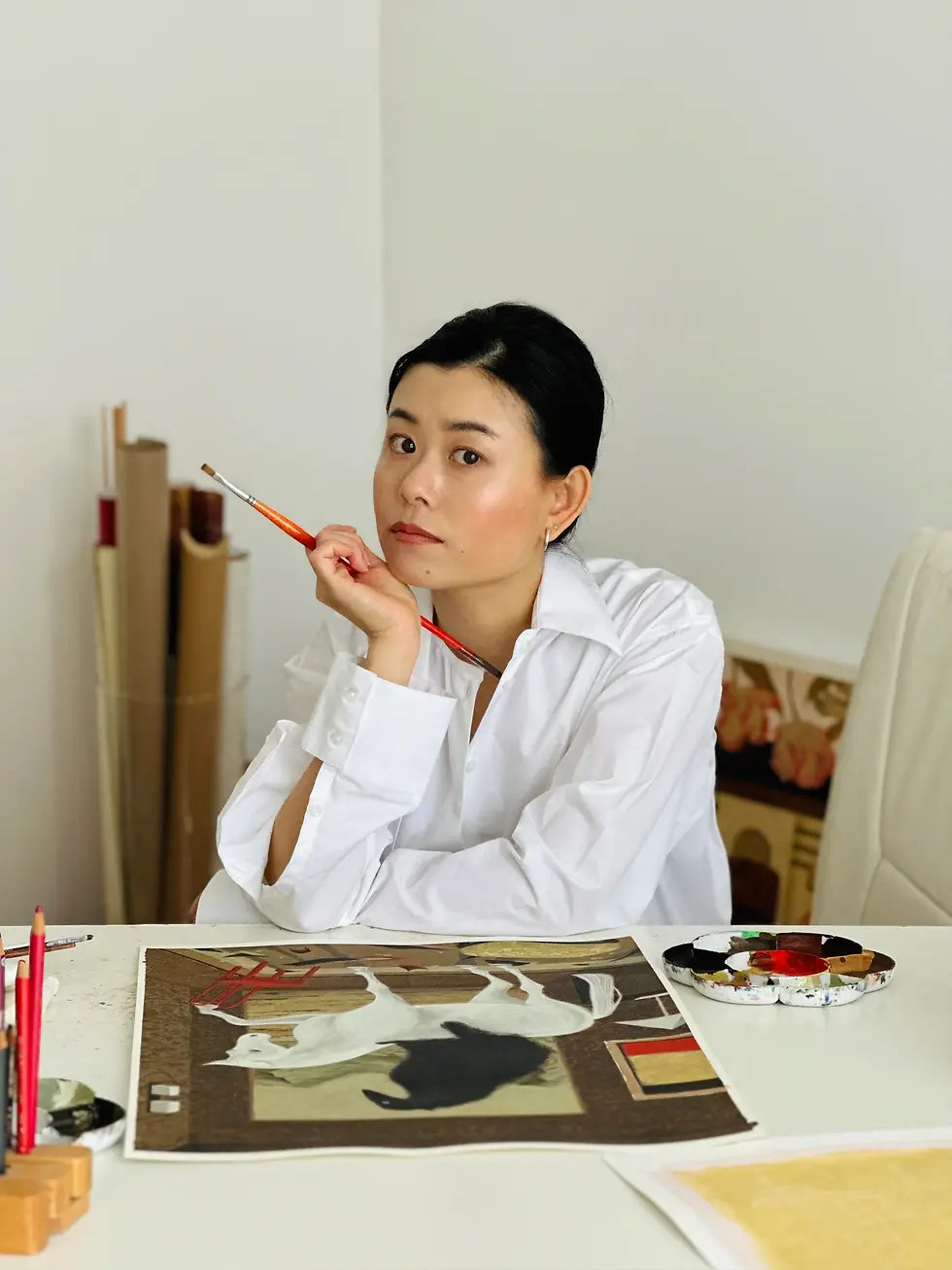
Mihika Poddar
Mihika Poddar is a Nepali visual artist living in New York City. She works with painting, drawing, sculpture, and mixed media to create psychological spaces that combine folklore, memory, and the unconscious. Her art looks at how fear and desire change over time. Elements of horror help her bring hidden emotions to the surface. Recurring motifs like twisting bedsheets, half-seen hands, and unstable figures shape her style. Influenced by Baroque painting, she builds her compositions slowly, making familiar scenes feel strange or uncertain. A key figure in her work is “Habu”, drawn from South Asian folklore, symbolizing the thin line between fear and fascination.

Q: What first drew you to horror as a way to talk about emotion instead of fear?
A: I’ve always found a kind of comfort in the horrific. It carries tension and unease, yet it feels oddly familiar. I’m interested in how fear can reveal, rather than just conceal, something about our instincts. It has a way of clarifying what we’re drawn to and what we’re taught to resist. I wanted to look at it from both the girl’s and the monster’s perspectives, because those roles often overlap. The horror in my work isn’t really about the creature itself, but in the way the girl has learned to see it.
Q: You describe “Habu” as both a monster and a mirror. When did that figure start to feel personal to you?
A: When the fear started to feel more like curiosity.

Q: Your paintings move between control and chaos. How do you know when to let the work take over?
A: That’s something I’m still learning. Letting go of control doesn’t come easily, but I’m trying to trust the process more. For now, the tension between control and surrender feels important; it’s where the work happens.

Q: Those twisting bedsheets and half-seen hands appear again and again. What keeps you returning to those images?
A: Bedsheets have always symbolized comfort and protection for me, while hands have often felt like a threat, symbols of the monster. But those meanings collapse in my paintings. The sheet that’s meant to shelter can suffocate, and the hand that’s meant to frighten can tempt. I’m interested in that friction, in how what we’re taught to see as safe or dangerous can quickly shift.

Q: The mix of beauty and unease feels central in your work. Where do you think that tension comes from?
A: It comes from the unknown space between attraction and discomfort, the uncertainty of not knowing when one might turn into the other. It’s similar to the erotic, which exists in that charged space between you and the object. The tension lives in the threshold, where beauty threatens to spill into something unsettling.
Q: How do childhood memories still echo in what you’re making now?
A: They’re everywhere. The folklore, myths, and horror tales I grew up with shaped how I think about fear and transformation. Even small details, like the floral upholstery that covered everything in my childhood home, find their way back as recurring patterns and colors.