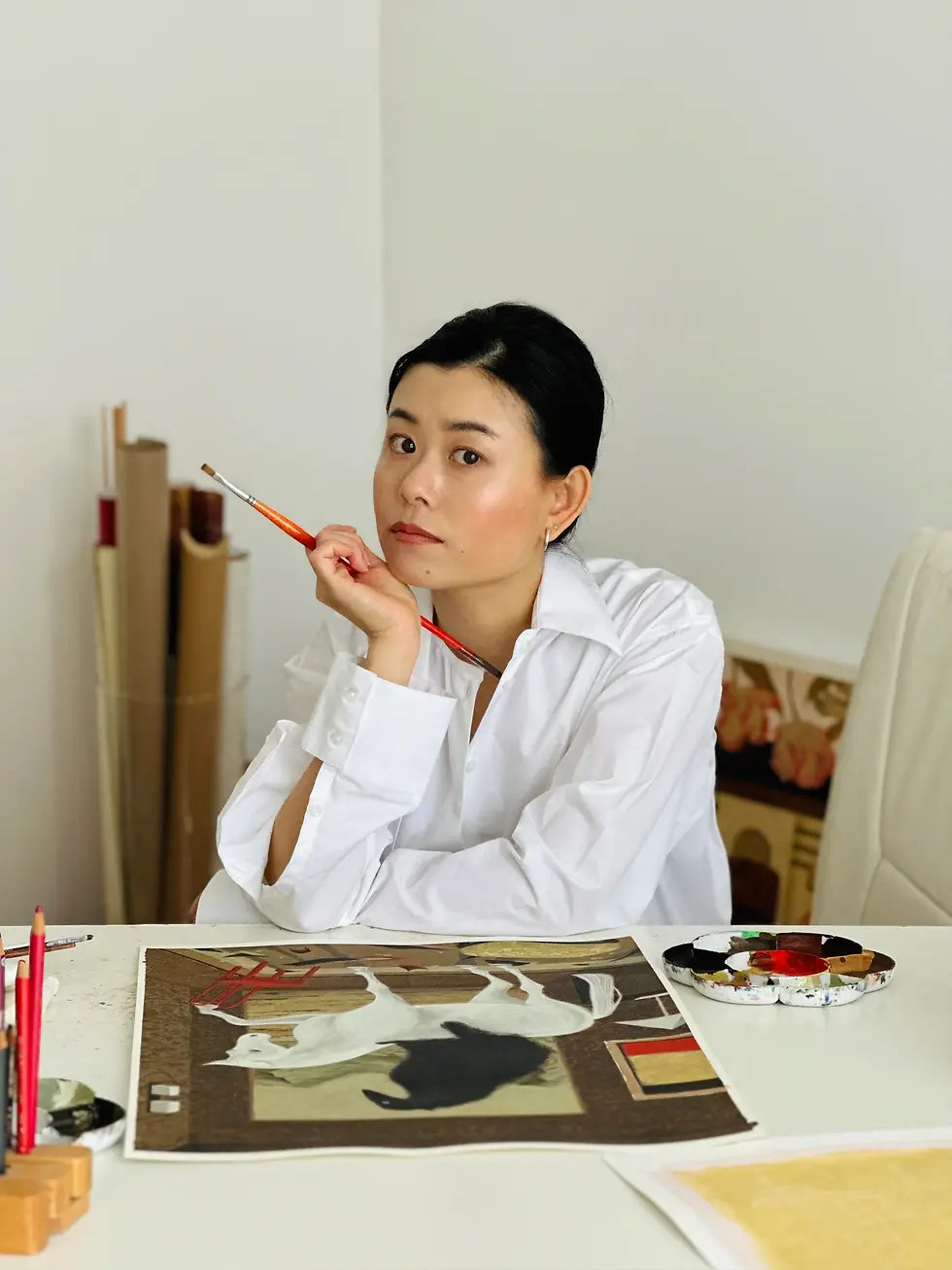
Marta Ornelas Monteiro
Updated: Jan 31
Marta Ornelas Monteiro is a Lisbon-born artist based between Lisbon and Barcelona, with a background in architecture. She works with painting, sculpture, and mixed media, often using concrete together with dried plants, branches, and natural forms she collects while traveling. Her process comes from years of working around construction sites and observing how built structures and organic materials relate in scale, weight, and proportion. These contrasts shape both her large canvases and her sculptural works.

Q: What first led you from architecture into working with natural materials?
A: During my work, I visit many construction sites, so at first I was eager to learn how to work with hard materials, tools, and techniques—especially concrete. While at home, I was collecting flowers and pieces of trees, painting them, and testing concrete molds and mixtures: from two-meter-high tree trunks to branches, leaves, and dried flowers. This parallel—between the rigor of construction and the fragility of natural elements—gradually became central to my practice. Working with materials ranging from two-meter-high tree trunks to the smallest dried flowers allowed me to imagine new forms and processes, transforming natural matter into unique pieces and offering nature another narrative beyond its original context.
Q: You often collect elements while traveling. What makes you choose a specific material to bring into a new piece?
A: When I travel, scale is an important consideration, but what ultimately guides my choices is the silhouette and proportions of the element. I am drawn to forms with a strong presence—often large plant leaves, especially from tropical landscapes. Back in the studio, these collected elements become the starting point for new works: I use them to build concrete structures or to translate their silhouettes onto large-scale canvases. Travel consistently offers a shift in perspective, and with it, an inexhaustible source of inspiration that feeds directly into my practice.


Q: Your work gives natural materials a second life beyond their original context. What do you pay attention to when transforming them into a composition?
A: It always depends on the technique I choose. In painting, I work to capture a specific moment through the contrast between precise and blurred plant silhouettes. The compositions move between clarity and softness, layering defined forms with more subdued boundaries—almost like shadows—suggesting movement and the fleeting nature of a moment as it exists and then disappears. In sculpture, the composition emerges directly from the dialogue between the natural material and the constructed structure. The piece evolves through balance, weight, and tension, allowing the material to retain traces of its original presence while being transformed into a new, autonomous form.
Q: “Layers of Life” looks at the hidden strata of existence. What drew you to explore these unseen narratives in nature?
A: It’s not that these narratives are unseen, but that they exist only once, in a specific moment. For example, observing the shadow of a large tree cast on a building façade: the wall remains the same, but the shadow constantly changes—shifted by light, seasons, or even the loss of a branch. Each day creates a new drawing. In my paintings, I aim to capture one of these fleeting narratives—the shadow moment—translating it onto canvas. In my sculptures, a similar idea takes form as a still moment: a branch or tree is placed atop a concrete base, creating a unique object that preserves that singular encounter with nature. The goal in both media is to give nature an additional narrative, offering a new way to see and experience it.

Q: How does intuition guide you as a piece develops?
A: Intuition plays a central role from the very beginning of a piece. Often, the moment I select a natural element, I know the colors, textures, or forms I will explore. Each color is carefully chosen in relation to the proportions and shapes of the element, creating a harmony between form and hue. As the work develops, intuition guides me in finding the right balance between the dramatic presence of the piece and a minimalist, restrained approach, ensuring that each element has its space to exist.
Sometimes inspiration comes from unexpected encounters: a visit to my favorite shop, Crack Kids Lisboa, might spark a color choice or a new combination that reshapes the work. Intuition, in this sense, is a constant dialogue—between the material, my senses, and the environment—allowing each piece to evolve organically and to reveal its own narrative.


Q: You work between Lisbon and Barcelona. How do these two environments influence the materials you gather and the work you make?
A: Working between Lisbon and Barcelona enriches my practice through both experience and connection. While the two cities are geographically close, each offers a distinct atmosphere, light, and landscape that subtly influence the materials I gather and the forms I create. Lisbon’s textures, colors, and light inspire softer, more contemplative approaches, while Barcelona’s vibrant energy and architectural intensity often encourage bolder gestures. Beyond materials, being present in both cities allows me to engage with different artistic communities, expanding my network and exchanging ideas. This interplay between place, material, and collaboration continually shapes the evolution of my work.