Marc Allgaier
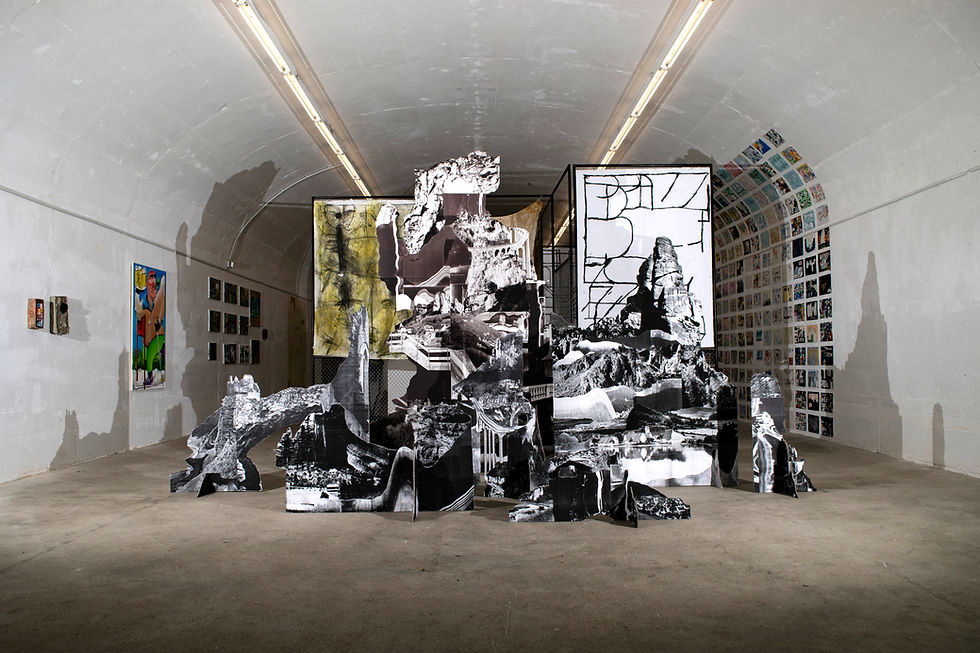
Marc Allgaier builds textured compositions using found materials like cardboard, discarded prints, and fragments from his everyday surroundings. His process is guided by intuition, allowing for interruptions and unexpected shifts. Through folding, cutting, and layering, he creates fragmented surfaces that feel both constructed and unsettled. Whether in works on paper or larger installations, his interest lies in how memory, perception, and structure play off each other in quiet but deliberate ways.


Q: What draws you to start with found materials like cardboard and print fragments?
A: There is a certain honesty in materials that have already lived a life before they reach my hands. Cardboard, print fragments, and discarded surfaces carry traces—of function, transit, communication. Working with them means engaging with memory, with entropy, with what lies beneath the surface. Reusing these materials becomes both an ecological and poetic gesture. They bring their own stories into the work and invite viewers to reconsider what is usually dismissed or overlooked.
Q: Your work often feels like walking through a map that’s been taken apart. Do you think in topographies while building?
A: Yes, though not in the sense of fixed geography. I think in layers, shifts, and terrains that refuse clarity. Landscape appears neutral, but never truly is. It stores memory, power, history. In my work, I treat landscape as something active and constructed—a stage for perception. I assemble, fold, and displace elements to reveal how our surroundings, like our thoughts, are shaped by what we bring to them. Movement through my work becomes a form of negotiation with this constructed terrain.
Q: How does teaching affect your own creative process, if at all?
A: Teaching helps me to stay attentive. It forces me to explain things I might otherwise do intuitively. But more importantly, it opens up conversations. Students bring questions, doubts, new perspectives. That exchange affects my own rhythm and keeps my process more open. It turns into a dialogue between my experience and their curiosity—a reciprocal loop of thinking and making.
Q: What do you look for when cutting and recombining images—instinct, rhythm, or disruption?
A: All three. Instinct guides the first cut. Rhythm helps me build a sense of flow. But disruption is where meaning starts to shift. I don’t want compositions to settle too quickly. There should be tension, pause, contradiction. Something that catches the viewer off guard. Collage is a language of interference—I look for the precise moment where it stops making sense in order to start saying something else.
Q: "Berg- und Talfahrt" invites people to move through space. What kind of experience do you hope they carry with them?
A: I hope they experience a shift—in movement, perception, orientation. The installation offers no fixed meanings. It creates a structure in motion, and each person contributes to its rhythm. The goal isn’t understanding, but resonance. I want them to leave with the sense that reality isn’t stable or objective, but relational—shaped by memory, position, and presence. That what seems given is often negotiable.
Q: You talk about the space between order and collapse. Has that tension changed meaning for you over time?
A: Yes. What once felt like a visual contrast has become a way of describing how I experience the world. This in-between space—between systems and fragments, between structure and failure—is no longer just a theme. It’s the condition I work from. I’m interested in how to stay in that space, how to build without pretending things are stable. Maybe fragility isn’t a flaw, but a method. A way of making forms that can adapt, hold contradiction, and remain open.


