Manena Pomeroy
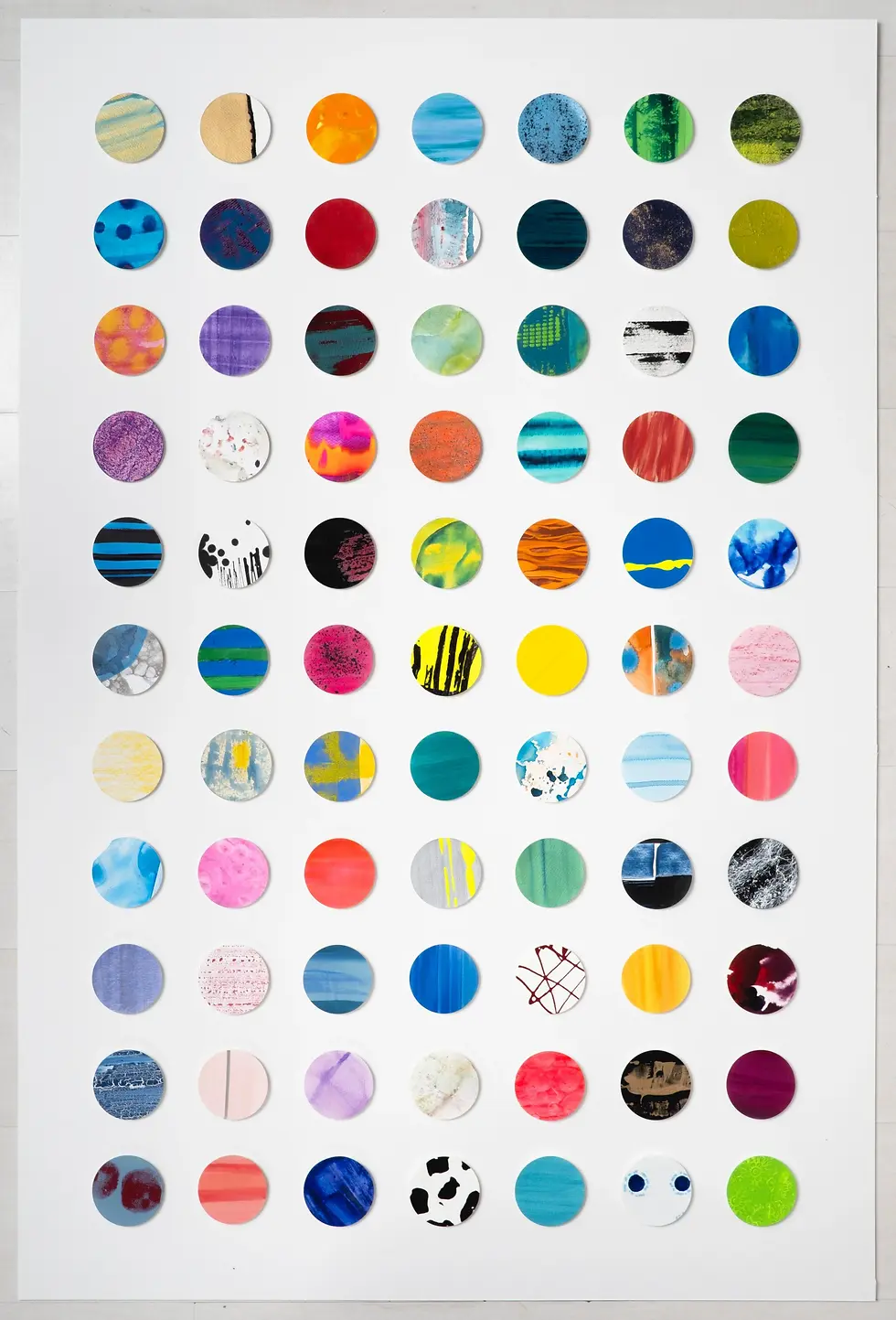
Manena Pomeroy is an artist based in Santiago, Chile, after many years working as a fashion stylist. She has always thought in color, first through clothes and later through paint, and she still approaches a surface the way she once built a look. She spends long stretches making small painted circles in different shades and textures, keeping them until they find their place in a larger composition. Structure matters to her, so she works within a grid, using it as a steady frame for instinct, emotion, and play.

Q: You worked in fashion styling for many years. How did you move into making your own work?
A: I always had my own voice. Since I was a little girl, my way of communicating was through artistic expression, making my own clothes from a very early age. After that, making pieces specifically for some shoots, to requiring work from designers to get the look I was going for. After being involved in fashion for many years and having done thousands of editorials, there was a big creative void starting to form inside of me. I was craving a new way to explore my constant need to discover new ways to integrate color into my life. I was always interested in color: how it is made up, how one behaves next to another, how color combinations work and why. I really needed to free myself from the restrictions of clothing to get on my own road. I started painting with whatever I had at hand, on anything that was at hand. That process probably informed a lot of the way I work today. Always mixed media, no attachments to specific techniques or media. So it continued to be a very instinctual way to approach my work. The transition was quite seamless and inevitable.


Q: You describe your work as a translation of your unconscious into color and texture. How do you begin that translation on a new piece?
A: I’ve always seen color and its combinations. So I usually start with what’s on my mind when I sit down to paint. It could be a specific palette, it could be something that inspires me literally (like the wine piece) or emotionally. Emotions have very specific shades in my head; I can almost see them in colors. When that happens, I just try to find these happening in any media I could be using at the moment.
Mixing different colors will also give you different results. They always say that green is hope and blue is trust. Mix them and their meaning changes completely—it becomes light at the end of the road. When someone looks at this painting, I want them to become engulfed in these new sensations.
It’s a path instead of a destination; you go from one to the other and work your way through the piece however you like. They twist and turn in a flexible storyline. I will work in different media for different types of colors or textures. I also experiment a lot, especially with textures. Since I’m not classically trained, I find myself looking for things that I don’t even know if they exist. So through experimenting, I stumble upon very interesting ways of doing things. Color comes naturally; textures are a more rational and labored endeavor.
Q: You work within a strict grid. What does that fixed structure give you while working?
A: It’s super interesting for me how the grid works. It’s a set rulebook that accepts an infinite number of possibilities inside its structure. I feel that messiness leads to entropy; I cannot work in a messy studio, so I guess that the grid provides a certain amount of structure that I need to work. A certain predictability that allows me to play with what’s inside each and every one of these little windows to my mind. All of those are an explosion of inspiration and different inputs; the grid makes them exist in unison. It’s, again, much like I used to work before: very theatrical fashion productions that had to be translated into pages in a magazine, put into a storyline that made sense. Grids give me the structure I need to really let go and express myself without spinning out of control.

Q: How do color and texture come together for you on a surface?
A: It’s a lot like clothes—one doesn’t work without the other. Texture makes you perceive color in different ways. It can change the intention of any specific color. So they really go together for me. Like I said before, textures come to me in a more rational way, so color will be attached to it unconsciously from the beginning of the process.
Nature is a big influence on me too. I try to replicate textures and colors that I find out there. Experimentation is always there—how to translate 3D things into my canvas. I’m always looking for different materials or chemical reactions that will give me all sorts of textures and colors. Sometimes it gets complicated too. You know how most people will say that the ocean is blue? For me it’s millions of colors and textures. When a wave crashes, the “blue” goes through an incredible transformation: different shapes, colors, textures, intensities, and I try to capture them all. So, like I said, they work together, inseparably.

Q: Which part of making a work feels the least predictable for you?
A: I work in two very distinct stages. First I paint and cut out circles from these paintings. I may work for days just making individual circles that don’t really have a “place to go” immediately. They are not made to fit some specific piece. All of these circles are my “words.” I have thousands of them, in different moods, colors, textures, etc. So that’s a pretty unpredictable thing. It’s a stream of consciousness that just flows into whatever it is that I’m working on. Some circles may not get used for years. They’re just there, waiting for their chance to say something in a piece. The stage in which I put together a piece happens at a different time, one that’s probably nothing like the one I was in when I made the circles. A composition comes to mind, then I start looking for the “words” I need to say or convey what it is that I want to say.
That’s very unpredictable too. I get some words on my canvas, then change some of them, go back, start over, always trying to express a very specific feeling. Some days I finish my “essay” in a few hours; sometimes it takes weeks to find the exact circles that I need. I couldn’t really tell you which stage is the least predictable.
Q: What are you focused on in the studio right now?
A: I’m always learning—new techniques, new chemical reactions, adding and mixing ingredients, discovering new color shades and combinations, having fun. I feel that with all the circles or “words” I have made, there’s a lot to say. I’m getting it out now. I’m speaking from Chile to the world.
Stay tuned at @manenapomeroyart


