Luigi Di Fabio
Luigi Di Fabio is from Termoli and lives in Milan. He studied at the Accademia di Brera. He paints on tinted canvas that he barely touches before starting. His figures have no ground under them, they hang in the air, and they have done that since his first drawings as a kid. Moths turn up sometimes too. He also makes video performances and photographic self-portraits, which he cuts up into digital collages and paints from. He won First Prize at the Premio Morlotti in 2024 and is working toward Humana Conditio, his first show back home in Termoli.

Q: Weightlessness, floating bodies, suspension. That's a very specific world you've built. How did you get there?
A: The idea of a floating world has accompanied me since childhood. Looking back at my earliest drawings, I notice that the figures already lacked coordinates, as if removed from gravity, immersed in a space without supports. I’ve always felt the need to remove weight from things and keep them suspended.
Over time, this inclination became clearer through study and practice, evolving from a spontaneous impulse into a genuine mode of inquiry. Making things float is not an effect, but a way of questioning reality: weightlessness becomes a lens through which to isolate deeper dynamics tied to the human condition.
At the same time, for me weightlessness is never an achievement, but rather an ideal and seductive state—one that reveals itself without ever being fully attained. It is this distance that generates desire: an unresolved upward tension, mirroring one of the core forces of human existence.

Q: You paint on tinted raw canvas rather than white. Why that surface?
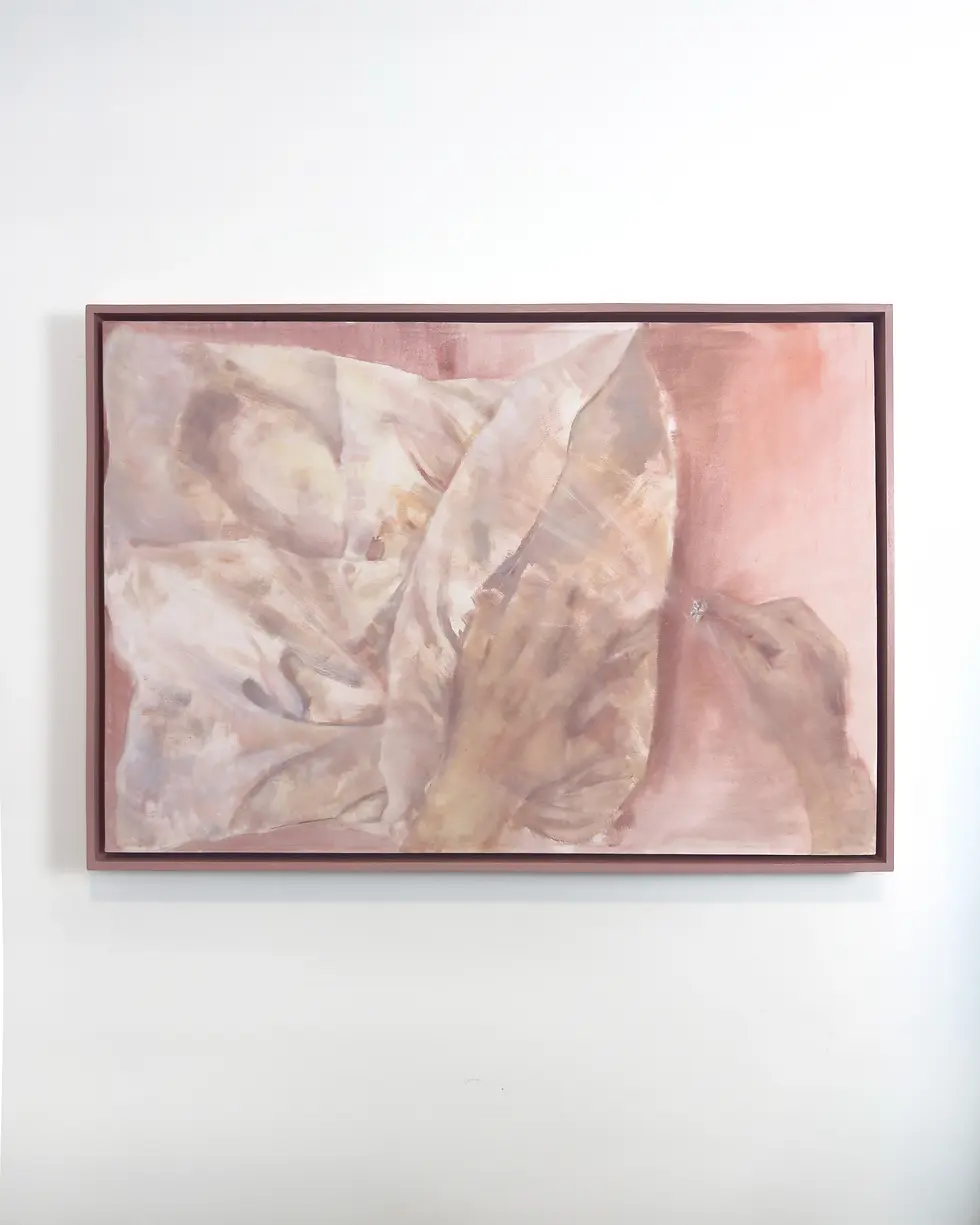
A: Working on raw canvas is a deliberate choice that reshapes the way I engage with painting. An unprimed surface creates a more exposed and less mediated condition: the support is not neutral, but porous, unstable, and somehow still open. Rather than functioning as a background, it acts as a threshold.
I often begin with pre-tinted raw fabrics, which I prepare just enough to receive the paint without erasing their original quality. What interests me is precisely this ambiguity: a surface that appears as a “coloured void,” already carrying a presence that does not depend on me. It becomes a starting point that introduces an immediate tension, because the colour exists before the gesture and forces me to respond to something already given.
In this way, painting brings into visibility what is already latent, allowing the image to emerge through an almost osmotic process.
Q: Moths and insects appear in your paintings from time to time. How did they get in?
A: Moths and other small insects entered my work only recently, when I began to reflect more explicitly on the desire for weightlessness. Their presence is not decorative but necessary, because they make visible a tension toward something that attracts, promises, yet never fully allows itself to be grasped. In nature, moths are driven by a basic, almost blind impulse that draws them toward light. It is an instinctive and unavoidable movement, governed by an internal force. This is precisely why they interest me: within the work, they become indicators of a field of attraction, a point toward which everything tends. At the same time, they take on a broader, almost human dimension, as they begin to mirror our own condition.
Q: You also make video performances and photographic self-portraits. How do those relate to the paintings?
A: Each medium, in its specificity, carries a limitation, and it is this limit that makes it necessary. Painting alludes, opening a field of possibility; photography holds and fixes a moment; video, instead, reveals and makes time visible. Video and photographic self-portraits are therefore central to my practice, not only as autonomous works but also as tools of construction. I often begin with material I produce myself—self-portraits or fragments extracted from videos—which I then assemble into digital collages. Many of the painted images originate from these preliminary compositions. In this sense, painting is never isolated, but develops within a broader process in which the body, the image, and time are continuously brought into relation.
Q: You won First Prize at the Premio Morlotti in 2024. What did that moment mean for you?
It was a very important moment for me, not as a point of arrival, but as a first real recognition within my path.
As a young artist, it’s often difficult to find solid feedback or to understand whether the direction you are pursuing has real substance. That award marked an important moment of recognition, reinforcing a research that had already started to unfold beyond the studio. More than a milestone, it felt like a moment of alignment, where I sensed that the work could enter into dialogue with a wider gaze. At the same time, it was a concrete push to keep going, to take what I was doing even more seriously, and to continue building my path with greater awareness.

Q: Humana Conditio is coming in 2027. What can you tell us about it?
A: This exhibition marks a significant moment for me, as it will be my first show in my city of origin, Termoli, in the Molise region. It will bring together different strands of my work - painting, video, and photography - within a project that I feel as something to give back to the local community. Termoli is a slow, suspended place, shaped by a particular sense of time and atmosphere that inevitably resonates with my practice. The exhibition will reflect this condition, gathering works that revolve around the tension between weight and the aspiration toward weightlessness. The project is supported by E20
Gallery in Milan, together with E20 Editore, which will contribute to the production of the exhibition catalogue, a support I receive with sincere gratitude.