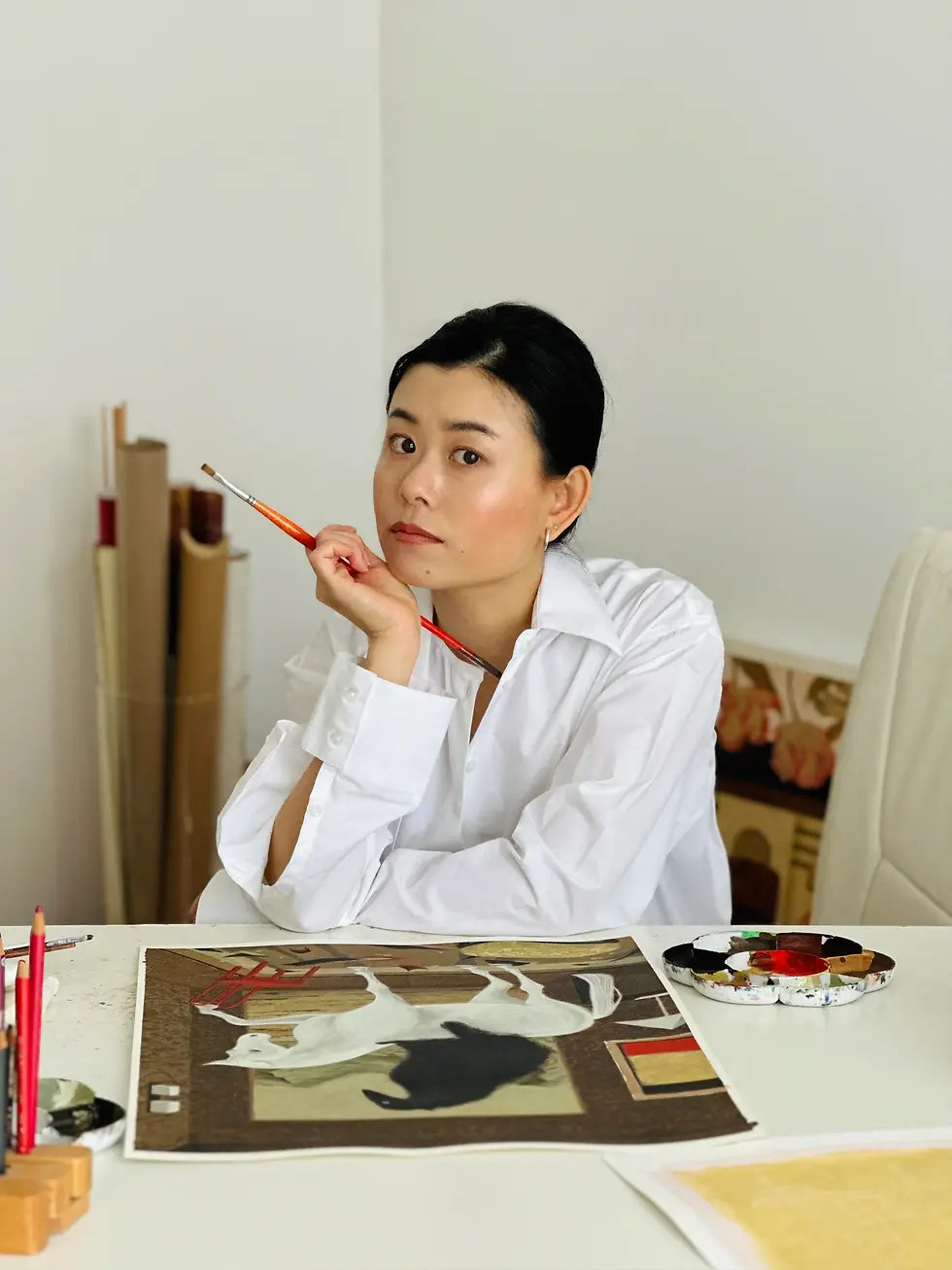
Kira Doutt
Kira Doutt is a Los Angeles-based painter who studied at MassArt and got her MFA at CalArts. She keeps painting the same marshland in coastal Massachusetts where she grew up, a place she and her brother used to sink into as kids. Her canvases are full of women doing odd, looping things in wet ground. From 2023 to 2025 she co-ran a small gallery called Spore Space in Ojai. Her father studied sea ice in the Arctic in the nineties, and her grandparents documented plants and marine life there in the 1930s. This May she joins the Arctic Circle Residency in Norway.

Q: You went from MassArt to CalArts. Tell us a bit about that path and how you ended up in LA.
A: I'm originally from Massachusetts and studied painting at Massachusetts College of Art and Design. The program was quite formal, and I spent my first year focused on observational painting, working from still life and the figure, and learning how to closely look at form and color relationships. It was a slow, attentive way of working that gave me a strong foundation. At the same time, I felt a pull toward something more conceptual. I moved to Los Angeles in 2015, and after about a year applied to CalArts.
The program opened up a different way of thinking and pushed me to expand my approach. I still find myself weaving those two modes together in my work.


Q: Your paintings are full of female figures doing these strange, looping tasks. Where do they come from?
A: These images tend to arrive intuitively, often while driving or before falling asleep. I'm drawn to placing figures into situations that feel slightly off or ambiguous.
In my recent marshland paintings, that tension comes from the environment itself. Marshes are wet, have uneven sinking surfaces, are full of insects, and constantly shifting, so the idea of figures resting or lingering there already feels somewhat absurd.
I also play with ambiguity around time. Through clothing or nudity, the figures resist being fixed in a single moment. Some feel historical, others more contemporary, which feels significant in landscapes shaped by layered and colonial histories. I'm also considering the feminized body's historical alignment with nature as something pure or stable, and what it means to push against that idea by placing the body within an ecosystem that is fragile, unstable, and increasingly at risk of collapse.
Q: You co-directed Spore Space in Ojai from 2023 to 2025. What did that time running a gallery give you?
A: I co-directed Spore Space, a small gallery in Ojai, CA, with artists Elizabeth Herring and Rosemary Hall, who had started the space a year earlier and then invited me to join them. They were both living in Ojai and had a clear vision of bringing in artists from the area as well as from LA. It was a really fun and collaborative experience, working closely with two others and bringing in artists whose practices we deeply admired. I learned a lot about curation as something relational, about building temporary ecosystems through exhibitions, and how much care, attention, and communication it takes to sustain a space like that.


Q: You keep coming back to the same coastal marshland in your paintings. What holds you there?
A: I grew up in a small coastal town in a house facing marshland. These wetlands were part of our everyday lives. My brother and I would play in it, sinking into the mud and pulling each other out with sticks, so it felt physical and familiar before I ever thought about it conceptually.
After living in more urban environments, I started to see it differently. When I returned home, I became more aware of how alive and in flux it is, shifting with tide, weather, and season. At high tide it can resemble a lake, and at low tide an exposed mudflat, never holding a fixed form. In my paintings, the marsh becomes a central presence rather than a backdrop. It becomes almost a character or myth-making force in itself. My viewpoint stays fixed while time moves through it, slipping from present iterations to future climates where ecological instability and resilience shape it.

Q: You list Anna Tsing, Timothy Morton, Donna Haraway as touchpoints. Does that reading steer the paintings directly, or is it more of an undercurrent?
A: Writers like Anna Tsing, Timothy Morton, and Donna Haraway became more central to my thinking in grad school. I wouldn't say I translate their work directly into images, but it shapes the way I think about landscape and relationality.
Tsing's The Mushroom at the End of the World was formative in how it frames life after rupture, and how forms of regeneration appear in the aftermath of destruction. That idea of non-linear survival really resonates with how I think about marshlands.
Similarly, Morton's writing on ecological entanglement and Haraway's broader ideas around multispecies relationships helped shift landscape for me from backdrop to active participant. I want the landscape in my work to not function as scenery, but behave more like a character, or a system with its own agency, entangled with human and non-human histories.

Q: You were part of the Arctic Circle Residency in Norway. What did that experience open up for you?
A: I'm participating in the Arctic Circle Residency in Norway this May. I was drawn to it partly because of my family's history of scientific research in the Arctic. My father studied sea ice in the 1990s, and my grandparents documented Arctic botany and marine life in the 1930s. I grew up with those stories, so the Arctic has always felt somewhat mythic, but filtered through a scientific lens. For my thesis at CalArts, I was thinking critically about that landscape and its ties to histories of scientific exploration and imperialism.
For me, the Arctic and marshlands are connected as fragile ecosystems that register environmental change early, almost like a canary in a coal mine. I'm interested in how we can comprehend landscapes that are transforming at that scale. I think creating paintings through a surreal lens becomes a useful tool, as it mirrors the incomprehensible strangeness of a landmass in flux.