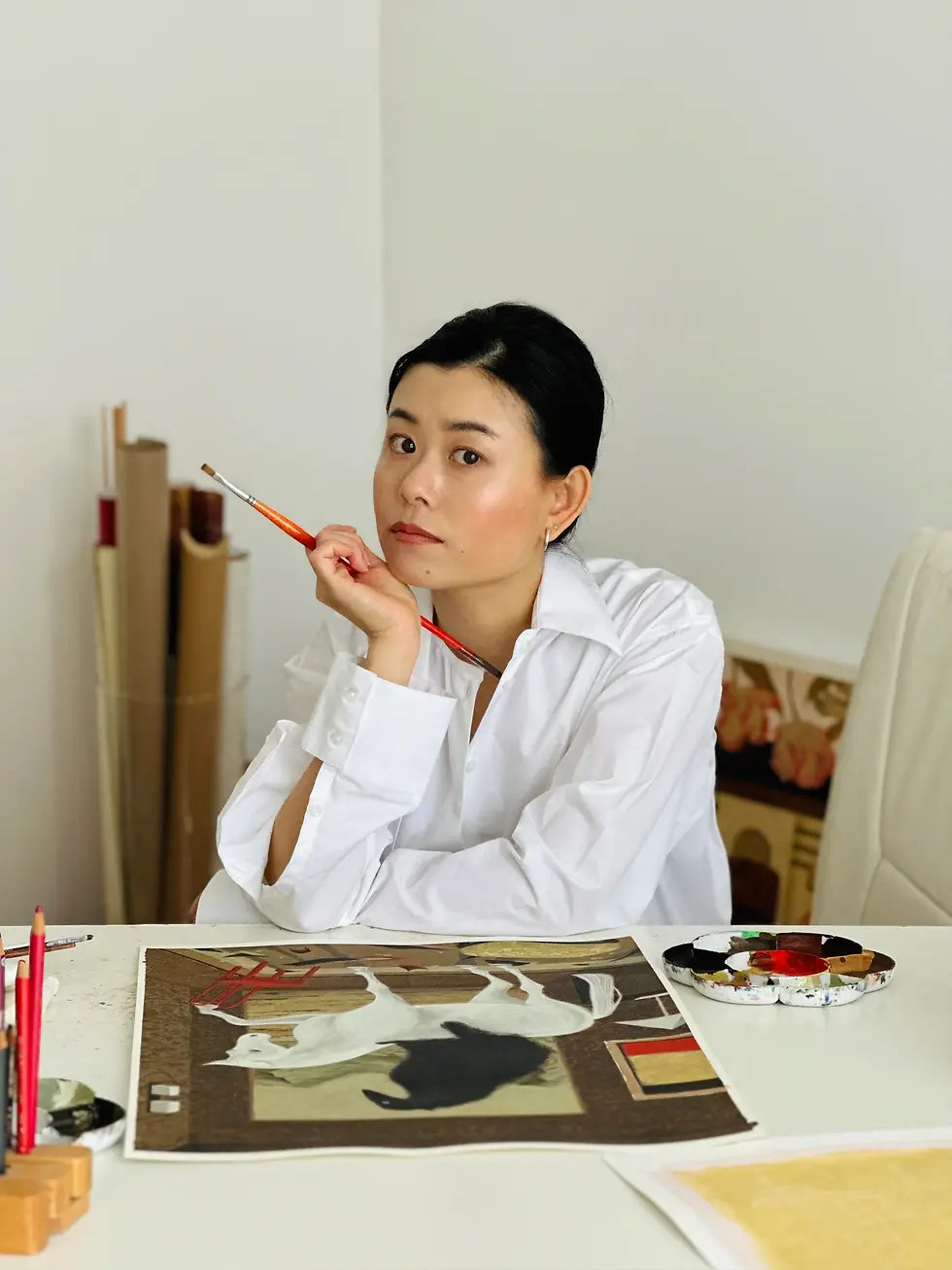
Liz Schneider
Liz Schneider is an artist based in New York who paints, makes ceramics, prints and installations. She had a deal with her parents that if she did not get into art school she would have to study computer science, so she applied and got accepted. Schneider paints from memory, starting from a mark or a stain and following whatever shows up. If she sees a bear in a paint stain she works with it until others can see it too. She sees humans as the most violent species and paints nonhumans instead. She says animals are a safe space, a pure form of communication. She finished her MFA at Columbia and teaches silkscreen there.

Q: Where did it all begin for you? What got you making things?
A: I've always been making and working with my hands, which is something I realized when my parents were pressing me to go to college. So I decided to apply to art school, and I had an agreement with my parents that if I didn't get accepted, I would have to apply to computer science or something along those lines. Thank God I got accepted. I can't really do without making things. I'm not a very expressive person, and without art I wouldn't know how to even begin to express my feelings or thoughts at all.

Q: You paint from memory or feeling rather than from life. What does that process actually look like?
A: I would do studies and sketches of whatever I wanted to paint to get familiar with the anatomy and proportions, and later on I would try to remember the important shapes of the subject. Mark making is a big step in the process. Whether it's a line or a stained surface, that would be my starting point, and I will continue intuitively from there. My hands and eyes will guide me from a memory or a feeling of how this mark could actually evolve. For example, if I see a bear in a paint stain I made, I would try to work with it so others could also recognize the bear in the composition, or at least some kind of living being.
Q: You work across painting, ceramics, printmaking, installation. When you take the same subject into a different medium, what changes?
A: A lot changes—is how I feel about it. The shift from 2D to 3D makes a big difference in how the end results come to be. The movement and materiality of the subject are very different. It might look more animated in a different medium, as well as giving that subject a more present existence in the world. That specific subject is now part of reality, as it has more evidence of existing in space.
Also, if I do sculpture or installation, I have to consider gravity, which doesn't have to be present at all if I paint or print.
Q: You teach silkscreen at Columbia and work as a professional printer. How does that technical side affect what you do in your own studio?
A: It's definitely helping me sharpen my skills and knowledge in a specific medium. As I teach students, I get to troubleshoot in real time if the prints don't come out right, and also brainstorm with them to help them achieve the results they want. I also troubleshoot while professionally printing editions and adjust the way I work so they all become a cohesive edition. I think because I have to print so many prints for an edition, when I get to the studio I tend to get more "messy" and let loose, so I gravitate toward monoprints or "dirty" prints for myself.


Q: You see humans as the most violent species and give the spotlight to nonhumans instead. Has it always been that clear for you?
A: In some way, yes. I have always loved animals and spending time with them; they are a safe space for me in a sense. I don't need to think about courtesy or what I say or how I act. It's a pure form of communication. Humans hurt or attack verbally or physically because there's usually a motive; it's rarely a biological fight or flight situation in daily life. A simple example would be the difference between nonhuman predators and human predators in our society. Violence is a term we coined and created. For other living creatures, it's part of their natural instincts, used for surviving in their ecosystems. There is no such thing as violence outside human culture.

Q: You finished your MFA at Columbia last year. What's ahead?
A: I'm working on figuring out a new body of work and seeing what I've actually learned from the experience, and how I challenge myself in the studio. I'm participating in shows here and there, and I am extremely grateful to many of the people I met along the way at grad school who are still there for me today. Someday I hope to give back as much as I was given.