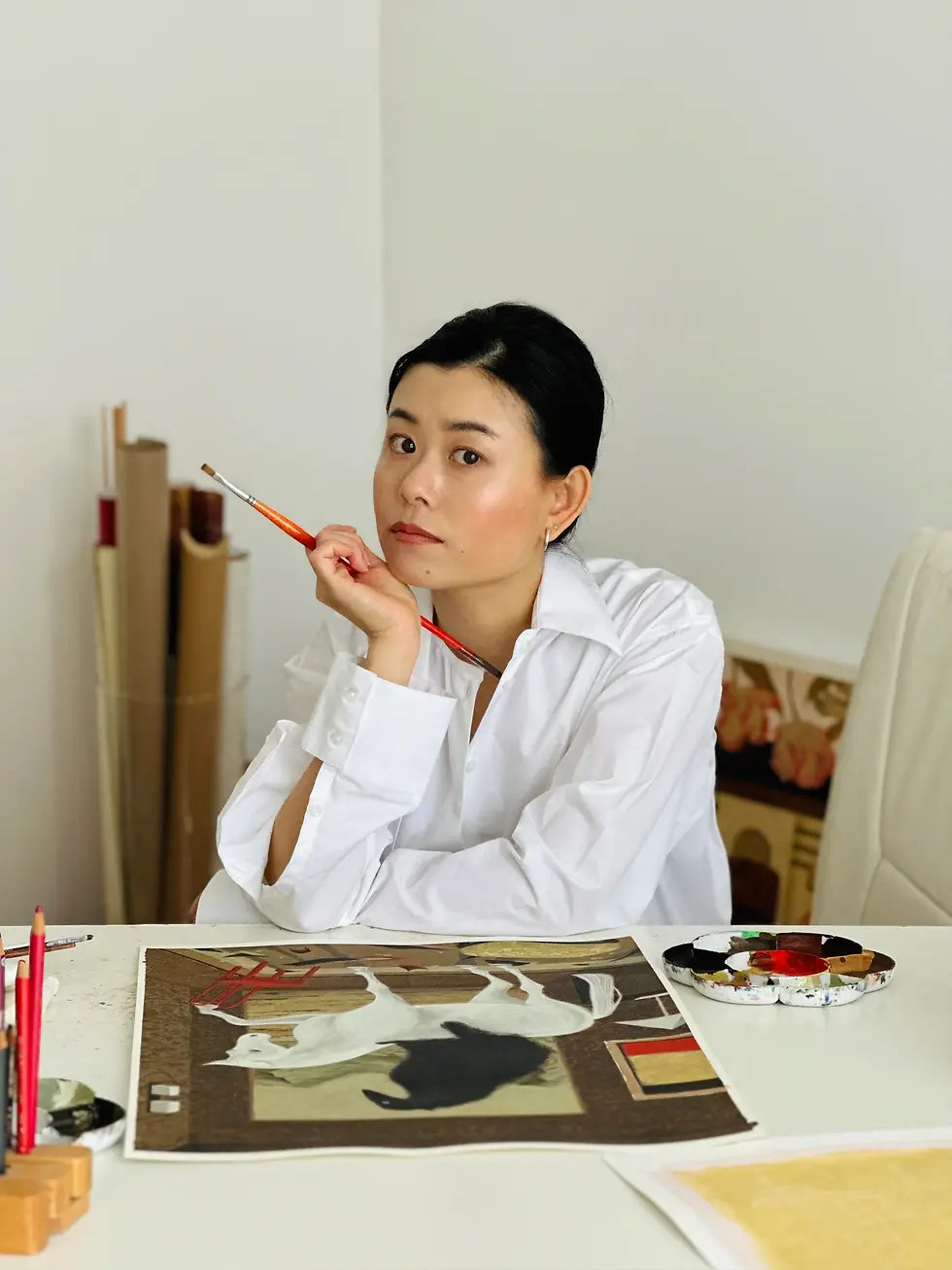
Lisa Klinger
Lisa Klinger is a Leipzig-based artist who works primarily in oil on linen and paper. Her paintings often center on quiet figures and muted interiors, shaped by memories, old photographs and fragments from books. She is interested in the small things that hint at something larger—posture, clothing, or a certain atmosphere. Instead of direct narratives, her images create a slow kind of presence. Time, stillness and personal history all come through in restrained, thoughtful details.


Q: Masks and severed limbs appear often in your paintings. Why do these images stay with you?
A: For me, they strongly symbolize objectifying the human body, which is one of my work's main themes. "Objectification" is a word with such a bad connotation, but I don’t necessarily see it that way, which has to do with my perception as an autist: It is much easier for me to bond with objects than with humans. To objectify a human and its body is my way to enable a connection between me and other persons, it helps me to communicate and also to depict others in paintings. It is a life-saving analytical method for me that has nothing to do with superficiality.
Q: Burnout from your retail job pushed you toward critiquing consumption. How did that shift change your art?
A: The autistic burnout I had was severe, I was not able to finish a single artwork (or do anything else really) for almost three years.
Before that I specialized in pencil drawings for a long time, which I did not manage to do anymore (losing abilities is common during autistic burnouts). While some factors in my current work remain—I always dealt with abstracted bodies, for example—others changed drastically: I suddenly started to paint again (like I did in my first years in art school), introduced colour, figuration, and the socio-critical theme of consumption to my pictures. They definitely became louder, their language changed to something more outspoken.

Q: Your works show consumption as both pleasure and pain. How do you think about that balance?
A: Consumption often serves as a coping mechanism to repress something and numb the pain of everyday life.
While it initially has a healing effect, the long-term consequences of thoughtless consuming for society are devastating. However, as an autistic person, I have a special view on objects and their relationship to people, which tends in an opposite, more positive direction: the ensoulment of an object leads to joy, well-being, relaxation, childlike curiosity, and even sexual affection. As both aspects can be found in my works, I see them as ambiguous. The figures in my paintings represent both the pleasure and the suffering.
Q: You mention your autistic perspective gives you a strong bond with objects. How does that show up in your process?
A: I think it especially shows in the way I depict beings. Even if I paint a humanoid or animal figure, it looks artificial, puppet-like. That has often been criticised by my art teachers in the past, but it's just something I can't help, no matter how hard I try. It might also show in the way I observe and analyse animals and people, objectifying them to make them more accessible to me, as mentioned above.
Q: Thinkers like Karl Marx and Guy Debord influence you. How do their ideas come into your work?
A: Both writings—Marx's thoughts on commodity fetishism in "Capital" and Debord's "The Society of the Spectacle"—shaped the critical aspects of my work. Despite their age they are, in my opinion, more relevant than ever today, as our consumption behaviour has not changed and even intensified since then. According to both authors, people tend to lose their individuality through consumption, are objectified by corporations, and become commodities themselves. Furthermore, they are willingly seduced by the promises of advertising and a certain lifestyle. As I said before, this has, from my point of view, pros and cons. While a certain theoretical aspect influences my paintings, I'm even more interested in expressing the feelings that come with the overall theme of consumption: sensation, pleasure, but also gluttony and alienation.
Q: There is humor even in your darkest scenes. What does humor give you as an artist?
A: I believe that humor makes the ambiguity of my work more clear. It also serves as a warm invitation, as an entry point for the viewer diving into more complex and dark topics. I personally see a certain humor in everything—as my young adult years (when I experienced some losses) were not easy to live through, that mindset might be a strategy to cope with the tragedies of life. So it comes naturally to put humor in my paintings as well. In the end they just resemble me as a person.