Chang-Rong Lin
Chang-Rong Lin works at the intersection of art, research, and curation, often focusing on how space, nature, and memory shape perception. His installations use light, time, and minimal materials to create quiet, temporary environments that heighten spatial awareness. Based in Taiwan, his recent projects have taken place across extreme landscapes from polar lakes to deserts, where he explores transience through direct interaction with natural conditions. Each work reflects a careful attention to atmosphere, presence, and the body's place in space.


Q: You often talk about “space as a body.” What does that idea mean to you in everyday life, not just in art?
A: For me, space is not merely a static container but an organic presence, much like a body. It breathes, it pulses, and it shapes our senses and behaviors. In daily life, I often notice how space alters my feelings: a cramped and crowded room can create pressure and unease, while a vast natural landscape allows the body to feel freedom and expansion. Light, sound, scent, and temperature within a space are, to me, like its blood and texture, resonating deeply with our own bodies.

Q: As both an artist and a scholar, how do you keep theory from getting in the way of instinct when you create?
A: I see theory and instinct not as opposites, but as complementary forces. At the beginning of the creative process, I allow instinct to guide me, since it has long been an integral part of my practice and belief system, often leading to unexpected breakthroughs. Theory comes afterward, serving as a tool for reflection and contextualization, helping me situate the work within a broader social and cultural framework. In simple terms, I act first and reflect later. I do not let theory suppress the initial impulse of creation but allow it to enrich and deepen the work in its later stages.
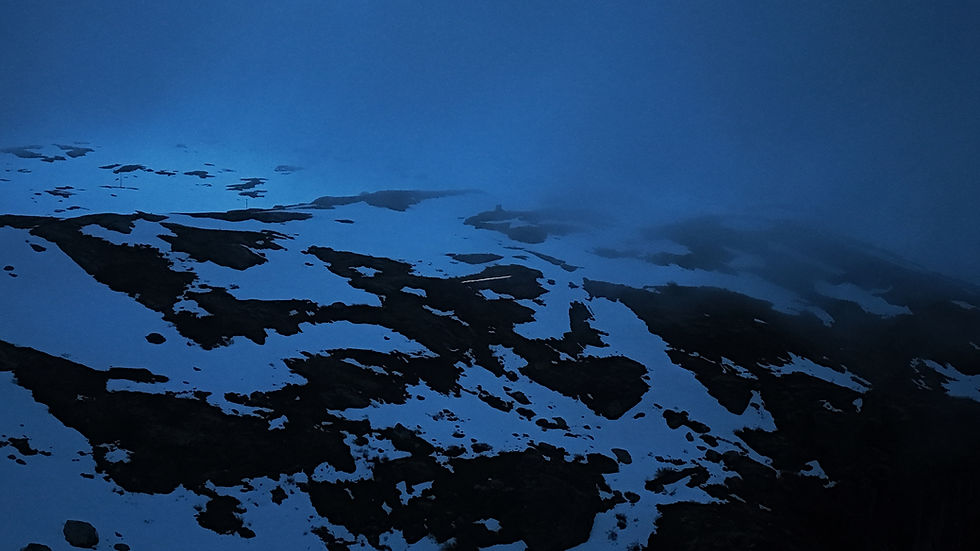
Q: In "Spatial Reality" you used a beam of light on ice. Why did you want to work with something so temporary and fragile?
A: The themes of transience and fragility have always fascinated me. The combination of light with ice and snow produced a tension of “being as vanishing.” Ice melts, light fades, and this inevitable disappearance becomes part of the work itself. For me, art does not always need to strive for material permanence; it can also exist as a fleeting experience, a perception that takes place in the moment.
When viewers become aware of the fragility of the work, they also become more sensitive to the passage of time and the brevity of life.
Q: Living between Taiwan and places like Norway or Finland, how does moving through such different environments shape your perspective?
A: Taiwan’s environment is humid, lush, and full of vitality, while the landscapes of Northern Europe are extreme, vast, and imbued with a sense of solitude. These contrasts have made me more aware of how environments shape human perception and culture. In Taiwan, my works often engage with social issues and human interaction, whereas in Northern Europe, they reflect a more philosophical dialogue with silence and emptiness. Moving between such different regions has trained me to continually adjust my perception and discover new artistic languages in each setting.
Q: Your work links society, nature, and memory. Where do you feel those tensions most strongly today?
A: I find the most intense tensions at the boundary between city and nature. The city embodies systems of power, capital, and technology, while nature preserves primal memory and the fragility of life. When these two forces intersect, conflicts inevitably arise, such as the clash between land development and environmental preservation, or the disappearance of natural memory amid climate change and humanity’s adaptation.
In these contradictions, art can serve as an intervention, urging us to reconsider our position between society and the natural world.
Q: In "Spatial Reality – Before Vanishing" the desert acts as an “anti-space.” How did that change the way you think about permanence?
A: While working in the desert of Oman, I felt deeply that the desert is both boundless and filled with disappearance. It is not an empty void but an “anti-space” that continually challenges human notions of permanence. Grains of sand shift endlessly, landscapes are in constant flux, and nothing can ever be truly fixed.
This experience led me to rethink permanence as not something static or unchanging, but rather as a continuous state of flow. In the desert, existence and disappearance intertwine, making me realize that both art and life are processes of seeking authenticity within constant transformation.


