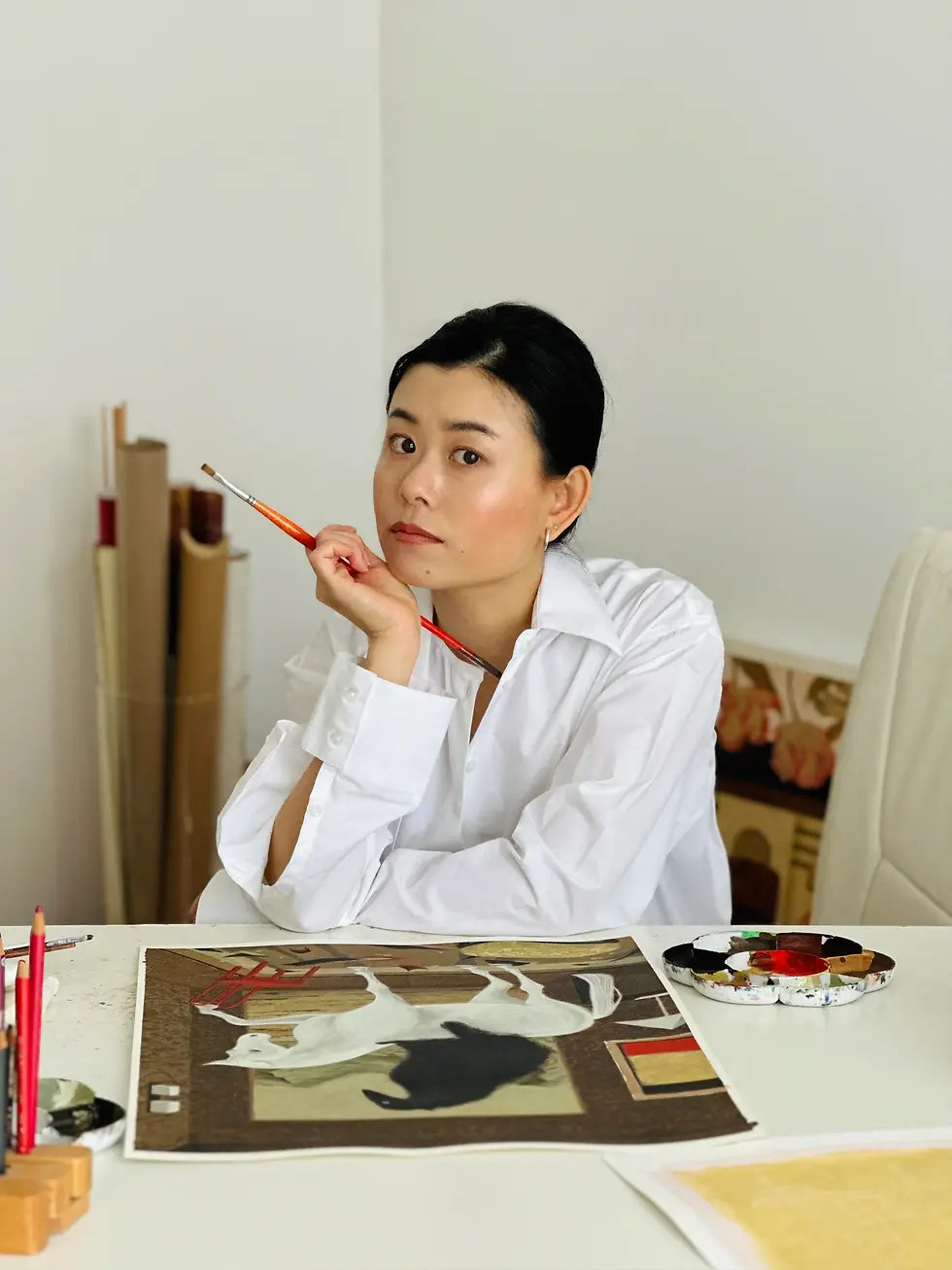
Laila Errazzouki
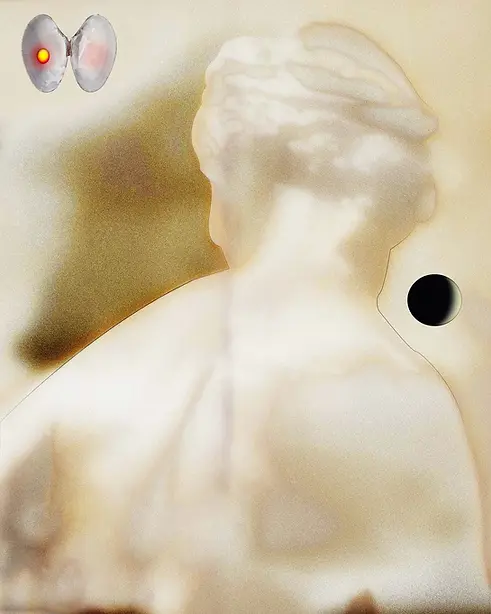
Laila Errazzouki is a Moroccan-American collagist whose work explores duality and transformation. She trained in graphic design at Virginia Commonwealth University School of the Arts. Using collage, she combines ancient and modern in a single visual space. Her work draws from medieval Islamicate astrology, Muslim folklore, and popular culture, connecting sources like Abu Ma’shar al-Balkhi and “The Wizard of Oz.” Repetition is key to her process, letting different cultural and historical threads come together in one composition.
Q: Your work often plays with opposites like connection and conflict, old and new. What keeps that balance interesting for you?
A: It’s interesting because it’s ubiquitous. It is embedded in the cycle of life and death, sunrise and sunset, the turn of the seasons, our relationships with others, and our relationship with ourselves. It is a pathway that leads to a remarkable depth, keeping me inspired. Through it, I have been able to recognize patterns and create exciting connections between subjects that initially seem unrelated.
Q: Medieval astrology and folklore appear often in your practice. What first pulled you toward those worlds?
A: I was searching for belonging. I found great comfort in medieval astrology because it teaches that the self is intertwined with the cosmos. Similarly, folklore explores the relationship of the self to the community.
As someone living in diaspora, home is an unfamiliar place. Regardless of where I am, I have always felt a profound sense of disconnection from my environment. Yet, studying folklore and medieval astrology, amongst other things, reframed how I once understood belonging not as a thing to be sought, but as something inherent that is rooted in my connection to the celestial, to traditions, and to myself.

Q: When you build a collage, do you think of it more like storytelling or like solving a puzzle?
A: Both. There’s always a story to be told and a puzzle to be solved. I think of it as a conversation. I’m talking to the collage and it’s talking back. The story gradually reveals itself throughout this back and forth. The puzzle is in knowing how to navigate this dialogue.
Q: You mention Abu Ma’shar and “The Wizard of Oz” in the same breath. What connects those two in your mind?
A: Both are revelatory in how they step behind the curtain and illuminate what is concealed. “The Wizard of Oz” introduced me to the idea of another vibrant world, some place somewhere. Later, studying the teachings of Abu Ma’shar granted me the knowledge of the celestial spheres and their radiant, hidden ways. Each has shifted my perspective at critical moments in my life: as a child, watching “The Wizard of Oz” cracked my world wide open; as an adult, studying Abu Ma’shar gave me the language for this vastness.

Q: Your pieces mix physical texture with almost digital precision. How do you decide where the human hand stops and the machine begins?
A: We’re both active from beginning to end. It’s a mutualistic relationship. Even in the brainstorming stage, I am thinking within the framework of the machine; therefore, it is always present. And, without my hand to guide the creation through the machine, the collage would not exist.
Q: You’re developing a new series around amulets and talismans. What kind of energy are you trying to tap into with that?
A: I’m interested in learning and understanding how an object or symbol becomes a vessel for divinity. At what point does the terrestrial become celestial? My obsession with duality, my practice of medieval astrology, and my research into folklore have all led me here. And, in researching and creating work based on amulets and talismans, I hope to honor these subjects that have been deeply influential to my craft by furthering my knowledge of the infinite ways they show up in the world.