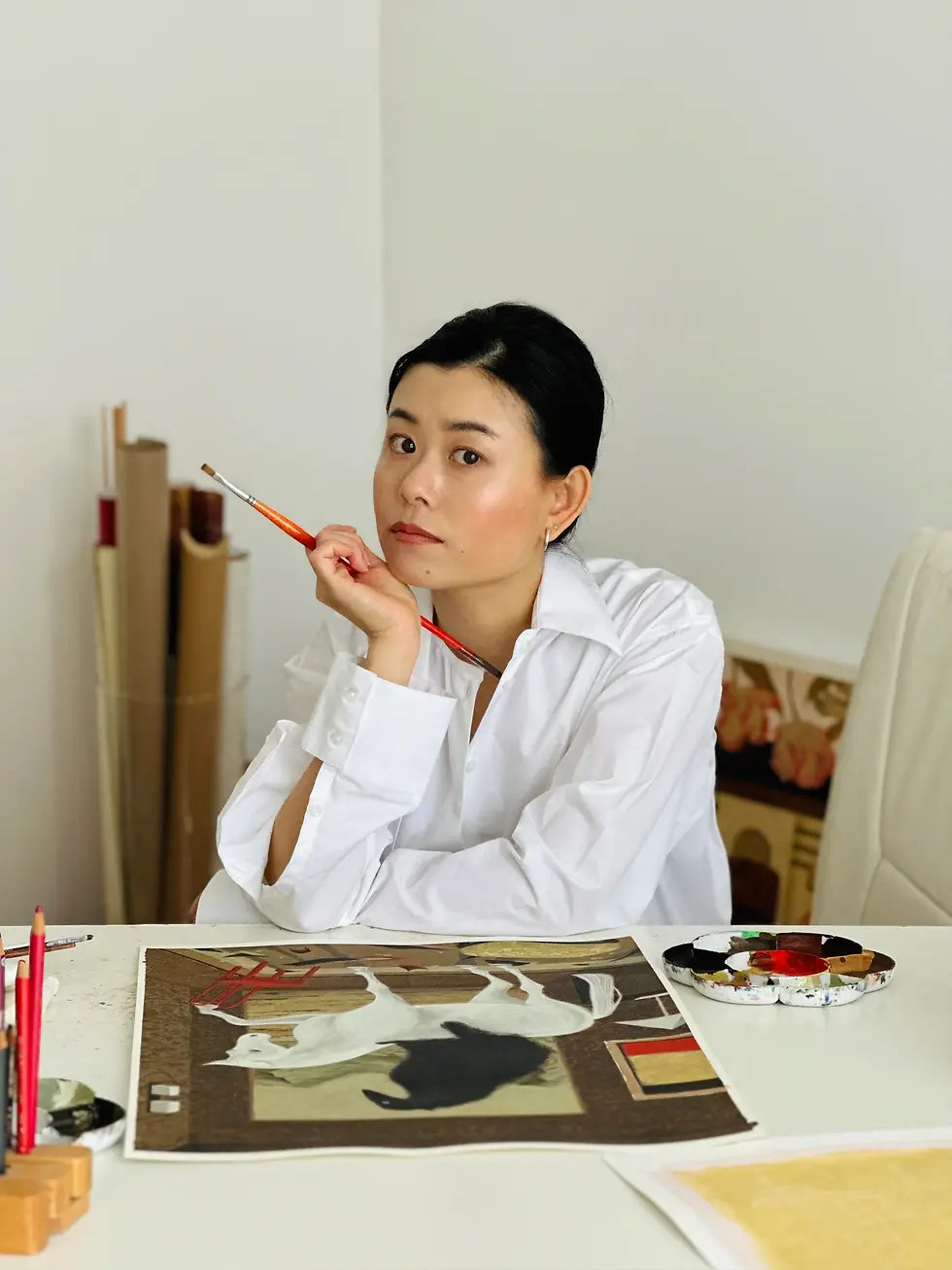
Kai Sebek
Kai Sebek is a Czech visual artist, photographer, and illustrator based in Prague. She often works in remote natural places, spending time observing and documenting what she finds there. Her images mix photography with simple hand-made elements and drawing, all built on real locations and real conditions. She is interested in how landscapes feel and change, and how stories can grow out of direct experience in the field.

Q: What parts of your early fascination with fantasy and adventure still stay with you when you begin a new piece?
A: Curiosity and the desire to see it with my own eyes. When you realize that much of what once seemed “impossible” or “just a dream” can actually be experienced or done, things start to happen.
Childhood dreams and fantasies can be made real, and that awareness gives you tremendous power. I draw from the imagination I had as a child when I looked at the world, and in each landscape and each of my projects, it takes on a new form, depending on what I am witnessing at the moment. It started with a story, and it continues through story.
The difference is that now, the stories can be lived, not just listened to or longed for, like those thousands of fantasy tales we used to get lost in as children.

Q: Your practice moves between real environments and imagined ones. How do you decide how far to push the fiction in a piece?
A: From my point of view, fiction can be a brilliant tool to clarify complex data and real-life processes. How far I go depends on the environment I’m in. If factual observation is strong enough on its own, I leave it as it is. But when a process is too complex or difficult to communicate, I use fictional elements to bring the idea closer to the viewer in a playful way, without disrupting its scientific foundation. The boundary is simple: fiction should enhance understanding, support reality and science, not replace them with pure fantasy. In essence, I use stories to add color to what the landscape or environment already holds within, so fiction always remains rooted in data, behavior, or experience in the field.
Q: When you’re out in the field, what usually stands out to you first in a place?
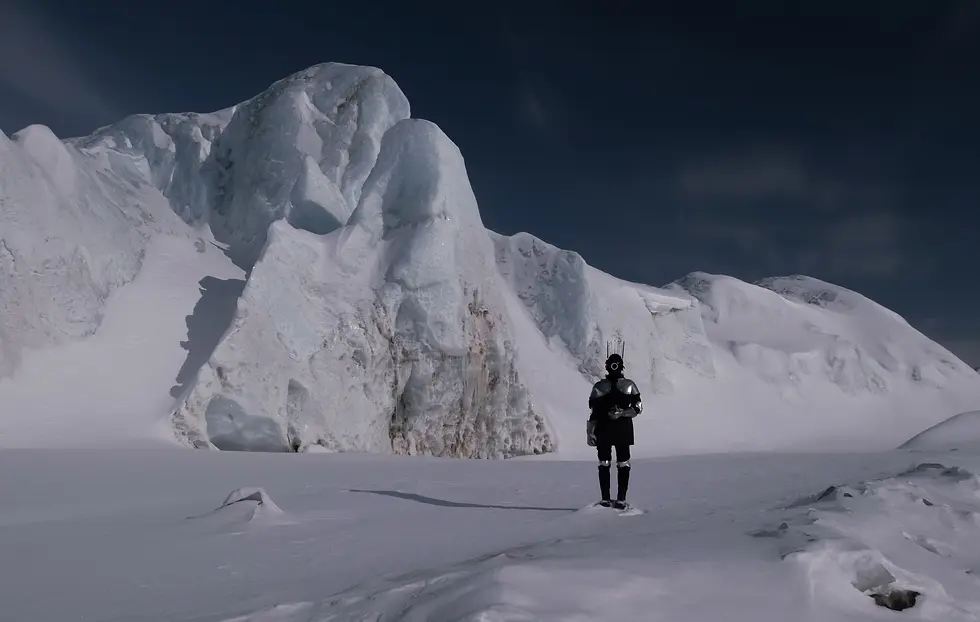
A: That really depends on where I am. :) Each place has its own charm, and I enjoy being a kind of chameleon on my expeditions. At first, I observe and adapt to the color, and only then do I allow myself to go deeper into exploration. In the high Arctic, the first thing that hit me was the intense cold on my face, followed by my jaw dropping at the endless scale, the mountains and glaciers too vast to fit into a frame. I wandered there in disbelief for an entire month, overwhelmed by this different world that never gets old. In volcanic regions, I love to search for and study the surface textures, their colors, and oddities. Volcanoes repaint everything—mosses are orange, trees are red, and underfoot the glowing yellow obsidian crackles with sulfur. Deep forests and jungles change their face with the weather. In the mist, they feel mysterious and dangerous, but in clear weather, you find yourself in a gentle fairytale.
Mountains offer views of more mountains, pulling you to explore one horizon after another. The ocean is a world of its own, especially considering how little of it has been explored.
We know only a fragment of what lives there, and that stirs my curiosity. So it’s hard to say. It doesn’t really depend on me, but on the place, and its inhabitants, if any. And that first “wow” moment is always different.
Q: You’re drawn to wilderness, organic patterns, and quiet, remote locations. What kind of landscape pulls you in the most?
A: Landscapes that seem resilient at first glance, and yet are the most fragile. Places where a small change can affect the entire environment, but where at the same time a unique logic of evolution and adaptation exists. Polar regions, volcanic islands, or deep-sea ecosystems—they all share this quality.
I’m drawn to places that feel otherworldly, and yet are unquestionably part of our planet. What’s more, they often have the greatest impact on Earth, especially when it comes to climate change and the ecological processes unfolding now. These places make the changes visible, even as they invisibly influence the entire world. They are proof that we live in fantastical worlds and also, unfortunately, how quickly those worlds are becoming myths. One day, we might tell tales of glacier castles. For now, they are still here.
Q: You want viewers to feel like explorers rather than being moralized to. How do you build an image so that invitation is there?
A: First of all, I never work with just a single image. Everything I create becomes part of a slowly building story. That story is made up of many media—illustration, photography, narration, science.
I try to build a world on real foundations, and the invitation for the viewer is the chance to become part of that story, to step into the shoes of an adventurer and try it for themselves. Because what I do, anyone can do.
We live in the world I capture, and it’s up to us how we behave in that setting. I want to awaken curiosity in viewers, and through storytelling, encourage them to take an interest in some of these ecosystems. Not because they have to, but only if they genuinely get excited about it. That’s how it works for me. I get fascinated by something, and then there’s simply no way I won’t explore it down to the last detail. In a way, it’s a gentle form of learning about our world and what it has to offer. When people feel like they discovered something on their own, in their own way, their connection to the topic is deeper, I think. My work is just meant to support that childlike curiosity, and the rest is up to you.

Q: You work with photography, illustration, 3D props, and performance. How do you choose which form a new story needs?
A: I generally enjoy discovering new things, and it’s no different when it comes to storytelling media. I’m open to almost anything, and I always adapt to the landscape and places I find myself in. Illustration and photography are always the narrative foundation, but what else joins in depends on the circumstances.
3D was something new for me this year, but I loved it because I could bring an entire imagined costume to life, down to the last detail, and work with it in such an unpredictable environment that creating a photographic stage was a real challenge. I don’t think I’ve ever been as cold as I was inside that armor, but it was worth it.
Since I “add color” to reality only lightly, it’s important for me to work with that reality as fully as possible. That’s why there’s not a trace of AI or photomontage in my work. The only addition to the photographs is illustration, but even under that illustration, the photo always shows what was really there, or what I physically created on site.