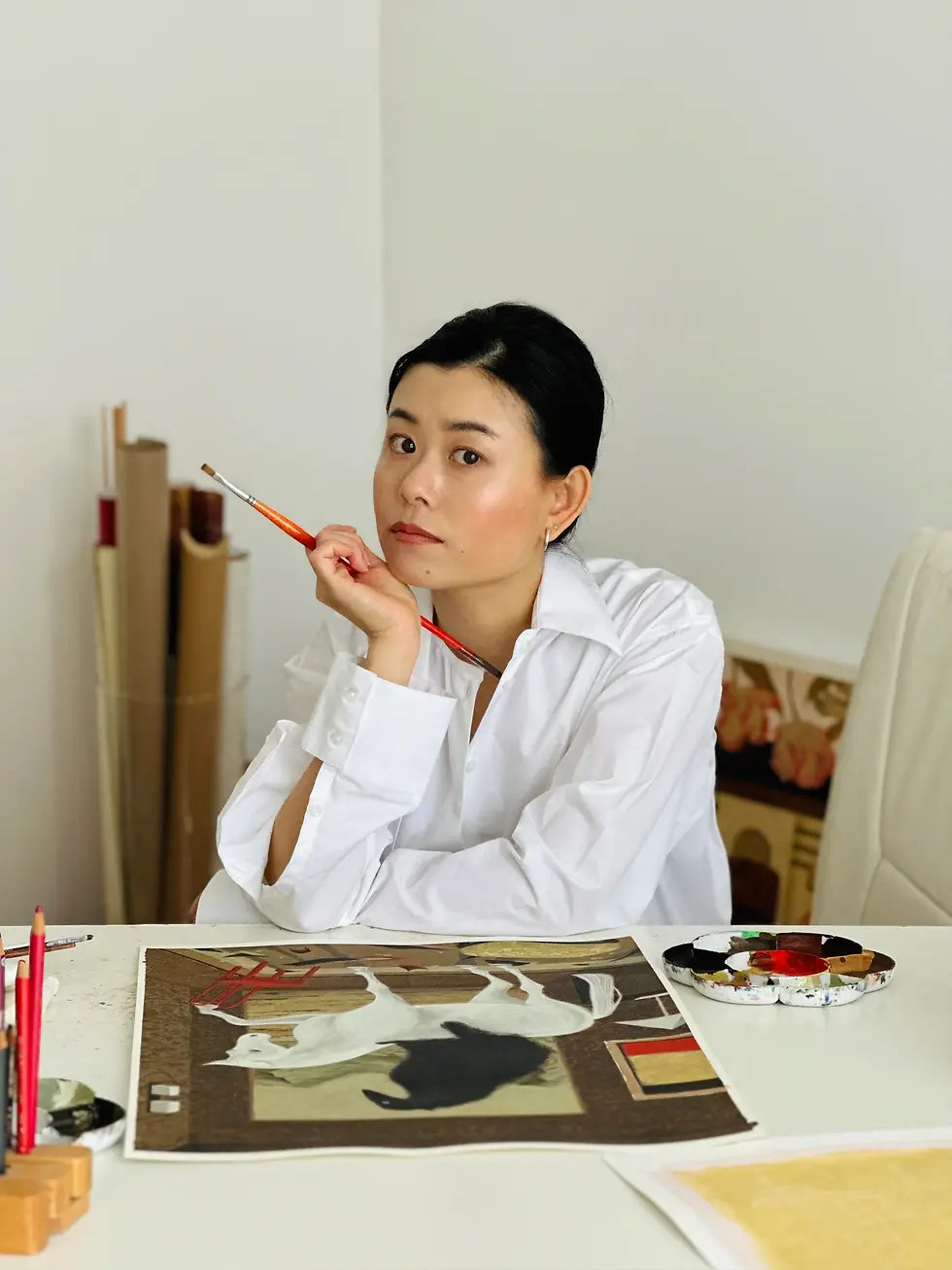
Jin Fang
Jin Fang is a Chinese artist who lives and works between Shenzhen and Amsterdam. She creates her paintings and drawings through slow layering, erasing, and reworking. Her art reflects impressions she gathers from travel and daily life. This approach allows images to develop gradually instead of being predetermined. Each piece is constructed through a rhythm of building and interruption. Marks are scraped, covered, and revisited, leaving behind traces that stay active in the final image. The surface becomes a record of these changes. In works like “The Primal Shadow” and “A Burning Pomegranate,” this process shapes a visual language shaped by change and persistence.

Q: Your work often moves between body and atmosphere. What usually starts that shift for you?
A: That shift usually comes from something very subtle — a mood, a scent, a sudden memory, or something I saw before. It’s never planned; it just happens naturally. When I paint, I follow that feeling, though I never know where it will lead. Sometimes it comes from the body, sometimes from a remembered image, but it always feels very precise. The moment when the body, atmosphere, and subconscious begin to blur and merge — that’s when everything becomes clearer, more real. That’s when the painting starts to come alive.
Q: “The Primal Shadow” feels raw and direct. What pushed it in that direction?
A: I used to think I needed a clear idea before starting a painting, but in reality, I never know how it will end.
My process is quite spontaneous — I work quickly, letting the subconscious take the lead rather than rational control. If everything were planned, the painting would be different. I want each brushstroke and color to feel like a pulse coming from within the body.

Q: There’s always some tension in your figures. Is that something you plan or just feel out as you go?
A: That tension isn’t something I plan — it emerges naturally in the process. It comes from moving back and forth between control and release. I’m drawn to that unstable state, when something is both forming and falling apart. For me, tension is what keeps the painting alive.
Q: You talk about destruction and renewal. How does that actually play out when you paint?
A: I often disrupt what’s already there — scraping, blurring, or erasing parts of the surface so that something unexpected can emerge. Destruction becomes a way of creating new space. Sometimes a form disappears entirely, but the trace it leaves behind shifts the rhythm of the whole painting. Renewal begins when I start responding to those remains — when what was once erased begins to speak again. For me, painting is a constant cycle of collapse and reconstruction, of absence turning into presence. It’s the way the work breathes.
Q: “A Burning Pomegranate” feels both calm and charged. Do you ever aim for that contrast, or does it just happen?
A: That contrast usually happens naturally. I’m drawn to moments where calmness and strength coexist — like something quietly burning beneath the surface. When I paint, I don’t try to resolve that opposition; I allow both forces to exist together.

Q: You’ve lived and worked in different places. Has that changed how you look at your own work?
A: Yes, moving between different places has changed how I see everything, including my own work. Each environment brings a different rhythm — the mood, the smell, or something visible — and these sensations slowly filter into the paintings. Living between cultures has made me more aware of transition and in-between states, of how identity and perception are always shifting. I see painting as a form of translation, something that carries traces of many places, yet belongs fully to none. That sense of displacement has become part of the language of my work.