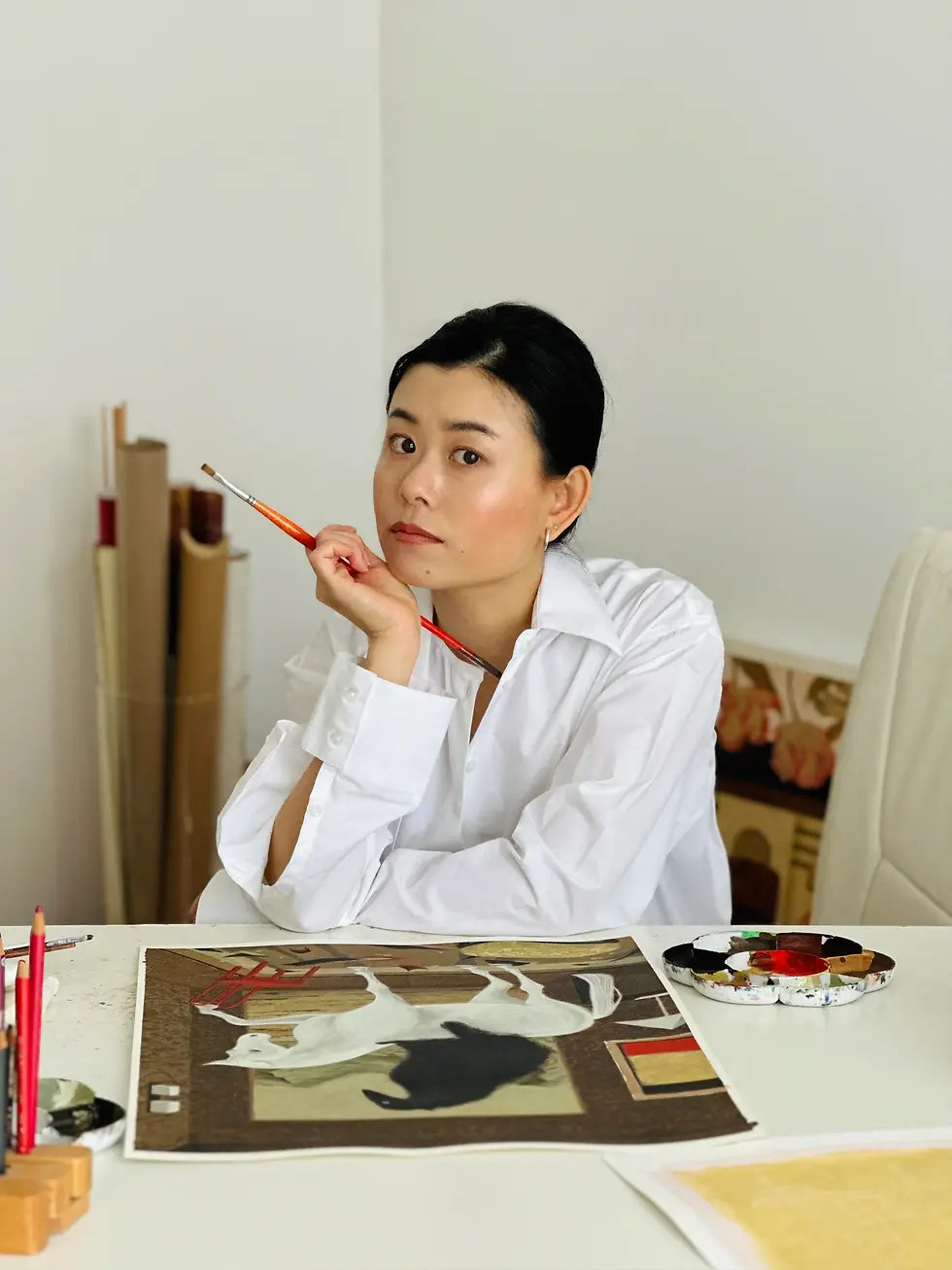
Jenna Sedlack
Jenna Sedlack is a multidisciplinary artist based between New Jersey and New York. She works with painting, sculpture and poetry. In nursery school she was reprimanded for painting the sun purple instead of yellow. Sedlack paints in soft pastel and makes sculptures from found objects, rocking horses, old slides, tiny toy horses, things people leave out at estate sales and spring cleanups. She writes poetry for the same reason she paints.

Q: What got you into making art? And how did painting and sculpture end up in the same practice?
A: In nursery school, I painted the sun purple, and when other children followed suit, I was reprimanded; the sun, I was told, had to be yellow. Later, I drew a monkey whose leg merged into the branch it sat on, disappearing entirely where the forms intersected. That early, subconscious impulse to alter reality, to challenge how we categorize the world, has become the foundation of my practice. Materials carry feeling, and painting and sculpture achieve that in wildly different ways. The paintings function as subtle, atmospheric spaces where instability is in flux. My sculptures lean into the absurdity of the tangible world, repurposing objects that have outlived their original utility with a blunt physicality.
Together, they create a more complete emotional environment; the paintings provide the internal, psychological logic of the experience, while the sculptures serve as the absurd "phantom artifacts" that ground those sensations in reality.
Q: Your pastel paintings require slow work. What keeps you patient with that process?
A: Patience is a necessary byproduct of the material's instability. Pastel is a medium of accumulation and erasure, where the image remains in a state of flux until the very end.
The surface is constantly shifting; every layer of pigment introduces a new risk of muddiness or accidental erasure, forcing me into a state of heightened focus while simultaneously allowing for recalibration.
This puts me in a space where time seems to lose meaning. I'm not aiming for anatomical correctness, but for a psychological one. The time spent is a strategy for staying in the unresolved, because the moment a figure becomes too definitive or correct, it loses that specific quality of a memory that hasn't fully settled.


Q: You've used rocking horses, old slides, speed bumps in your sculptures. How do those objects end up in your studio?
A: Most of these objects are happened upon, sourced during community spring cleanup days or from "picker's delight" estate sales—the uncurated kind where it feels like excavating. There is something deeply compelling about sifting through the raw, accumulated history and sediment of someone else's life.
I am often drawn to the collections left behind: most recently, an abundance of tiny toy horses or a whole box of sparkly rubber bait abandoned by an avid fisherman. I don't go out searching for specific things, but I keep my eyes open for objects that seem tired of their original function.
I am not just repurposing these discarded artifacts into new forms; I am engaging with the traces of the people who held them, staging a dialogue between the previous life of an object and its new, recontextualized existence.
Q: What fascinates you about memory getting it wrong?
A: The brain is a highly efficient machine, not a perfect recording device. Unable to retain infinite data, the mind relies on "predictive guessing" to navigate the world.
It holds onto fragments such as a color, a spatial relationship, or a singular sensation, and uses deep-seated assumptions to stitch them into a coherent whole. We accept the resulting image as fact because it feels familiar. We perceive memory as solid ground, yet it is a composite of probability rather than strict documentation. I lean into the moment where the brain's "auto-complete" function becomes visible, highlighting the friction of misaligned assumptions.
When a gesture separates from its shadow or a figure dissolves at the edge of legibility, it mimics the feeling of a memory that hasn't fully coalesced. I explore this fallibility not as a flaw, but as a fundamental, defining part of the human condition.

Q: How does poetry connect to the paintings?
A: Poetry and painting are different ways of giving form to something that resists easy articulation. Psychologically, both practices require me to sit with ambiguity rather than resolve it. Neither the poem nor the painting is intended to serve as a translation of reality; instead, they operate as catalysts for the viewer's own subjective projections.
Writing forces me to trust the gaps, to leave room for the viewer or reader to fill in their own assumptions, which mirrors the way I approach the unresolved figures and phantom spaces in my visual work. Both practices are rooted in the same fundamental question: how do you communicate a sensation that exists just beyond the reach of direct language or literal representation? The answer, for me, always lives in the tension between what is stated and what is withheld.
Q: What are you working on right now?
A: I am developing a body of work investigating the psychological landscape of "stalled" play. This involves creating a series of sculptures using discarded playground and hobbyist artifacts, rendering them in states of absolute stasis. By stripping these objects of their intended function and recontextualizing them in absurd configurations, I explore the inherent loss of play. We project meaning onto the relics of our past and assign value to things that no longer serve a purpose; these sculptures act as physical manifestations of cognitive dissonance, occupying the space between the recognizable silhouette of a toy and the eerie form of a relic. I want to highlight the tension of forcing a collision between our nostalgic "predictive guessing" and the reality of an object's obsolescence.
Ultimately, mapping the emotional discomfort of outgrowing our history and the shifting blur of how we assign purpose to what we leave behind.