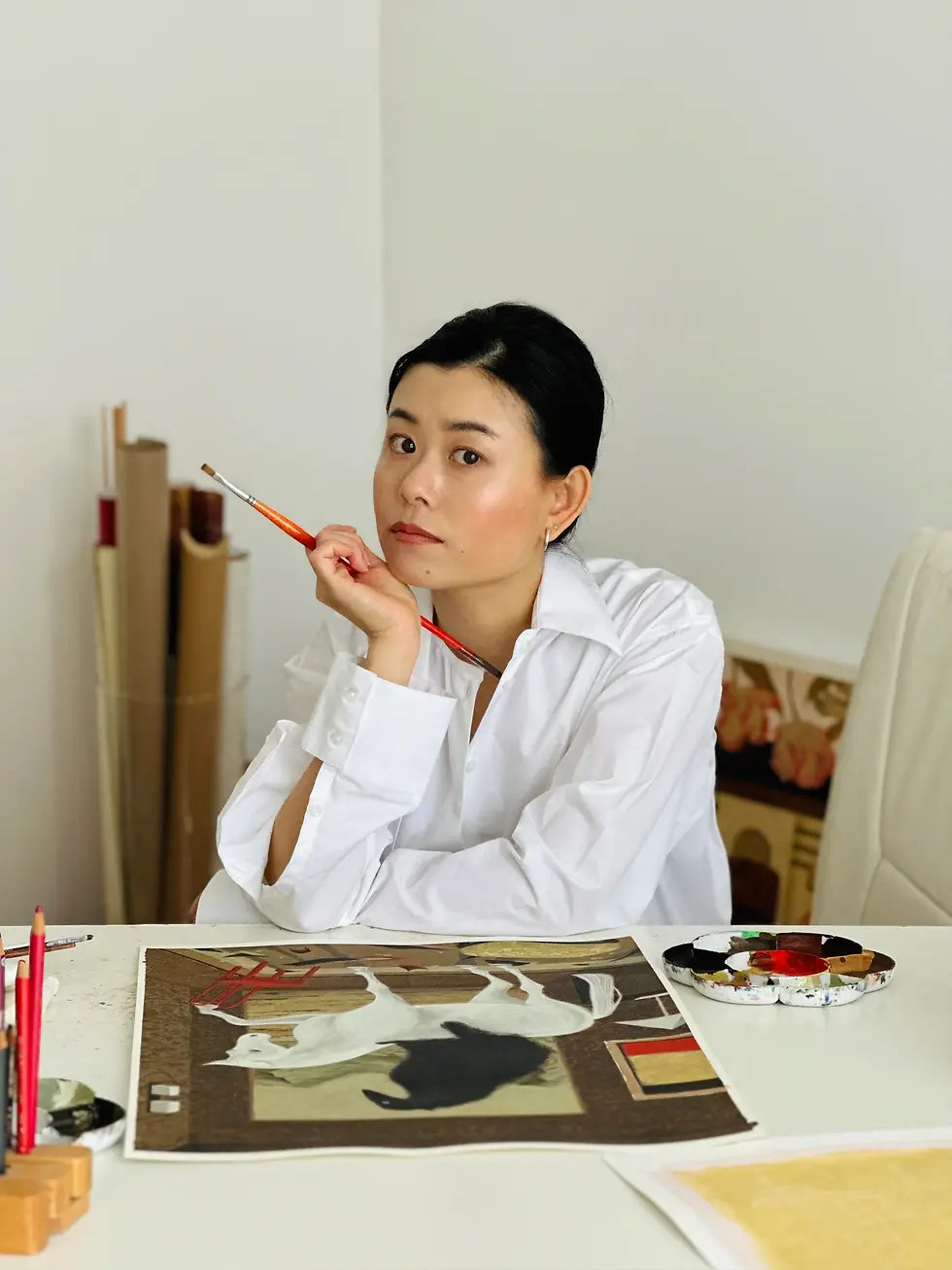
Jan Skácelík
Jan Skácelík is a visual artist and designer from the Czech Republic. He works mainly with painting and digital illustration. His images use clean shapes and clear color relationships. Some works reference architecture or small parts of everyday life, reduced to their essential forms. His recent series include paintings made in muted tones, inspired by the light in his studio. He lives and works in Prague.

Q: Do you remember when you first felt you’d found your own visual world? What led to that moment?
A: I was a very creative kid, always doodling and making things. I spent hours in Microsoft Paint. I don’t think I have a single, definitive visual voice; I’ve always experimented with different styles. About seven years ago I started developing the organic and geometric language I use now, and I’ve been refining it ever since.

Q: You started out in graphic design before moving fully into art. What pushed you to make that shift?
A: The main reason was that client work is almost always a compromise. In graphic design you have to follow feedback and adjust to the client’s taste, so the final result often isn’t what you truly wanted. With art, the process is far more satisfying creatively.

Q: You often talk about balance between order and freedom. Does that come naturally now, or is it still something you wrestle with in each piece?
A: It’s always a challenge. The balance is fragile, especially in more minimal pieces. One small movement of an element and the whole composition can fall apart. Finding the right equilibrium still takes me a long time with each piece.

Q: “Festival of Colors” marked a turning point for you. What changed in how you approached your work after that?
A: It was actually “Summer Nights.” That work combined my earlier minimalist approach with more freeform, sketched elements. The mix opened new directions for me. Lately I’ve been pushing into more experimental territory, using shapes as guides rather than rules, and I’m excited to see where that leads.
Q: Color seems deeply emotional in your process, like in the “In the Oasis” series. Do you see color as mood, or as structure?
A: Color is crucial, especially the relationships between hues. Tuning tones and values can make or break a piece; a single hue shift can elevate or destroy it. Finding the right palette can be tedious. I don’t begin with a fixed mood; I look for combinations that feel right to me.

Q: Your sculptures bring that same language into space. What does working in three dimensions give you that painting can’t?
A: Sculpture gives me the craft I crave. I love making physical objects and working with hard materials, tools, and different techniques. Painting is physical too, but bringing my language into three dimensions lets me think about form, presence, and space in a way a canvas can’t.