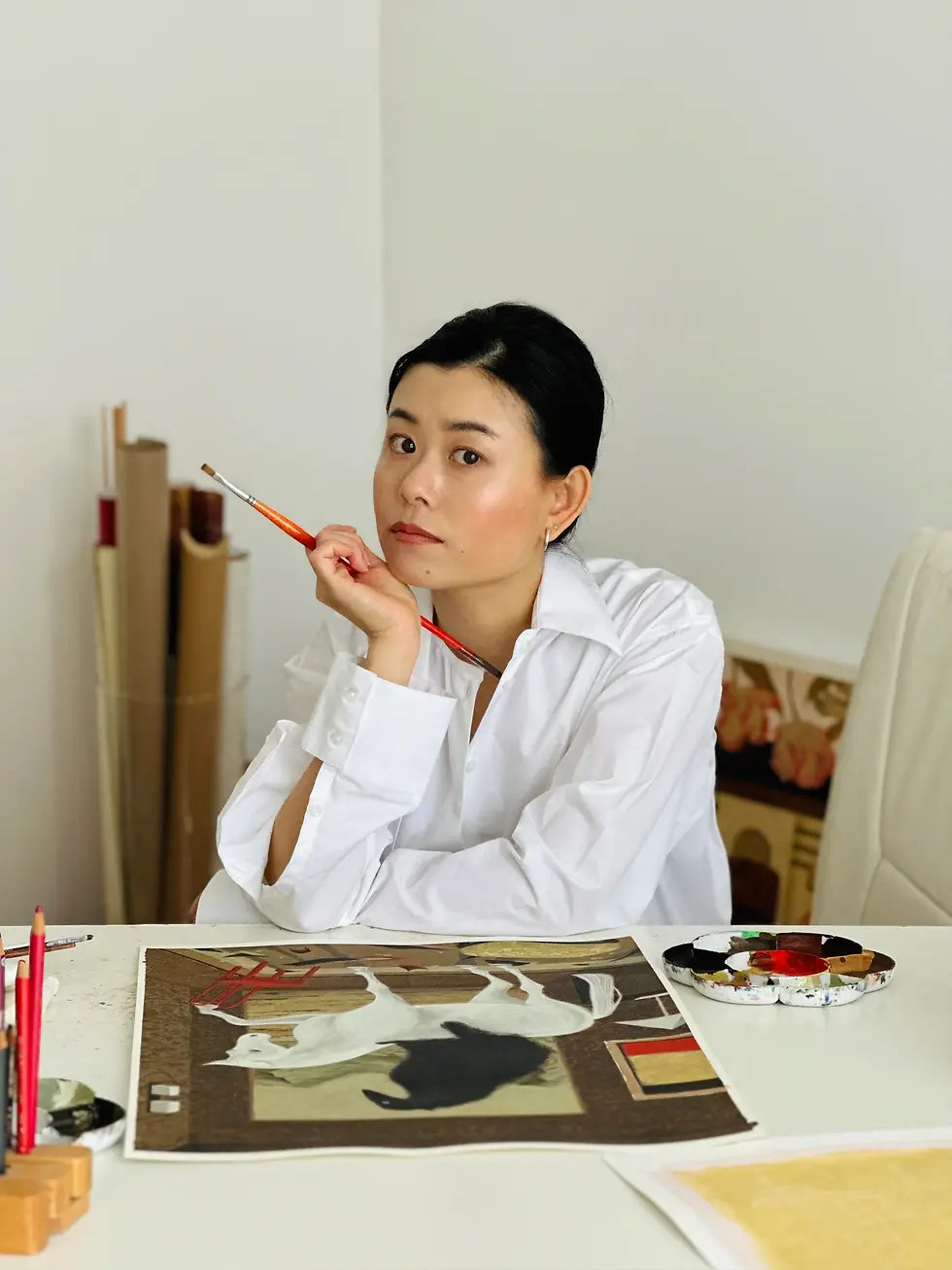
Issy Wilson
Issy Wilson is a London and US based artist working with painting, drawing and textiles. Her work is shaped by natural systems like roots, moss and rhizomes, and often grows through layering, reuse and slow change. She uses materials such as ink, charcoal and cotton fiber for their connection to the environment. Her studio works like an ecosystem, where pieces influence each other and evolve over time. In 2022 she hiked the full Appalachian Trail, an experience that continues to shape her approach to structure and repetition. Recent works include “Turtle Stones,” made from dried ink-soaked paper towels collected in her studio.

Q: You describe your studio as an ecosystem. What does a typical day in that environment look like for you?
A: I describe my studio as an ecosystem because I’m typically working on many different pieces at the same time, and these different elements influence and borrow from each other. While drawing and painting are a main part of my practice, I spend a lot of my time simply on rearranging, moving, and recombining fragments within the studio. In this way, even though nothing is alive, it creates the sense that things are evolving and traveling within the studio space. The studio is also another version of a nest or home for me and my artwork, and in this sense it’s like I’m creating my own context or ecosystem.
Q: How did hiking the entire Appalachian Trail reshape how you think about structure, repetition, or systems in your work?
A: The Appalachian Trail greatly changed how I understand repetition. Every day you have the same goal: hiking. At times this could feel monotonous, but when I actually think about the days that I had, the landscapes I traversed, the people that I met, and the seasons that I watched change, I realized that every day offered a new adventure. Repetition requires perseverance and a trust in the process or goal, and this has a lot of overlap with pursuing an artistic life. These kinds of goals can feel very overwhelming, but I know that they can be accomplished by chipping away at them one day at a time.
Visually, the trail influenced or expanded upon a lot of the structures that you can see in my practice. The organic grids were there before I hiked, but I believe that the constant sensory input of living outside honed and sharpened my attention to these kinds of dendritic elements.

Q: You mention the rhizome as both a form and a process. What drew you to that metaphor, and how do you see it evolving in your current pieces?
A: The rhizome works well as a metaphor for my practice because of its versatile applications. Sometimes I find it difficult to describe all of my different pieces with the same terminology, but rhizomes work well because of their branching structure and the ability to grow both roots and shoots. Philosophically, I like that it refers to multifaceted and nonlinear thinking, which is also what my artwork is getting at at a deeper level than the immediate ecological focus. Additionally, I am influenced by the way that mosses, lichen, fungi, and trees grow and collaborate. They have social structures and forms of intelligence and resilience so remarkable and different from our anthropomorphic perspective. The materials that I use also possess their own form of systems and knowledge. Considering these other forms of understanding and thinking is a crucial element to my practice, and it is exemplified by the rhizome.


Q: Your materials—ink, charcoal, cotton fiber—carry a strong sense of the organic. How do you choose what to work with, and what role does sustainability play in that?
A: My interest in studying ecology led me to search for more sustainable ways to create paintings, drawings, and textiles. In the process, I’ve learned so much from the materials and have been drawn to their inherent qualities.
They resonate with my subject matter and they feel healthier to work with in the direct sense that they are not toxic on my skin or creating toxic fumes.
It is not possible to be entirely sustainable, but I believe that it is important to have a consideration of where and why I am using the materials that I use. I still use acrylic or water-based emulsion paints for the effect that they create in my paintings. My goal with these is to use recycled or discarded emulsion paints and to not use large quantities. It’s not perfect, but my relationship with my materials and sustainability is one that will always be evolving.


Q: There’s a clear dialogue in your practice between order and disruption—grids and organic forms, systems and spontaneity. How do you navigate that tension?
A: Navigating this tension is exactly what I love about my practice and making art.
The natural world is full of geometric structures and order that then shift into organic forms. Actually, I don’t think there is as much of a distinction between geometric grids and organic forms as we tend to observe. In nature, these different elements fluidly transform and make one another. In a lot of ways, I feel that these differences are used to distinguish human-made and nature-made from one another, and yet everything that humans have made comes from nature. This othering of the natural world from ourselves as humans is a key part of the problems that we are dealing with when it comes to climate change and our relationship with the world.
We are intertwined with our environment and unless we can start to acknowledge and understand that, we will continue to just use the world as a resource and not see it as a partner and home. And so, it’s not that geometric and organic forms are exactly the same, but they have a relationship and nuance between the two that I find visually enticing and conceptually important.
Q: You often reuse fragments and off-cuts. Is there a particular piece where that recycling led to something unexpected?
A: The “Turtle Stones” installation that I just exhibited a few weeks ago in London is a good example of something unexpected. The “turtles” have been floating around my studio for at least the last year now, and they are created from piling up paper towels that have been used to clean up ink and water from other projects. Once they dry, they create these little sculpture creatures that then travel through my studio.