Gabriele Artusio
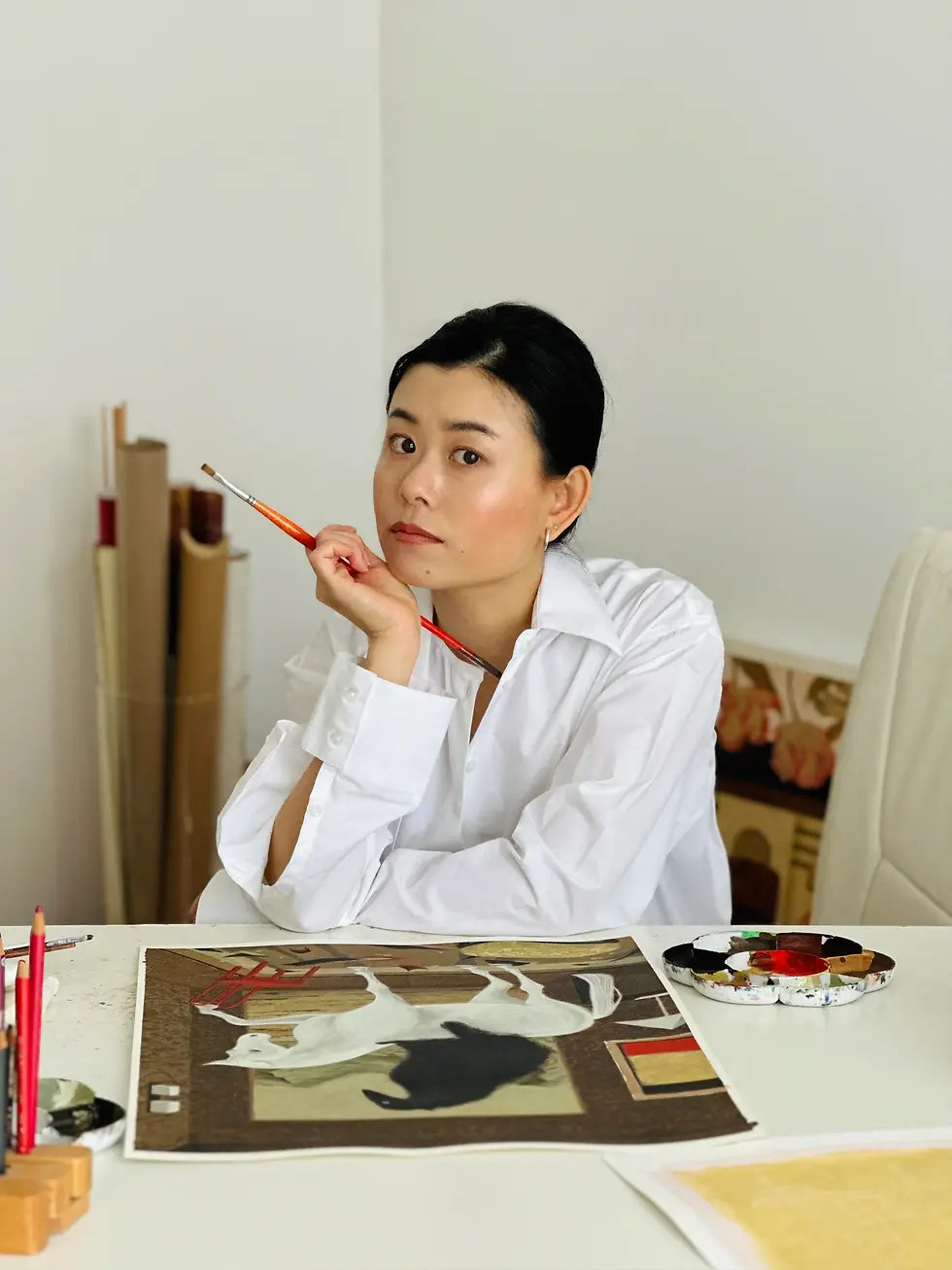
Gabriele Artusio’s work revolves around Ines, a fictional character who first appeared in an unfinished comic and gradually became the center of his practice. His drawings and paintings often feature repeated variations of her image, layered with textile-inspired patterns, gentle eroticism, and references from Japanese and Chinese visual culture. Artusio’s background in textile and wallpaper design shapes his approach to rhythm and composition, while recent experiments with oil on canvas and rice paper scrolls open new narrative directions. Based in Volpiano, he also teaches at a local art high school and regularly exhibits across Europe and the US.

Q: Ines began as a character for an unfinished comic. How did she grow into the thread that now connects your practice?
A: At the end of high school, I had set her aside a little, and on the advice of some of my teachers I began experimenting in different directions: new techniques, themes, and subjects. Yet Ines kept resurfacing in my sketches, maybe as a quick doodle in the margin of a notebook at the Academy or on a travel sketchbook. I enjoyed — and still enjoy — filling blank pages with a sequence of drawings around the same theme, or with images that stand independently of one another. In 2019, after a trip to Japan, I started drawing her more frequently again, often in oriental clothing or cyberpunk settings (just before leaving I had watched "Blade Runner" and "Blade Runner 2049" for the first time, and certain parts of Tokyo really felt like they had come out of those films). Later that summer, I went to Monaco to Villa Sauber, where there was a George Condo retrospective with large canvases from the early 2000s, saturated with figures and details to the point of excess. That exhibition was a spark: I realized I could combine my need for sketches and small “scenes” within a broader and interconnected context: she can play many roles and I can rework older ideas, a sparkle I just got by watching an exhibition or a video, and this constant experimenting also helped me to make my style more mature.


Q: Your work often mixes Japanese influence, fabric patterns, and gentle eroticism. How do you bring those elements together without losing focus?
A: For years I jumped from one subject to another without real continuity. During my time at the Academy, however, I started collaborating with a textile studio in Como. It was a crucial experience: it introduced me to a professional world where I could make use of my skills, I learned the language and concepts of fashion and graphic design, but most importantly I realized that apparently distant elements could coexist.
The constant need to move from one design to another, searching for new combinations, made me think that I could apply the same approach to my personal work. My interest in Japan — both traditional and contemporary culture — also led me to manga. In both classic prints and modern manga, the erotic element is always present, but handled with great delicacy, never in a vulgar or pornographic way. I think, for example, of Itō Shinsui (an engraver of the Shin-hanga movement at the turn of the 20th century) and of Masakazu Katsura ("Video Girl Ai," "I"s," "DNA²"). In both cases, eroticism merges with elaborate decorative elements and evocative landscapes. I really admire and appreciate the balance of these two artists and I’m always trying to be in a similar position, and even if I try to push it toward some spicier solution, I don’t feel the need to be too explicit. In recent years I’ve explored and developed this sensitivity, building an archive of subjects and ideas to draw on. More recently, I’ve also tried new solutions inspired by the "oblique strategies," combining even more distant elements that, surprisingly, work together — such as an illustration I’m currently working on, inspired by the Lamassu of Mesopotamian mythology mixed with contemporary fashion.
Q: You describe the repetition of Ines as "almost neurotic." What do you find in that act of repeating her image?
A: Even though I haven’t lost interest in other directions and I always try to evolve my style, Ines remains a comfort zone, a safe harbor. Drawing her is a way to clear my head: depicting her in relaxed, languid poses is a form of decompression. After a demanding day or a stressful period, nothing feels better than sketching Ines immersed in a lush jungle, among the waves of the sea, or in other suspended scenarios.
Q: Recently you’ve been exploring oil painting and rice paper scrolls. What pushed you toward these more traditional formats?
A: For a long time my practice revolved mainly around drawing and illustration in small formats, both for convenience and because my first exhibitions in Germany confirmed how much works on paper were appreciated there. At the same time, however, I felt drawn to oil painting.
I had tried it in the past without finding a personal language; now, with a recurring subject to develop, I felt the need to venture back into it. Some ideas I had initially conceived as drawings simply didn’t work in ink and required another medium. An artist I follow closely is the Danish painter Martin Bigum: I’m fascinated not only by his use of color, but also by how he leaves parts of the raw canvas visible as an active element of the image. In "Ines (Coro)," for instance, I chose to leave the canvas exposed to evoke the fabric of the characters’ robes. Rice paper, on the other hand, attracts me both for the Chinese painting tradition — with its unique way of absorbing water and ink — and for the narrative potential of the format. Many Chinese paintings and books are rolled and unrolled depending on whether they are displayed or not: they have a different readability from Western paintings, more fluid and sequential.
This resonates with my tendency to accumulate figures and details, to the point that a single segment of a scroll could stand as an autonomous work. A similar idea had already been explored by Pinot Gallizio, who sold his works on painted rolls by the meter. This makes me think that the original comic idea might resurface in a new and unusual way, but I don’t want to rush things.
Q: You move between textiles, wallpaper design, and painting. How do these different practices feed into each other?
A: My experience with textile design allowed me to train and become familiar with the concept of rhythmic and modular repetition of a subject — something that applies both to textiles and wallpaper. But wallpapers go beyond mechanical repetition, and it’s interesting to explore varied and inventive solutions within them.
By now, I tend to intertwine my different areas of research: an idea or a scene discarded from a work on Ines can become a wallpaper design; some textile designs I’ve reworked into school projects, and so on. I don’t like to draw rigid boundaries — I find that counterproductive — and I try to remain inspired and receptive across many fields (painting, illustration, comics, fashion, cinema, and beyond).
Q: Teaching is also part of your life. How has being around students affected the way you think about your own work?
A: Teaching came relatively recently, mainly as a form of economic stability so that I could continue to pursue my artistic research. At first, I saw almost only the negative sides: less time for myself, the need to learn new programs before I could teach them, and the daily challenge of working with students.
There were ups and downs, as well as bureaucratic and organizational aspects — probably the hardest part. In recent years, though, I’ve found a balance. I’ve had the good fortune to work in a provincial art high school, in a pleasant and serene environment, with very diverse but generally motivated students. This has pushed me to constantly update myself in order to teach better, and in turn has given me new stimuli for my own practice. I’ve rediscovered Gothic calligraphy, reignited my passion for comics, and even approached ceramic painting — a tradition deeply rooted in the area — that I think could become an interesting source of inspiration for future works.