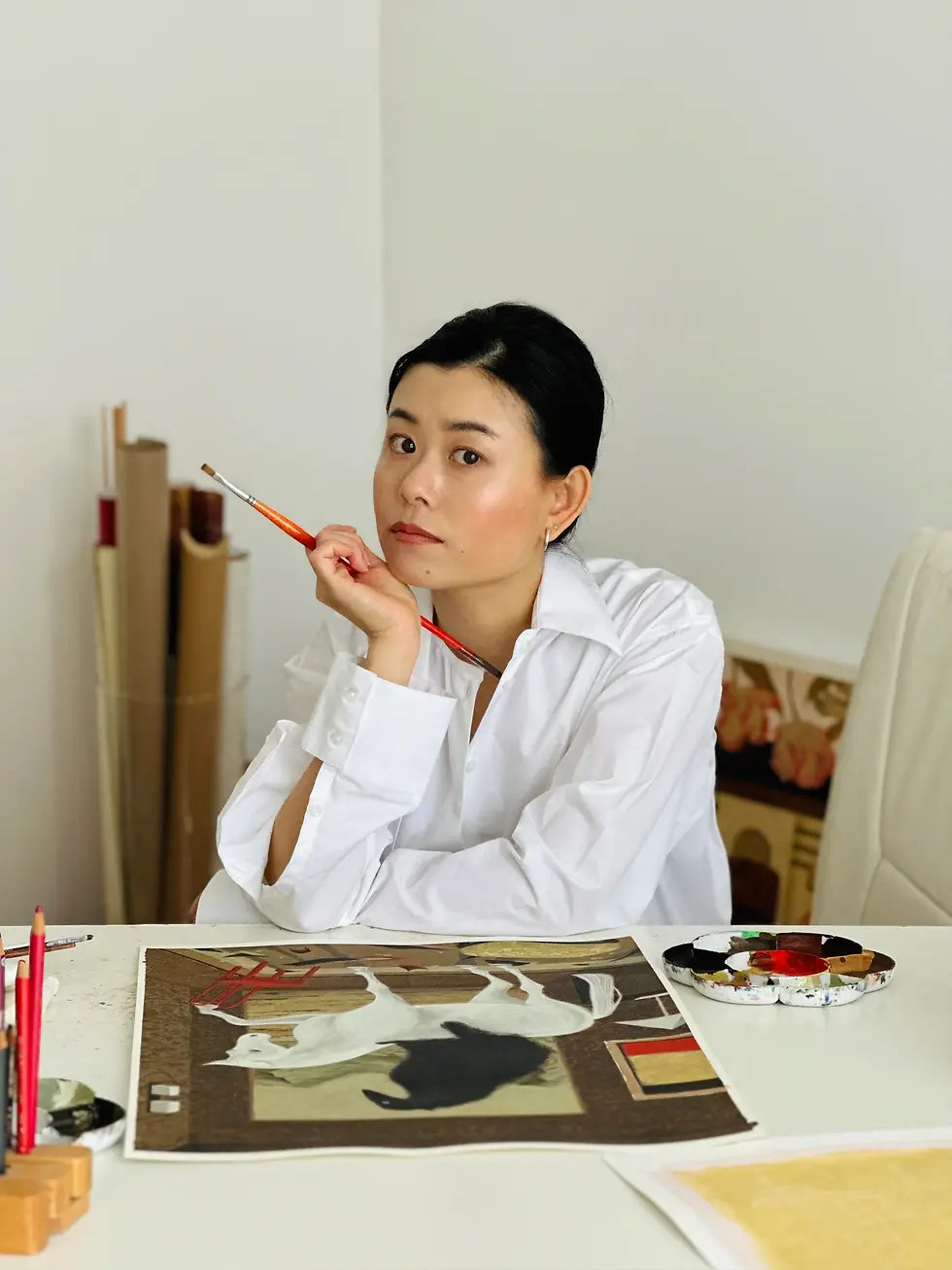
Fabio Adani
Fabio Adani is an Italian painter based in Correggio. He studied at the Academy of Fine Arts in Bologna and now teaches drawing and art history at secondary school. He is known for watercolours made with very light, diluted colour and a lot of open space on the page. He works with a small number of elements and a calm, steady studio routine. Alongside watercolour, he also uses writing, graphite, acrylic, and photography.

Q: Your images are very quiet and reduced. When did this way of working start to feel right for you?
A: This answer forces me to go back in time, to the beginning of my artistic career, which began—as I would say for many—with a series of explorations in very different directions and techniques. Then, spontaneously, this characteristic of blurring tones and contours emerged: a search for lightness, for detachment from the material, initially with pencil works using increasingly harder leads and increasingly evident shades until the mark was cancelled out. This then led to a natural transition to watercolour, developing over time an “unconventional” technique that continued this characteristic of blurring, through the dilution of colour and a process of glazing to transform colour into light.
This research does not concern only technique, but its development coincided with a poetic quest that was becoming increasingly apparent, namely that of wanting to lighten the mind and senses, which were overloaded with too many, often excessive, stimuli. I felt the need to move towards something essential that is not found in matter, but in a more immaterial, introspective, and spiritual dimension. Something lighter for the eyes and senses.


Q: Light is important in your paintings. How do you build it with watercolor?
A: Light is an essential element in my work, almost the ultimate goal of what the work should convey: detachment, lightness, spirituality. Watercolour, with its natural characteristics of lightness and transparency, has become my preferred medium; this diffused, soft light is created by countless layers of very diluted colour, superimposed on top of each other.
Watercolour works by subtraction: the light is already in the white of the paper, the layers of colour seem to hide it in some parts and make it emerge powerfully where they do not work, always in an extremely diluted and nuanced way, so that the light itself acquires a more powerful and intense emanation.
This way of working by subtracting colour to bring out the light coincides precisely with the poetic idea of removing everything that is excessive in our lives to bring out what is truer, more necessary, and essential—like a light, in fact.
Another characteristic of watercolour, given precisely by its transparency, is the fact that it does not allow for mistakes and consequently corrections, so every veil of colour must be carefully calibrated, and this leads to a very concentrated, but above all calm and reflective, attitude—another poetic characteristic that I try to convey through my works.

Q: You often work within a soft, pale color range. How do you choose your colors?
A: The prevalence of these shades went hand in hand with technical and poetic development, in a natural way. The prevalence of cool colours, mainly certain shades of blue and light blue, more easily convey the concept of lightness and spirituality, so it was a spontaneous choice, almost a “love at first sight,” especially for certain shades of these colours. In particular, I could define the fact that, rather than being a colour, I intend this blue as air, an intangible essence, a detachment from matter towards light.
Q: Your surfaces feel very light and layered. How do you decide when a work is finished?
A: When I start a work, I have a certain image in mind, linked to the type of message I want to convey. The watercolour technique I usually use, being very liquid, has a strong dose of unpredictability; the colour is free to run on the paper. Knowing its effects from experience, I can predict how it will settle on it, but I cannot totally control this effect.
Therefore, the progress of the work is a constant interplay of delicate combinations of light, colour, and dilution, i.e. shading. When all these elements have reached their balance and the image I had in mind at the beginning takes shape in all its communicative power, and I feel that nothing more needs to be added, I can consider the work finished.
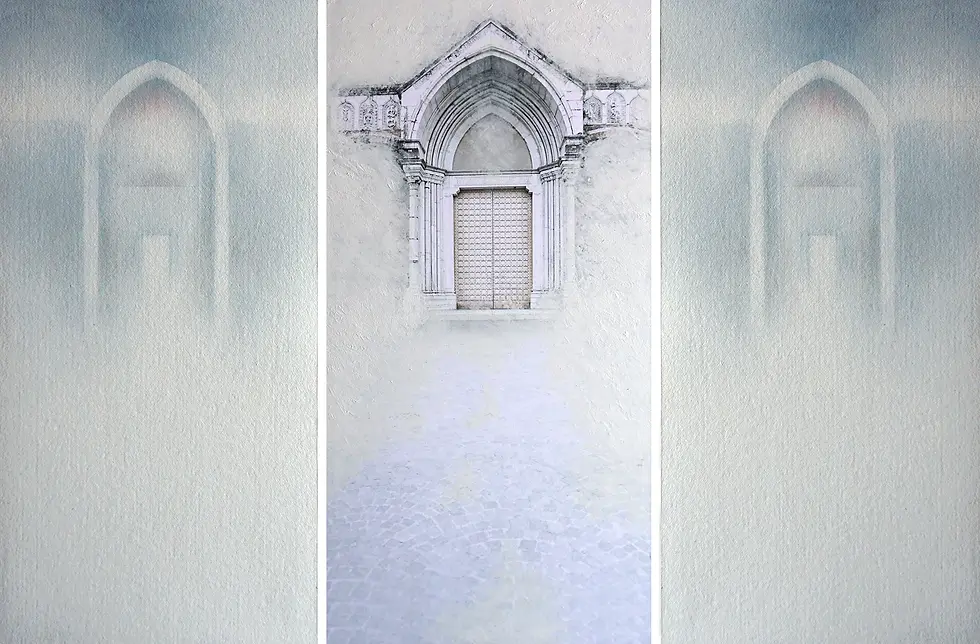
Q: In recent projects you’ve brought in writing and photography. What made you start working with these alongside painting?
A: An artistic work is a continuous process of growth, which goes hand in hand with the growth of the person, the changing of their worldview and ideas, even in subtle ways.
It is a continuous work of investigation and of indulging the needs that arise along the way. The introduction of photography manifests itself in works that are usually diptychs or triptychs, in dialogue with a watercolour part that continues to maintain the initial poetics of my work. The new visual element starts from a photographic base that is worked on both in post-production and, above all, pictorially. It alludes to an objective starting point, which gave rise to the idea that is usually transfigured by watercolour—it can be a space, a landscape, a view of a city, an object, etc.—as if to indicate a play between what appears to the eyes and therefore the most immediate aspect of reality that we perceive and on which we dwell without going too far, and the emotional trace that this visual stimulus can leave in us, where it is transformed into something else within us: experience, memory, desire, etc., as if the initial inspiration could take on a life of its own in another dimension, a sort of transfiguration. The diptych/triptych works invite precisely this dialogue between the two worlds. Writing, on the other hand, arises from a strictly personal need: on the one hand, the need to investigate the genesis of certain stimuli that gave rise to the work, the thought that gave rise to the initial inspiration.
On the other hand, it is also a way of bringing the work to life in another direction through the use of words. The world of writing and poetry has always intrigued and fascinated me, and this is an attempt to explore it, recounting a series of works through a collection of images and writings—a sort of diary that accompanies the unfolding of that work, perhaps linked to a specific idea or place.
Q: After your recent exhibitions and site-specific works, what are you working on now?
A: This last period, since the summer, has been quite intense with various events and solo exhibitions, including one at the Philosophy Festival in Modena at the Artekyp Gallery. I am now working on a new project for the Salamon Fine Art Gallery in Milan, where I will be exploring the natural world, particularly the theme of woods and trees.
These latest works have allowed me to expand my technical and poetic research with the inclusion of new materials, such as salt and gold leaf, as elements that can give new transparencies and new lights. These are also new solutions, all to be explored, to be combined with my natural poetics, which in any case aims to maintain this evocative and introspective stimulus towards the observer.