Eric Berry
Eric Berry’s practice focuses on the textures and realities of rural American life. Through painting, sculpture, and installation, he draws attention to overlooked objects and materials tied to working-class labor and everyday environments. His work reflects on class, economic structures, and the tension between high and low culture, while also engaging with ideas of time and impermanence. Based in Maine, he balances his studio work with building furniture, using traditional woodworking techniques as a steady part of his daily practice.

Q: What first made you see everyday rural life as something worth turning into art?
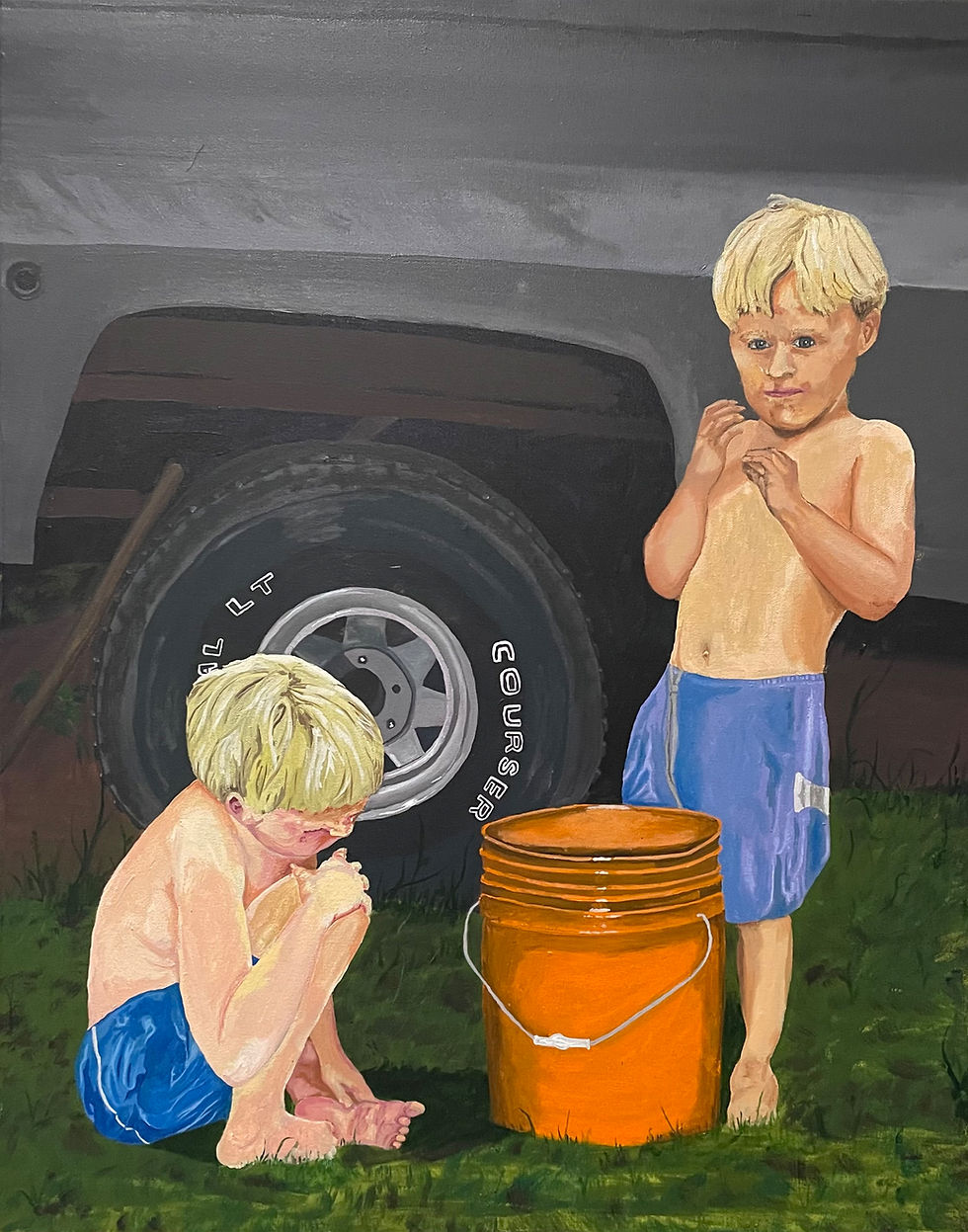
A: I grew up in a tiny rural town in Maine with a year-round population of 400. I drew inspiration from that environment. As I got older and more involved with the art community, I noticed there wasn’t much representation of that in galleries or museums. Art always seemed romanticized, cities seemed to dominate the scene. In a way I am still romanticizing a moment—it’s just a moment from the way of life that I saw. The life of a lower-class, blue-collar, rural dweller.
Showcasing these raw moments is important to me. They’re not beautiful landscape paintings, but in a way, they are.
Q: How do you decide when a material or object has enough meaning to work with?
A: They all have had a life of their own—they tell a story. The narratives connected with these objects and images are endless. They mean just as much to our existence as anything else. Something that has been well-used, “broken in,” and truly loved. These objects, materials, and images all represent a juncture in our lives.
Q: Has building furniture to support your practice changed how you think about labor in your art?
A: Creating a piece is always a work of labor. An artist physically interacting with and manipulating a piece involves a tactile, laborious undertaking. Every job I’ve ever had has been a form of labor in one way or another. The versatility of building furniture has crossed into my art and greatly refined my overall artistry.
Q: Do you see your work more as observation or as a kind of quiet protest?
A: I think most viewers’ quick assumption would be that my work appears as an observation, a snapshot. Each piece has several different intentions, whether being a protest, a story, a scrutiny, or simply an allure to a composition.

Q: When you talk about ephemerality, are you thinking more about people, objects—or both?
A: This relates closely to the question about when I decide if a material or object has enough meaning. Ephemerality is something that we all live with. Our physical world is ephemeral.
Our relationships, our memories, objects—everything as we know it. It’s hard not to think about it, especially when making my work. I ask myself questions like, “How long will this painting outlive my life?” “How long will this object last before it deteriorates?” “What is fundamentally most important?”
Q: What kind of reactions matter most to you when someone sees your work—recognition, discomfort, or something else?
A: The reaction I am looking for is more about contemplation. As a viewer, have you thought about what gives something value? Do you ask yourself existential questions when thinking of a specific moment, experience, or feeling? If so, have you recognized the beauty within the mundanity of that? Finding comfort in the uncomfortable and beauty in the ugly are paramount in my work.