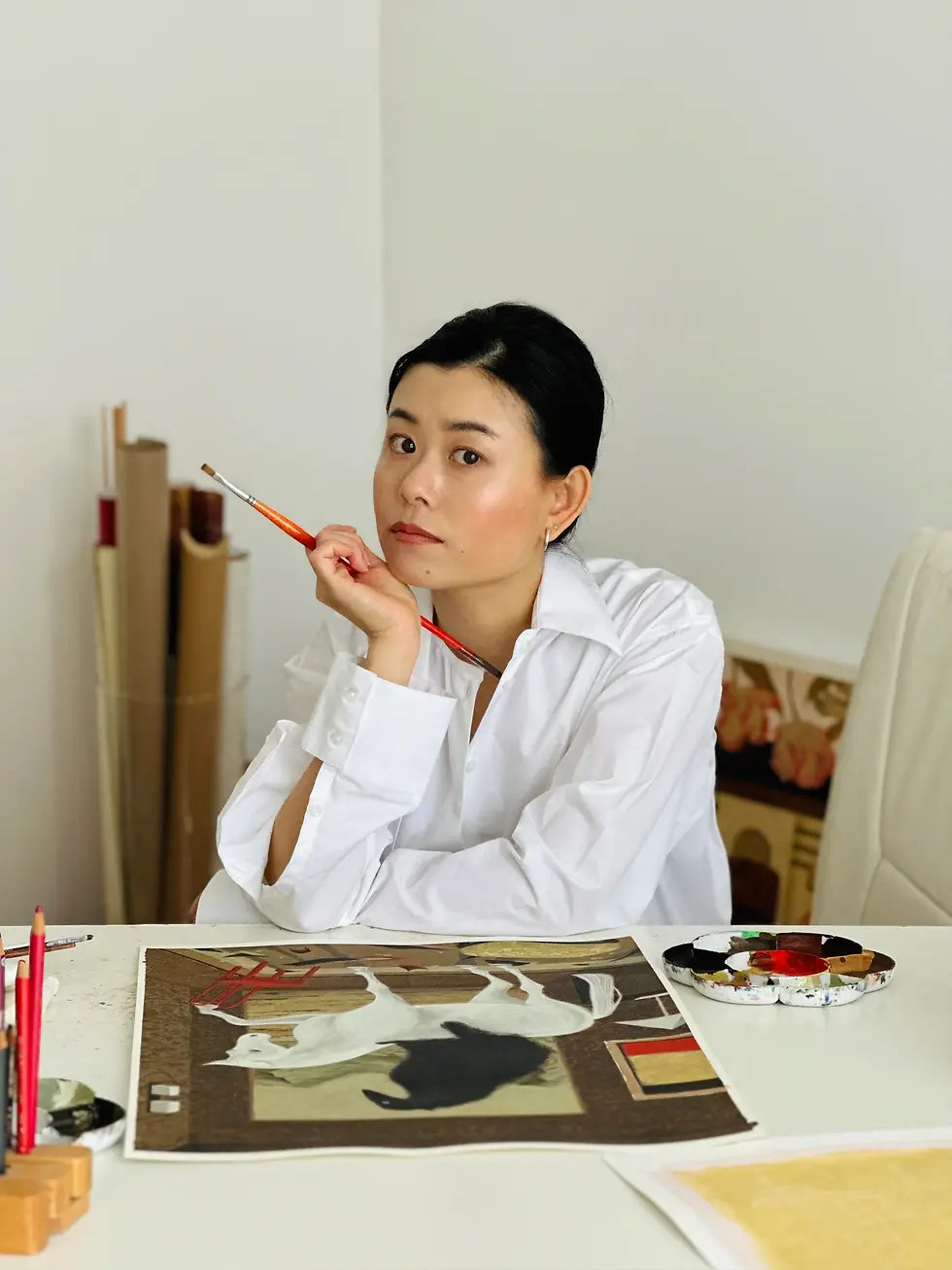
Diana Smykova and Maria Motyleva
Diana Smykova is a photographer and visual artist, currently working nomadically and often based in Cairo. Maria Motyleva is a textile and multimedia artist focused on embroidery and community-based work, moving between Switzerland, the Caucasus, and the Middle East. They collaborate through photography and fabric, working with women and collecting personal narratives and visual fragments. Their joint project “Lingering in the Light” developed through research and fieldwork in Saudi Arabia.

Q: What first made you want to work together with everyday gestures and women’s stories at the center?
M: Women’s gestures have always been at the center of my practice. Growing up as the daughter of a single mother and surrounded by aunts and grandmothers, women were my primary influence. As a textile artist, I feel this medium connects me to a long lineage of women’s work—quiet gestures that resist grandiosity yet carry stories of care, resilience, and intimacy.
D: Originally, we imagined this project in Egypt, in Siwa, but it gradually found its way to Saudi Arabia. At its core is a textile face-covering garment—a form rooted in pre-Islamic history—which we approached as a vessel for storytelling. It became a surface for memory, emotion, and women’s stories of resilience, carrying traces of lived experience across time.
This collaboration is both research-based and personal for me. I also grew up among women, and the quiet transmission of memory across generations has always shaped my work.
Engaging with the stories of women from other cultures helps me locate myself in the world—and, in a way, return closer to my own family and origins.
Q: During your travels in Saudi Arabia, what kinds of moments made you stop and begin a new piece?
M: In Saudi Arabia, one moment in particular sparked a new beginning. I was in the desert outside Riyadh for the first time, observing plants and their surroundings. I saw camels resting in the shade of an acacia tree, and small flowers blooming at my feet. I felt the strength of these plants—not only surviving the harsh climate but offering food, shade, and beauty to everything around them. It struck me deeply, and I began to see the people of the desert in a similar way. This moment became the starting point for exploring ideas of shadows and the refuge they offer.
D: One of the most touching moments for me happened in the old farms of AlUla. It is an oasis in northern Saudi Arabia, a place that is changing very fast now.
On a burning summer day, we walked into abandoned gardens. Trees and palms were growing through the ruins of old houses. It felt quiet, but alive.
Just before that, we had spoken with Faiza, one of the women in our project. She shared memories of her childhood—spending summers on these farms to escape the heat, moving back to the city in winter, living surrounded by community. She spoke about palm weaving and about seeing herself in the palm tree—standing strong, offering shade, surviving despite harsh conditions.
Standing there, I felt that memory can live in landscapes. Layer by layer, generation after generation. This place inspired a series of three silkscreen works, combining photography and embroidery, shaped by Faiza’s story and by that land.

Q: You move between photography, textiles, and found materials. How do you choose where an idea belongs?
M: Each medium offers a different angle from which to tell a story. Photography is always fragmentary. It captures only a small moment in time, never the whole story. It can be selective, even manipulative, shaped by where we stand and what we choose to see.
But this is also what brings it close to memory. Memory is never complete—it appears in pieces, in flashes, in details. A texture, a shadow, a gesture. Through photography, I try to hold these fragile moments, knowing they will always remain incomplete, just like our memories of home, of people, of the past.
Textiles hold time within their gestures. In this project, embroidery becomes a way to connect landscapes, eras, and memories, weaving them together into one narrative fabric.
Q: What usually makes a small gesture feel like the start of a piece?
M: For me, the beginning lies in staying with the gesture for as long as possible—without thinking about the final form. I immerse myself in the movement, letting it unfold freely, without deciding what it should become. Over time, patterns and relationships emerge between gestures, stories, and ideas, and only then do I begin assembling them. This first stage is always my favorite.
Working on a project that combines such different media—especially photography, which in my understanding works completely differently—has been a challenge, definitely a rewarding one.
D: A small gesture often becomes the start of a piece through dialogue—between materials, between artists, between ideas. In this project, working for the first time as a duo with Maria, it was our conversation with the materials that felt most alive. Photography acted as a way to capture fragments, moments, and memories, while embroidery brought them together, creating new forms and connections.
For me, certain moments during the journey sparked a clear image—a photograph, a print—and from there, I could experiment, letting the work take shape. When combined with embroidery and textiles, the pieces transformed again, revealing something unexpected, alive, and shared.

Q: How do you find the connection between the fragments you collect, like pigments, plants, and personal memories?
M: Our practice feels like a collaboration with the memories of the people and objects we encounter. Every fragment, every piece of fabric tells a story, and we are here not to use it but to listen and talk to it. It involves a lot of listening and creating space for these stories to interact with one another and with my own voice, of course. We pay attention to the poetry of how they rhyme and resonate, and our role becomes enhancing and honoring those connections.
Q: As you continue “Lingering in the Light,” what directions feel most important to explore next?
M: We would love to continue the work in all its aspects: research, community engagement, and artistic development. Materially, we want to further explore the intersection of fabric and photography—experimenting with embroidery, printing techniques, and new materials to see how they can tell stories together more powerfully. After all, this project is not only about the stories we encounter; it’s also about our story and our gestures, or our hands learning to create together.
We also hope to deepen our community work by spending more time with women, facilitating embroidery circles, and creating spaces for local women to work with their archives and stories. Listening, learning, exchanging knowledge, and supporting skill-building where needed are all central to our vision.
Overall, we are eager to learn more about the stories of Saudi (and broader SWANA) communities, especially women, and to continue building work that grows from these encounters.