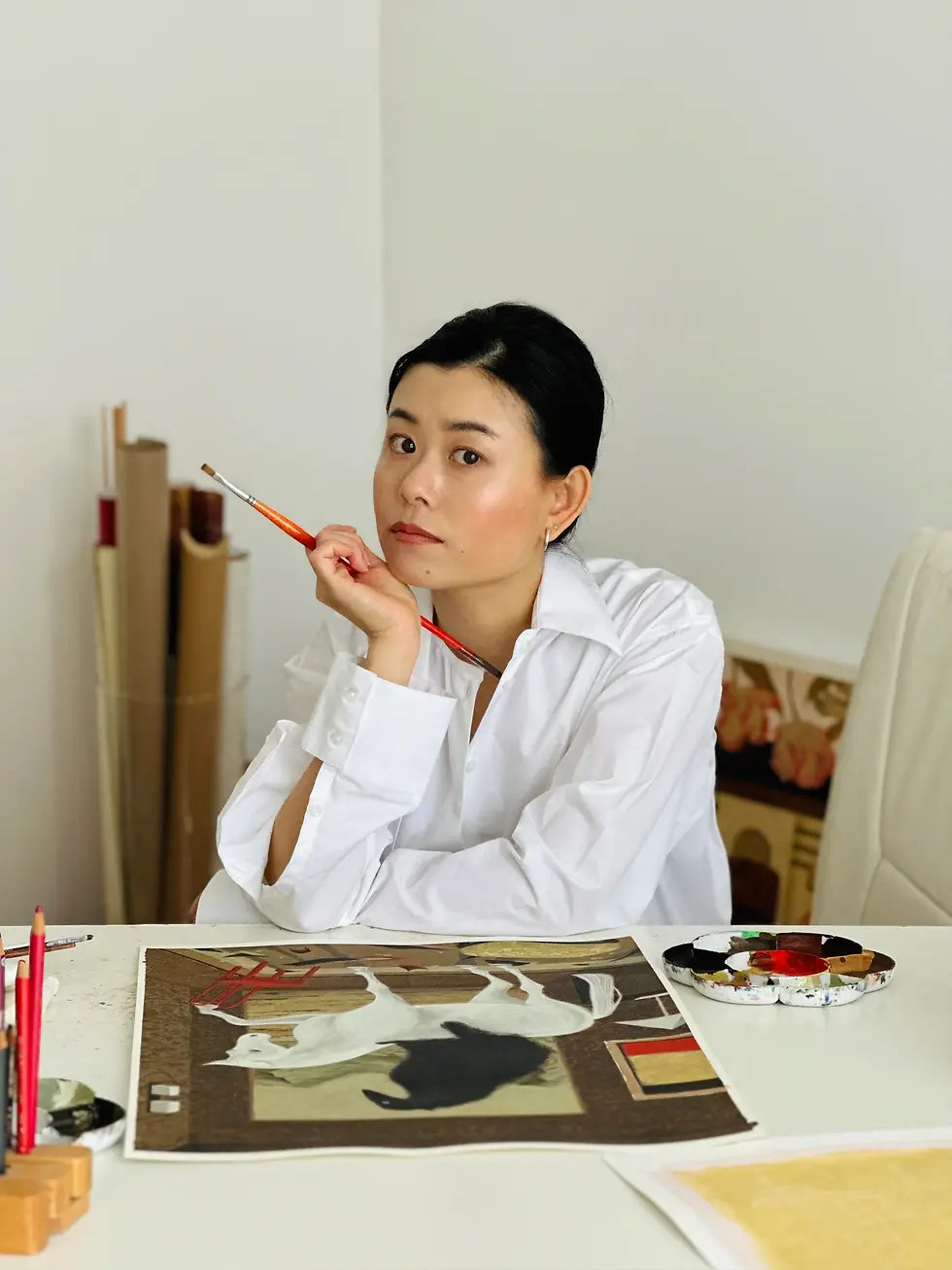
Dana McKee-Sexton
Updated: Apr 29, 2025
Dana Mckee-Sexton paints by instinct. Memories, moods, and details from everyday life show up in her work without needing to be explained. She works on wood panels, using the grain to shape her images. The surface leads, and she follows—figures and scenes begin to appear, often with a sense of intimacy and distance at once. Her paintings hold quiet moments that ask for attention, offering fragments rather than full narratives.

Q: You said you stopped painting for others and started painting for yourself. What changed after that?
A: After graduating from college, I jumped straight into teaching and taught art to children for years. Being fully committed to creating art curriculums for students, I stopped making my own art and couldn’t easily find time for something if it wasn’t financially beneficial. I realized how negatively that impacted my mental health—to not create for myself—and decided it didn’t matter what I made, as long as I made something, I’d feel better. From then on, I discovered my art style for the first time.
Q: Your figures feel raw and direct. Where do they come from for you?
A: I’ve come to understand my pieces the longer I created this style of work. To me, they are the inner demons and conflicts within myself that I can translate often after the pieces are finished. I depict them lingering around, non-confrontationally present and quiet. Some represent specific situations I was in/around, and others are symbols of consistency.

Q: You paint on wood and follow the grain. How does that shape what shows up?
A: Following the grain of the wood is my way of uncovering these characters from within myself. The grain dictates and allows me to sit for long periods, searching for them and understanding why they appear the way they do. That part of my process is the longest, depending on where I am mentally. Some pieces I can see immediately and finish very quickly, while others can take hours to arrange a meaningful composition with what I am given from the wood.
Q: There’s a push and pull between hiding and showing in your work. What keeps you in that space?
A: I think it all stems from my feelings during the painting process. As an artist, sometimes all we want is to be heard and understood through our creativity, and when that doesn’t happen, we again speak through our work. There are themes I want to share vocally within my work and others I only want visible to those who search for them. My goal is to make work that reaches audiences it maybe wasn’t supposed to reach—to speak to the viewer in the way the viewer needs it to, versus being completely understandable right away to everyone.


Q: Do you know what a painting’s about while you’re making it—or does it hit later?
A: I have only made one painting going into it knowing what it meant to me right away. All of the others revealed themselves after I finished and took a step back. I’ve always been an impulsive person, thinking very quickly and not taking breaks to understand my path before it's walked. In my art, it is often depicted as crowded, unorganized, and cluttered with characters, which is very in tune with how I see my brain operating. Once the process is over, I realize how symbolic my pieces come out and that each one has a story to tell me afterwards.
Q: Your world feels heavy but also kind of joyful. How do those two things sit together for you?
A: I think I have always thrived in chaotic situations. I feel my work pushes the concept that having inner demons and conflicts isn’t necessarily scary or demanding. We all need a certain balance to maintain our worlds and to find our center. I used to color red predominantly in my work as balance in itself. Red is the color of anger and fear, but also the color of passion and love. Life and art will always be hard and rewarding at the same time, but I believe the best things come from both.