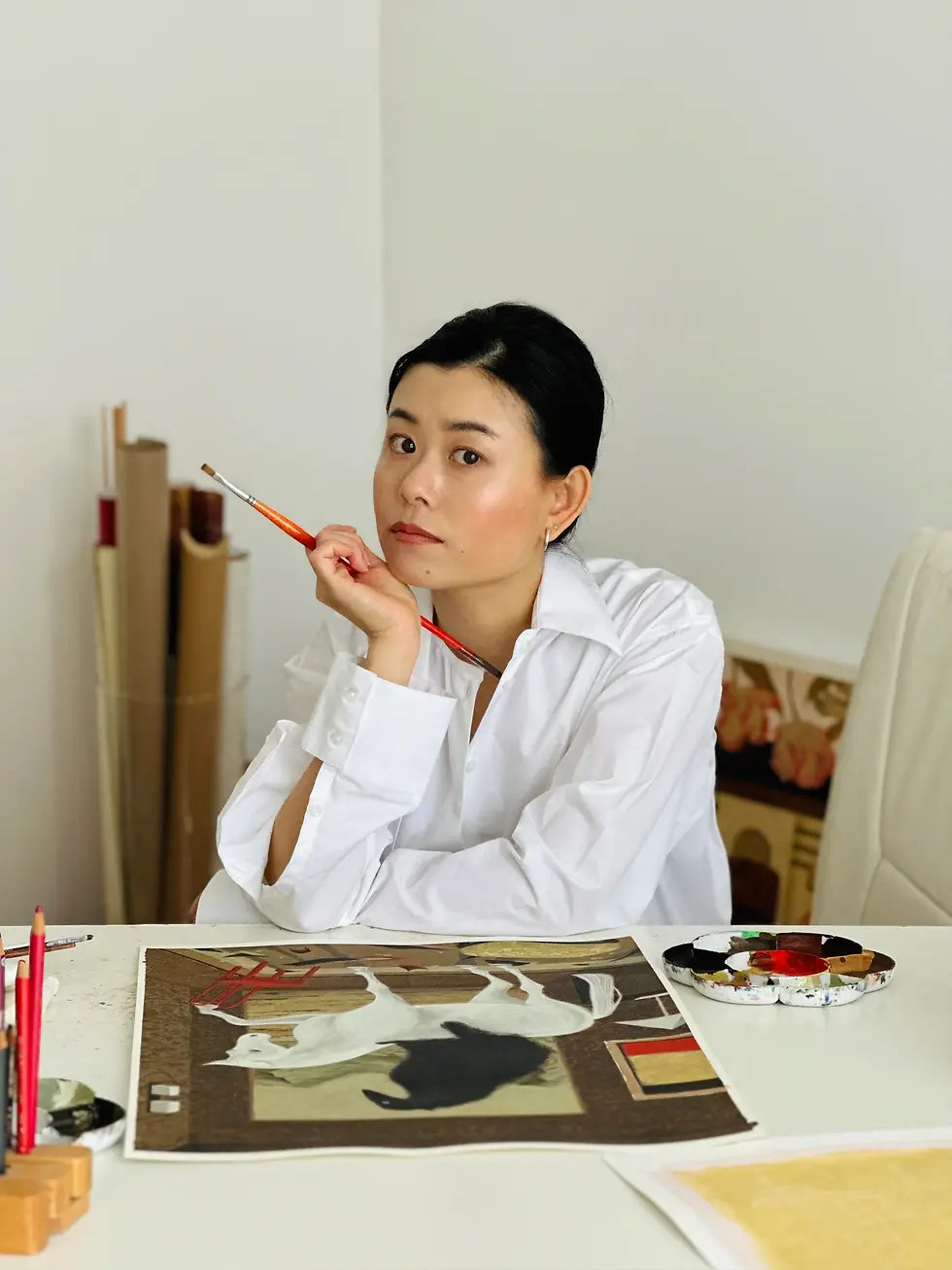
Chia-hsuan Lin
Chia-hsuan Lin is a London-based artist working with sculpture, installation, and mixed media. She is drawn to ordinary materials and small details in built spaces, like fences, tiles, or structural gaps that people usually pass without noticing. She collects and reworks found objects, wood, metal, and fragments from everyday environments. Her work grows from looking closely at how spaces are held together and how these elements shape the way we move, pause, and set boundaries.

Q: What first made you pay attention to the small details in buildings and everyday structures?
A: The first time I became deeply drawn to building structures was about two years ago, while I was playing tennis. I noticed that the mesh fence of the court sat directly beside a solid metal fence belonging to the nearby community. Between them was a narrow gap—an abandoned, inaccessible space. That overlooked area made me think about how buildings and everyday structures shape our daily lives, and about the power dynamics between those who set boundaries and those who encounter them. It also led me to reflect on how we establish our own physical and emotional boundaries, and what those boundaries mean to us.

Q: You often work with found or everyday materials. How do you choose what to pick up and use?
A: I am drawn to materials that are quiet, understated, and often overlooked—objects that don’t immediately demand attention. To me, these items act as containers of everyday life, carrying the emotions, histories, and stories of the people who interacted with them. Through my process of collecting and editing, I aim to reverse their usual roles, bringing these humble objects into the spotlight and revealing the paths they’ve traveled, as well as the narratives they quietly hold.
Q: Your works play with what’s visible and what’s hidden. How do you decide how far to push either one?
A: I explore visibility and concealment as a way to examine our relationship with objects and textures, and the roles they play in everyday life. I push these contrasts until the elements within a piece begin to engage in a subtle dialogue—creating tension, balance, and ambiguity. I consider a work complete when this interplay sparks curiosity, inviting the viewer to look closer, question their assumptions, and discover layers that might otherwise go unnoticed.

Q: You collect elements from nature and from domestic spaces. What usually makes something feel worth keeping?
A: I’m most drawn to quiet objects that silently witness everyday life or participate in it without demanding attention. Many of the materials I collect are abandoned, discarded, or offcuts. By gathering them, I feel I am also collecting the stories embedded within them. These objects carry traces of time, use, and emotion that other materials don’t, and together they suggest the construction of a possible way of living.
Q: Some of your pieces echo tools or supports without actually functioning as them. What interests you about creating that kind of object?
A: I’m interested in questioning the authority of function and how it shapes our understanding of objects. When something is defined mainly by usefulness, its material presence and emotional potential are often overlooked. By removing or disrupting function, I shift attention back to the object itself—its form, weight, texture, and ambiguity. This moment of uncertainty slows down recognition and invites closer engagement. I’m interested in how objects guide our behavior and quietly structure our ways of living, and how non-functional forms can open space to reconsider utility, control, and expectation.
Q: As you continue this body of work, what directions or questions feel most important for you right now?
A: At this stage, my work aims to offer both myself and the viewer a renewed perspective on contemporary life—one that slows habitual ways of looking and brings attention to what is often overlooked. I continue to collect and experiment with materials, allowing their histories and textures to guide each piece rather than imposing fixed outcomes. Alongside this material exploration, I am increasingly interested in incorporating non-physical elements such as sound, which I think could extend the work beyond visual form, creating a more embodied experience and exploring how memory, emotion, and spatial awareness shape our perception of everyday environments.