Caihui Lim
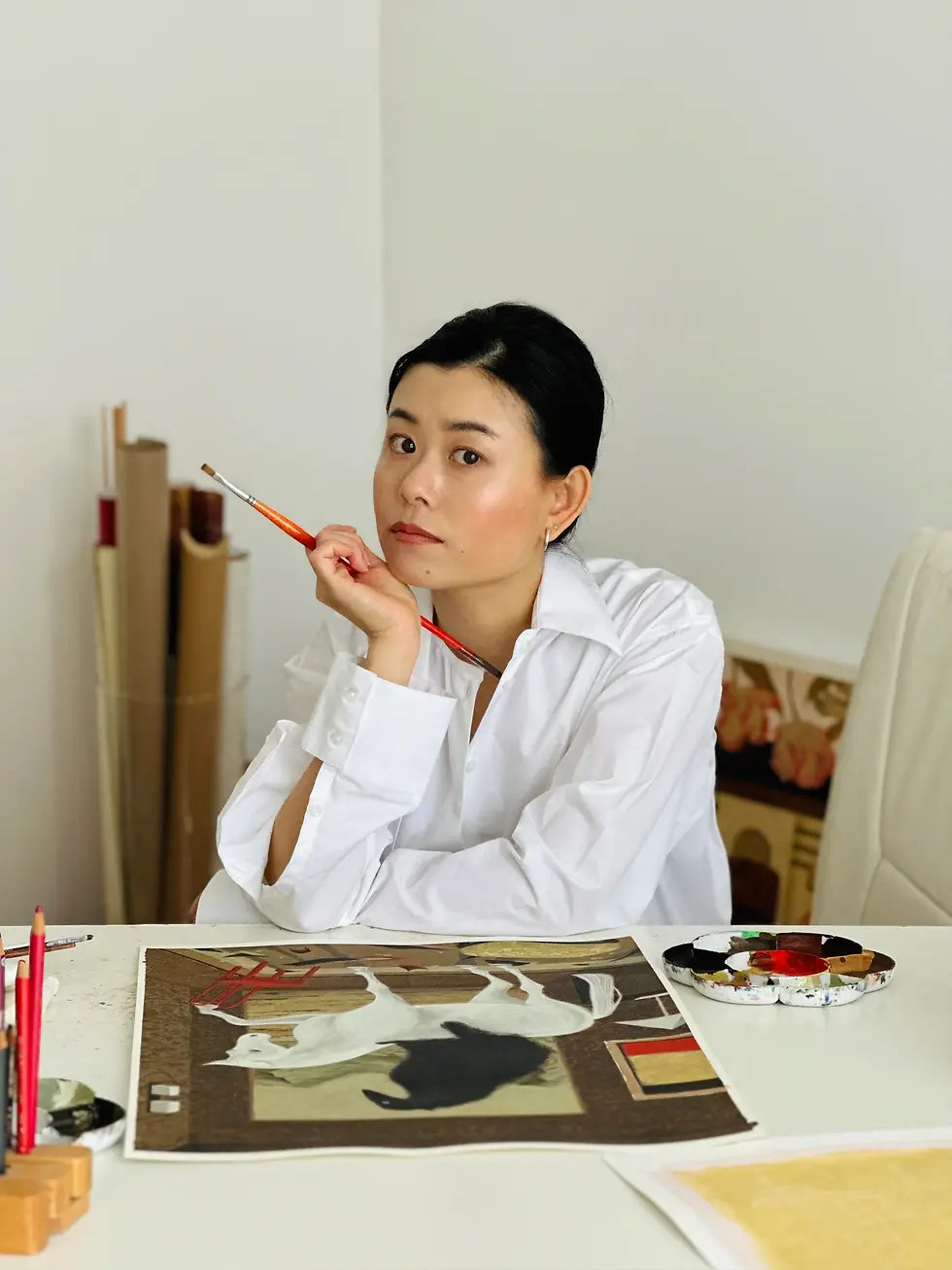
Caihui Lim’s work centers on affirmation and inner clarity. Using Japanese-style pastel techniques, she creates soft, wave-like compositions that reflect emotional rhythms and personal growth. Each piece is shaped by hand and incorporates a guiding phrase, offering a moment of pause and presence. Her Chakra x Phoenix series highlights different emotional states through color and form, aiming to support self-reflection and healing. Based in Singapore, Caihui shares her practice through exhibitions, interviews, and wearable art, connecting visual language with daily acts of self-care.

Q: Your process is deeply connected to touch—blending pastels by hand. What happens for you emotionally during that part of making?
A: Blending pastels by hand is a deeply sensory and joyful process for me—one that reconnects me with a part of myself that often gets lost in adulthood. As children, we create with our hands so freely, but somewhere along the way, especially as I stepped into adulthood and motherhood, I felt pressured to be serious, to have all the answers, and I lost touch with that simple delight.
There’s a sheer, almost rebellious joy in getting my fingers stained with pastel pigments and feeling the texture of paper as I blend the colours. Growing up, mess was often frowned upon, so allowing myself to embrace the messiness of art feels both liberating and cathartic. It’s as if I’m giving my inner child permission to play again, to express what my heart wants to sing—without fear or self-censorship.
The creative process is medicine for my soul. In daily life, I often struggle to voice my own needs, falling into people-pleasing patterns. But when I create, I can release all of that through my hands. I often describe the process as a kind of gestation, and when a piece is finished, it feels like giving birth—there’s a rush of pure love and oxytocin, much like seeing my newborn for the first time.
Each artwork is a healing journey, a return to my authentic self. This flow state is pure bliss, and I feel incredibly blessed to experience it every time I create.
Q: You often embed affirmations into your work. Which one has stayed with you the longest, and why?
A: The affirmation that has stayed with me the longest is from my very first affirmation artwork, “Emotional Landscape.” This piece is an abstract wave of colours that celebrates the full spectrum of human emotions—without dividing them into “good” or “bad.” I realised that by embracing all our emotions as part of our human experience, we actually create a beautiful emotional landscape within ourselves. The affirmation for this piece is “I embrace all of me.”
This message has been especially meaningful to me because I have always been my own harshest critic, finding it difficult to accept myself fully. For a long time, I would only curate the “good” parts of myself to be seen, driven by perfectionism and the need to be loved and accepted by everyone. This caused a lot of inner turmoil. Over time, I’ve come to understand that I am the only person who will walk through every step of my journey, and I need to be my own best friend. That means accepting all parts of myself—both the “good” and the “bad.”
I am still a work in progress, but I know I’m not alone in this struggle. So many of us are hard on ourselves, and I believe this is at the root of many mental well-being challenges we face. That’s why I now produce “Emotional Landscape” as postcards, hoping the message of self-acceptance can reach more people. The soothing rainbow of colours makes it a gentle, positive affirmation to behold. Growing up in a traditional Asian household where love was rarely spoken and often felt conditional, my adulthood has become an ongoing journey of reparenting myself—reminding myself that I am enough, and that all parts of me are lovable.

Q: You describe each piece as a kind of visual meditation. What helps you stay present while you create?
A: I’ll be honest—just like anyone who’s tried meditation, I don’t always stay perfectly present while I create. My “monkey mind” is often active, even during my creative flow. But, much like in meditation, I’ve learned to observe my thoughts as if they’re passing clouds. Sometimes, especially during emotionally charged periods, my art practice becomes a grounding exercise—cloud-watching for the mind, where the clouds are simply my thoughts drifting by.
When I notice myself getting attached to a thought, I try to release it without judgement and gently return to the act of creating. The deeper I go in my spiritual practice, the easier it becomes to stay present. What really helps me is remembering the intention behind my affirmation art: to uplift and empower others with positive energy. This purpose keeps me anchored.
That’s why I now choose to create at the very start of my day—waking up to paint at 6 a.m., just before sunrise. There’s a special purity in the early morning energy, and setting my intention for the day through art feels incredibly empowering. I believe that my thoughts and energy are infused into each piece, so I consciously practise letting go of judgement and returning to the present moment. My greatest purpose is to create with the purest energy possible, and this practice of mindful presence is at the heart of every artwork I make.
Q: How has your relationship with colour changed over time, especially as it connects to emotion?
A: This is such an interesting question, because I never imagined my relationship with colour would change so profoundly. For a long time, colours were simply colours—just visual elements. But once I began creating abstract affirmation art, I realised that colour carries its own emotional language. When I work with colours now, I notice how they evoke different sensations in my body, almost like a physical response. Our bodies hold so much wisdom—often more than we can ever understand cognitively.
Over time, I’ve come to see myself as something of a colour alchemist, blending pigments to soothe the heart, mind, body, and soul. In many ways, I feel a parallel to a medicine woman—except my remedies are colours rather than herbs. I treat each colour with care and respect, like an old friend who knows exactly what I need in any given moment.
Colours have become my source of creative expression, especially when words fail me. There are times when I feel blocked in my throat, unable to express what I truly feel—often because I don’t feel safe or understood. In those moments, colour becomes my safe space, allowing me to communicate and process emotions that are difficult to articulate.
In my creative practice, I let intuition guide my choices—trusting that the colours I’m drawn to are the ones I need, or that my viewers might need as well. Ultimately, colour has become my way of communicating what words often cannot. It’s a source of excitement, healing, and connection—a bridge between my inner world and the world outside.


Q: The circle appears often in your work. What does that shape mean to you personally, beyond its symbolism?
A: Personally, the circle represents hope and a safe space—a womb for growth and transformation. It’s a shape that feels nurturing and infinite, much like the embrace of the mother’s womb or the beginning of life itself, which starts from a single, tiny circle: the egg.
I’m also drawn to the meaning of the word “en” in Japanese, which can mean both circle and fate or destiny. Similarly, in Chinese, the word “yuan” carries the same dual meaning, signifying both the geometric shape and the idea of destined connections or affinity.
I love how, in both languages, the sound and meaning of the word connect the circle to the concept of interconnectedness and the invisible threads that bind us all.
For me, the circle is about human connection on every level. It reminds me of how, in many cultures and tribes, people gather in circles to share, support, and celebrate together. The circle is a place where everyone is equal, seen, and held. It’s also a symbol of infinity and unconditional love—a reminder that we are always part of something larger, and that we can return to this safe, loving space whenever we need. I also believe that every single one of us has a deep presence—something that exists beyond the human flesh and is eternal. This deep presence is always there, but often gets buried beneath the chaos of the conscious mind. To me, it feels like a tiny orb, a beautiful circle, that nestles within each of our hearts, quietly awaiting the moment to be cracked open and revealed as our authentic self.
Q: How do you know when a piece is finished—when the emotion or energy feels complete?
A: Over time, I’ve learned to drop down into my heart space and trust my intuition. Just like gestation, I believe you have to let nature run its course. There’s an inner knowing that arises—a sense that the movement is slowing down, much like how a mother’s movements slow as she approaches labour. This slowing is a sure sign that everything is coming into alignment, and I don’t force the process. You could say I prefer “natural labour” when it comes to finishing my artworks!
With my current practice of painting first thing in the morning before sunrise, I never paint for more than an hour at a time. Some pieces take days or even weeks to complete, and I never rush.
When I feel a piece might be finished, I give it a cooling period—setting it aside for a day so I can revisit it with fresh eyes. If, the next morning, my heart sings and I feel that rush of unconditional love—much like looking at a newborn—I know the piece is complete.
It’s a magical, heart-led process. My hand is simply a conduit for my heart to sing its colours. I trust my heart and body to tell me when the energy is whole and the work is truly finished.