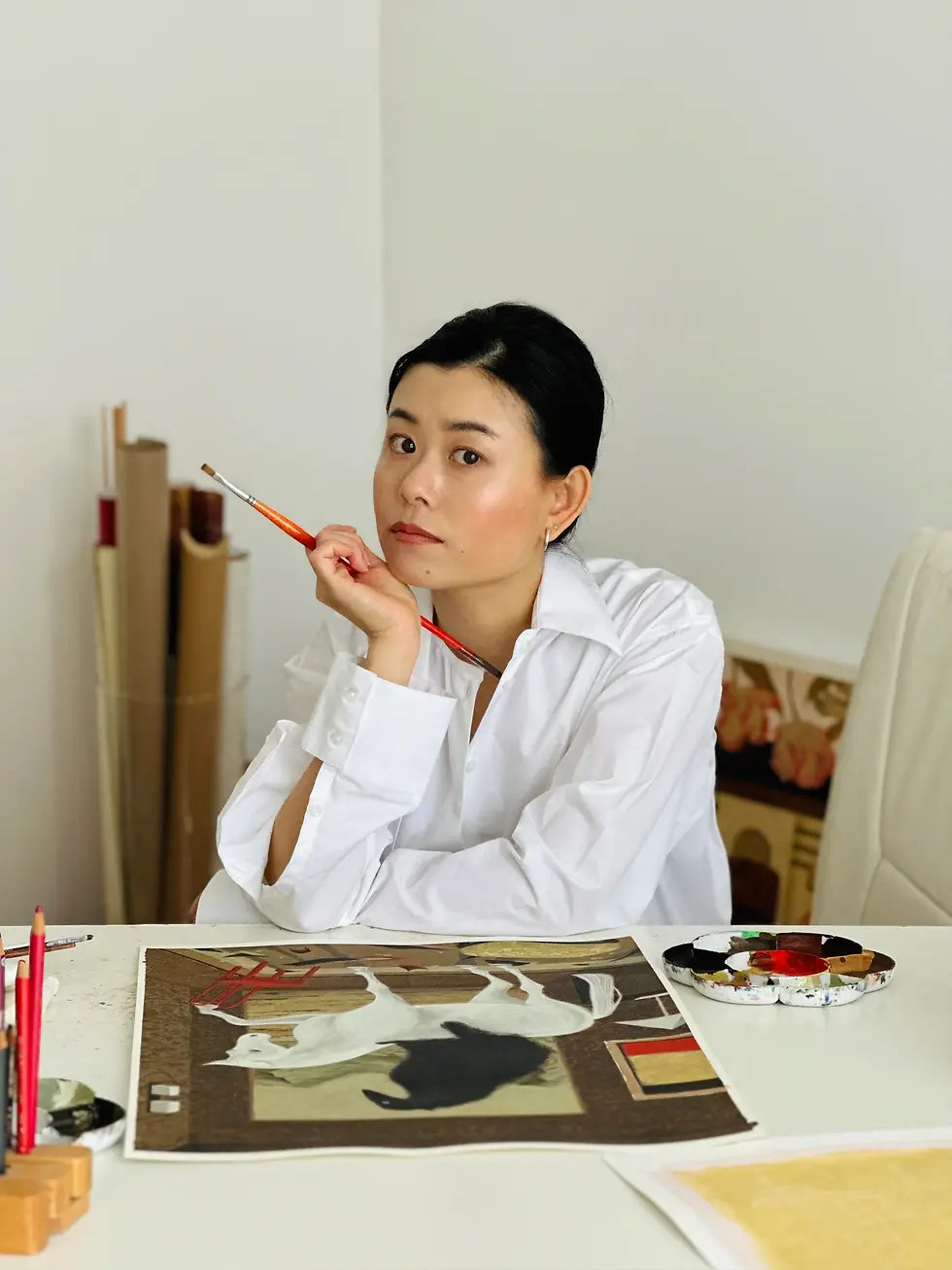
Aziya
Updated: Jun 15
Aziya is a Kazakh painter based in Prague. She grew up in Almaty, where her father had a sculpture studio and her mother ran a theater. She worked corporate jobs in New York and London for years before painting full time. She works with airbrush and leaves no brushstroke on the surface. She references orientalism and surrealism but takes the visual vocabulary and turns the gaze around. She has exhibited in Paris, Berlin and Prague.

Q: From Kazakhstan to Prague, with a lot of places in between. How did painting become the constant?
A: Painting has always been the constant. What moved was everything around it. I was raised between my father's sculpture studio and my mother's theater in Almaty, so image-making was the air I breathed before I could choose it. Then I lived in New York, London, Prague. For years I worked in corporations to build the savings I needed to paint full-time. I waited until I could commit on my own terms. Prague is where I finally did. The cities each gave me a different light, a different palette, a different body.
What I kept carrying across them was a way of paying attention. How the same face changes under a different sky, how a self that has traveled is never the same color as the self that left.

Q: You use airbrush, which distances the image from your hand. What drew you to that tool?
A: Airbrush is one of the tools I use, alongside traditional brushes. Distance from the hand was part of what drew me to it. What I was really after was something about the image itself.
I wanted the surface to feel graphic. Crisp. Clean edges, resolved color, no painterly anxiety. The kind of clarity we now expect from a contemporary image, and I wanted to build that clarity by hand, slowly, in paint. My surfaces are made with the patience of a painting and the finish of an image. The image as presence, not performance. Over time this became a discipline, a humility before the canvas. The brushstroke-free surface has a long tradition. The Flemish masters polished their panels to the point of invisibility so the image could feel present, self-sufficient, almost devotional. Something the viewer meets on its own terms, without the artist in the way.

Q: Tell us about Illuminated. What's the connection between light and identity in that piece?
A: Illuminated came out of an ongoing study of light and reflection, and what they have in common. Reflection is a journey of light – light redirected, returning altered. Through that process a single subject can appear doubled, not as opposites, but as parallel states existing at the same time. As an immigrant, I experience identity the same way, not as something fixed, but as an ongoing process shaped by movement, shifts in perspective, and distance. In this work, the figure is caught in the moment when light falls onto the body. It feels both ordinary and transformative, like certain life-changing experiences, where the subject remains the same yet is subtly altered.
Nothing dramatic happens on the surface, but something has shifted. The illumination here is not divine or absolute. It is personal and partial – a light that changes the figure without claiming to resolve her.

Q: Your paintings are very quiet. Is that deliberate?
A: Yes, deliberately. Quiet but not passive. I want the painting to slow the viewer down. To ask for attention rather than demand it. A loud painting arrives at the viewer; a quiet one asks the viewer to come closer. That choice shapes everything – the polished surface, the stillness of the figures, the muted palette.
Quietness has a long tradition in painting. Morandi spent decades with a few bottles on a shelf. Hammershøi painted empty rooms and women with their backs turned. Their quietness was never decoration. It was concentration. A way of slowing the viewer down until the image could register.
For a long time, people described my work as peaceful, and I let that be the frame. The paintings are still quiet. I let them hold more now. My figures aren't at rest – they're holding something. That isn't calmness. It's composure.

Q: You draw on orientalism and surrealism, which is an unusual pairing. How do those two traditions meet in your work?
A: Both traditions interest me with critical distance, not allegiance. Orientalism gave the West a way of looking at bodies like mine – decoratively, from outside. I'm not interested in reproducing that gaze. What I take from the tradition is the visual vocabulary: the protective object, the textile, the ornament, the stylized figure. I take the vocabulary, and I turn the gaze around. My women aren't being looked at. They are looking out, looking in, deciding what to let reach them. Surrealism is where the image becomes a question. The mirror that doesn't match. The reflection that arrives in a different color.
The locket with one eye open and one closed. Magritte painted this way – the image as a philosophical proposition. I'm not interested in dreams or the unconscious. I am interested in the image as something that can ask what does seeing mean, and not answer.


Q: Is there anything new in the works you can tell us about?
A: A few things are on my mind right now. I keep coming back to framed perception – how much of what we see is shaped in advance, not only by images but by memory, expectation, and the way we learn to see ourselves. Painting Held in Frame was the beginning of this. I want to go further.
I'm also interested in bringing more tension into the work. For years my paintings held peace; now they are learning to hold tension too. I want the stillness to contain something that wasn't there before – a weight, a charge, a question the figure doesn't answer.
And I keep returning to landscapes as bodies. Where a hill and a shoulder share a schema. Where the body doesn't end at the skin. The portraits will stay. The still lifes too. The surface is where the change is happening.