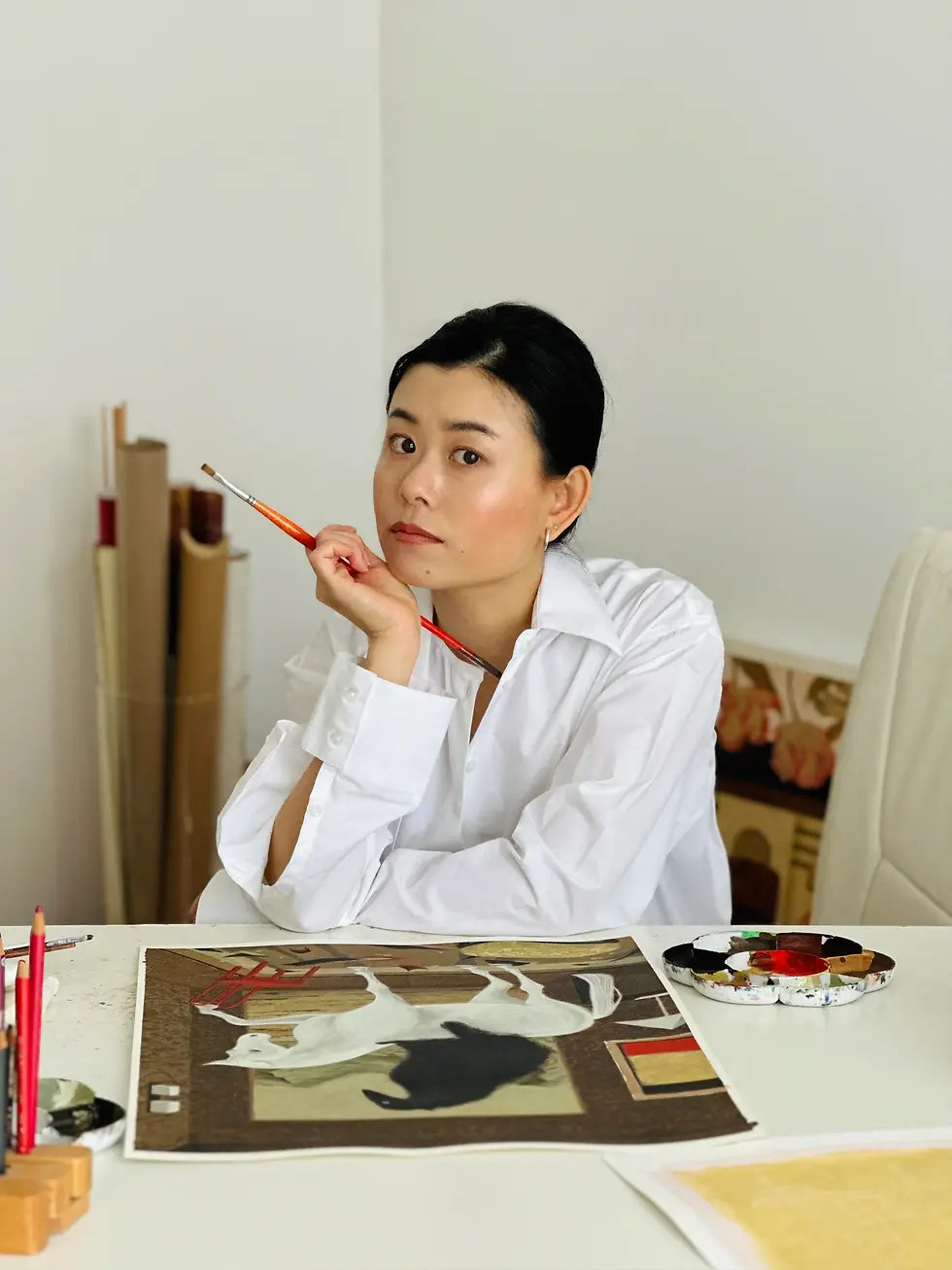
Ava Giannobile
Ava Giannobile is a Canadian artist based in Toronto whose work focuses on printmaking and fibre. Her practice draws from personal experience, particularly her early exposure to textile work through her grandmother and her time in Catholic school. She explores themes around the female body, intimacy, and sexuality through materials and imagery that shift between directness and subtlety. Her works often raise questions about perception, control, and self-representation, using both process and subject matter to reflect on how personal and cultural narratives take shape.

Q: How did learning fibre work from your grandmother shape the way you work now?
A: Learning fibre-based practices from my Baba has heavily influenced my technique, patience, and artistic endurance. She taught me everything I know—how to thread a needle, tie a knot, and how to hold fabric so you don’t pierce your finger. Growing up, I spent a lot of time in her home immersed in her creations: large doilies, knitted blankets, and needlepoint images, all of which took years to complete. She used to tell me how she would sneak off at work to get a couple of extra stitches done. As a six-year-old with almost no patience and very little skill, these seemed so far out of my realm of possibility. When I catch myself rushing or not putting enough care into my stitchwork, I hear her voice in my head: “полако, полако” (“slowly, slowly”).

Q: What makes you choose between fibre and print when starting something new?
A: When beginning a new piece, the choice of medium depends on what I want to convey. Visually, my print work is bold, full of text, and usually has a playful feel, while my fibre work is the opposite—being less structured and more covert in its meaning. In the very early stages of a piece, I usually have a vague idea of the imagery and sketch it out as both a potential print and fibre piece. Based on what underlying message each version portrays, whichever resonates more deeply or feels more honest to the idea is the one I commit to.
Q: How do your experiences in Catholic school show up in your work today?
A: The underlying shame that I was taught when it comes to our bodies started as early as elementary school. I remember a dress code change: no more wearing tank tops or leggings. When questioned about this change, teachers simply answered, “So you don’t distract the boys.” At 10 years old I found this absurd.
I came to school to learn and play, not to worry about the male gaze. In high school it got worse. Health class was littered with more Bible verses and shameful anecdotes than actual education, which led me to notice how girls either rebelled dangerously or existed in shame. This sparked my desire to challenge these outdated beliefs by amplifying their absurdity or by shedding light on their harmful effects.
Q: What does it take to bring intimacy into your practice?
A: A lot of vulnerability. When I started incorporating my body in my pieces, I would catch myself being extremely nitpicky—I hated how my skin folded, how my acne looked, how my boobs were too small. I caught myself imposing beauty standards on myself and wanting to change things that couldn't be changed.
It was really a matter of lifting the veil of imposed perfection and sitting with myself, letting myself embrace my imperfections, and forcing myself to be okay with them being broadcast if it meant the messages behind my work would be shared.


Q: When you work with pain and healing, what tells you a piece is done?
A: It’s a feeling, as simple as that sounds. Healing for me is something that does not follow a fixed path—it is incredibly fluid, unique, and ever-transforming. During certain instances of healing, I’ve created multiple pieces, while others just needed one single work. The act of creating is healing in itself, and once I start, I rarely know where it will go. I create alongside the process, allowing it to lead me, whether that means revisiting painful moments or just focusing on the release. When there is nothing more to express or process, I know it’s finished.
Q: What kinds of responses do you hope your work creates?
A: My entire body of work exists in hopes of sparking conversation and change in relation to rules, beliefs, and consumption of the female body. My overall goal is for viewers of my work to leave with an alternative perspective of the female body—understanding that a person taking ownership of how she will be seen, and the choice to embrace her sexuality, does not reduce her to a sexual object.